

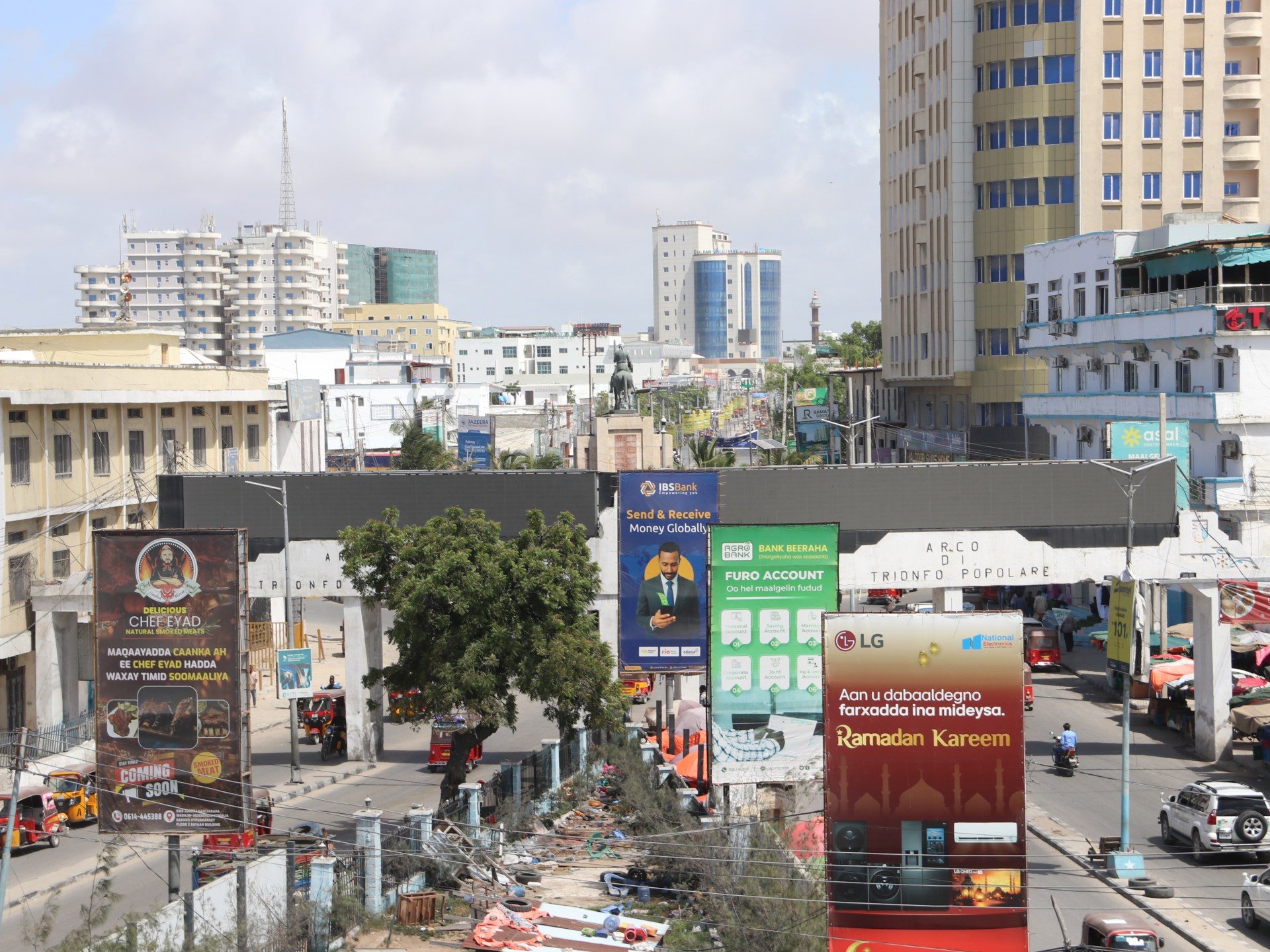
Mogadishu, Somalia – Mustafa, 33, dreads election time in Somalia. He drives a bajaj — a three-wheeled taxi — and says that when tensions rise, as they always do when polls are near, the whole city feels it, and drivers like him are among the first.
On Wednesday, he was passing through the Hawl Wadaag district when heavy gunfire between government and opposition forces erupted all around him.
Recommended Stories
list of 2 itemsend of list
“I couldn’t even think. Everyone was shouting and running for their lives, and we all fled from the bullets,” he told Al Jazeera. “We haven’t seen fighting this bad in years.”
The shooting that began that afternoon around the homes of former Prime Minister Hassan Ali Khaire and, later, former President Sheikh Sharif Sheikh Ahmed, came as opposition figures were planning to organise protests against what they describe as an illegal term extension by incumbent President Hassan Sheikh Mohamud.
Khaire and Sharif Sheikh Ahmed were among opposition leaders spreadheading the planned protests amid rising tensions with the federal government.
The government said the planned protests would undermine security in a city still grappling with persistent armed violence.
Hundreds of families fled neighbourhoods near the fighting, and by the next day, many of the capital’s central areas had emptied. The sudden eruption of violence ended a period of improving security in Mogadishu, shattering the perception that the city had begun turning a corner.
“The most frustrating thing is that we have nothing to do with it, and it impacts so many of us,” Mustafa said. “We make our living in this city”.
Security forces sealed Maka al-Mukarama Road, one of Mogadishu’s main arteries, while Bakara market, the largest commercial hub in the city, was effectively closed for business.
“Look, it’s midday, and there’s almost no one here, shops are closed, and usually by this time the place is jammed,” Ahmed, a street vendor at Bakara market, told Al Jazeera, gesturing at shuttered stalls.
Ali Wardheere, the deputy central bank governor, estimated the direct cost to businesses and services at $3.8m, though he stressed the figure was a model-based projection, not an official or final tally.
Like most Somalis, Mustafa has never voted for a president or a member of parliament. The country has not held a direct election for national leadership since the late 1960s.
Since the state was re-established in 2012 after its 1991 collapse, leaders have been selected through an indirect system negotiated by clan elders and political elites.
As presidential terms near their end, low trust among political actors often leads to intense competition over power — and at times violence — as disputes over the electoral timetable come to a head.
At a press conference in late May, Sharif warned that the political deadlock could turn violent if negotiations failed.
“Where do things stand? [We say] Leave, and [you say] I won’t leave. What comes next? Bullets.”
The warning echoed events in 2021, when then-President Mohamed Abdullahi Farmaajo remained in office more than a year beyond the end of his term, triggering clashes in Mogadishu before a political agreement was reached.
Higher stakes this election
This time, the political standoff carries higher stakes.
President Hassan Sheikh Mohamud says that constitutional amendments approved by parliament extended his mandate by an additional year from May 15. The opposition rejects that and has begun referring to him as a “former president”.
Two of Somalia’s most influential federal states also reject the amendments, leaving the country divided over the constitutional framework governing the next election, with no constitutional court to resolve the dispute.
After parliament approved the changes, Mohamud declared that the “provisional constitution, and the provisional era, was a sun which set yesterday,” signalling that his administration would press ahead despite objections from its opponents.
Tensions had been building for days. Ahead of a protest planned for Thursday, opposition leaders left the heavily fortified “green zone” near Mogadishu’s airport and returned to their residences across the city.
Some opposition figures said they would deploy their own armed guards at the demonstration, a proposal Mohamud rejected. The dispute heightened fears of a confrontation before fighting eventually broke out.
Both sides blame the other for starting the clashes. Khaire accused Mohamud of directing a “sustained and indiscriminate military assault” that lasted more than 20 hours, a claim Sharif echoed after fighting reached his own residence.
Ahmed Moalim Fiqi, the defence minister, accused the opposition of militarising the standoff, likening it to Sudan’s Rapid Support Forces and alleging that opposition figures had “distributed mortars and artillery across the capital”.
“Force and militias,” he said, would no longer be allowed to “seize power or block the state.”
How it came to this
The roots of the crisis run back to the 2012 provisional constitution, which set up a federal, parliamentary system built on broad consensus and clan-based power-sharing, which every government since has promised to achieve and failed to attain.
This year, after a long review, parliament amended the constitution through a disputed process that split the political class. The government has insisted that the new constitution advances the statebuilding process and that the Somali public should be allowed to directly elect its representatives.
For Ahmed Abdi Koshin, a federal MP who boycotted the draft, the danger is that the whole settlement comes apart. The process, he said, “clearly doesn’t have buy-in,” and the original constitution, for all its faults — “an imperfect product of compromise” — was the “only glue holding Somalia together”.
Koshin is not against a direct vote in principle, he said, but does not believe the country is ready for one. “We don’t have legislation for a direct vote; censuses and the security situation remains compromised. It really is up to the president to either reach a deal and save Somalia, or watch it fall apart,” he said.
The opposition, organised as a coalition known as the Somali Future Council and including two serving federal-state presidents, former prime ministers and a former president, has pressed Mohamud to accept that his mandate has ended and negotiate a new electoral framework, as in past transitions.
It alleges that his push for a direct vote is a pretext for extending his term and potentially securing another.
The government rejects that, casting a national one-person, one-vote election — the first since the 1960s — as essential to a drawn-out state-building project. When electoral talks collapsed on May 15, the Ministry of Information accused the opposition of bringing demands that ran counter to “the citizen’s fundamental right to vote and to be voted for”, and vowed to press ahead.
Mohamed Ibrahim Moalimuu, a lower-house MP who backed the amendments, said further delay could not be justified. “We’ve waited for more than 12 years,” he told Al Jazeera.
“If they had arguments against them, they should have taken part in the process and raised their issues. A constitution isn’t a Quran, and they should come back and work through parliament to make their views clear.”
A whole generation of Somalis, he noted, have never cast a ballot, and a real election “would be a major milestone and would bring some hope”.
The old indirect system, he added, was notoriously corrupt, with parliamentary seats changing hands for anywhere from $100,000 to as much as $1.3m. “This system is too dirty and keeps people out,” said Maliumuu. “It needs to be changed.”
A deeper problem
A regional official, speaking on condition of anonymity because he was not authorised to talk to the media, described an elite “divided strategically over what type of country they want, whether a strong centralised state or a weak decentralised one, and tactically over who the right candidate is to take them there”.
Mohamud, the official said, had moved from a decentralised vision for Somalia that embraces federalism towards a stronger executive, and his early, promising relationships with the federal-state leaders had since soured.
Those fractures have opened on several fronts at once.
Somaliland, which declared independence in 1991 and has stayed out of the constitutional review entirely, was recognised by Israel late last year after earlier courting Ethiopia.
Puntland and Jubaland, two of Somalia’s six federal states, have withdrawn from the federal system over the new constitution, while more than 100 MPs and senators from both boycotted the final vote.
Broader regional crises, from Sudan’s civil war to disease outbreaks elsewhere on the continent, have pushed Somalia further down the list of international priorities, leaving international engagement more fragmented and inconsistent.
The country is also grappling with a deepening humanitarian crisis and aid cuts, prompting famine monitors to warn of a heightened risk of hunger in parts of Somalia.
Yusuf Aynte, a veteran religious leader and former MP, said Somalia’s leaders needed to build consensus rather than push through changes that risk deepening divisions.
“The president says what he is doing is good, and that may be so,” he told Al Jazeera. “But the most important thing is what everyone can agree on.
“At the moment, Somalia has too many problems, and can’t afford to be distracted like this.”
Jamal Shiil, a youth activist, told Al Jazeera that Somalia’s large youth population would ultimately bear the cost of the persistent instability.
“Young people want to make a living here, for Somalia to be peaceful and not to have to leave because of the problems,” he said. “But if things don’t change it won’t leave them much of a choice”.
