

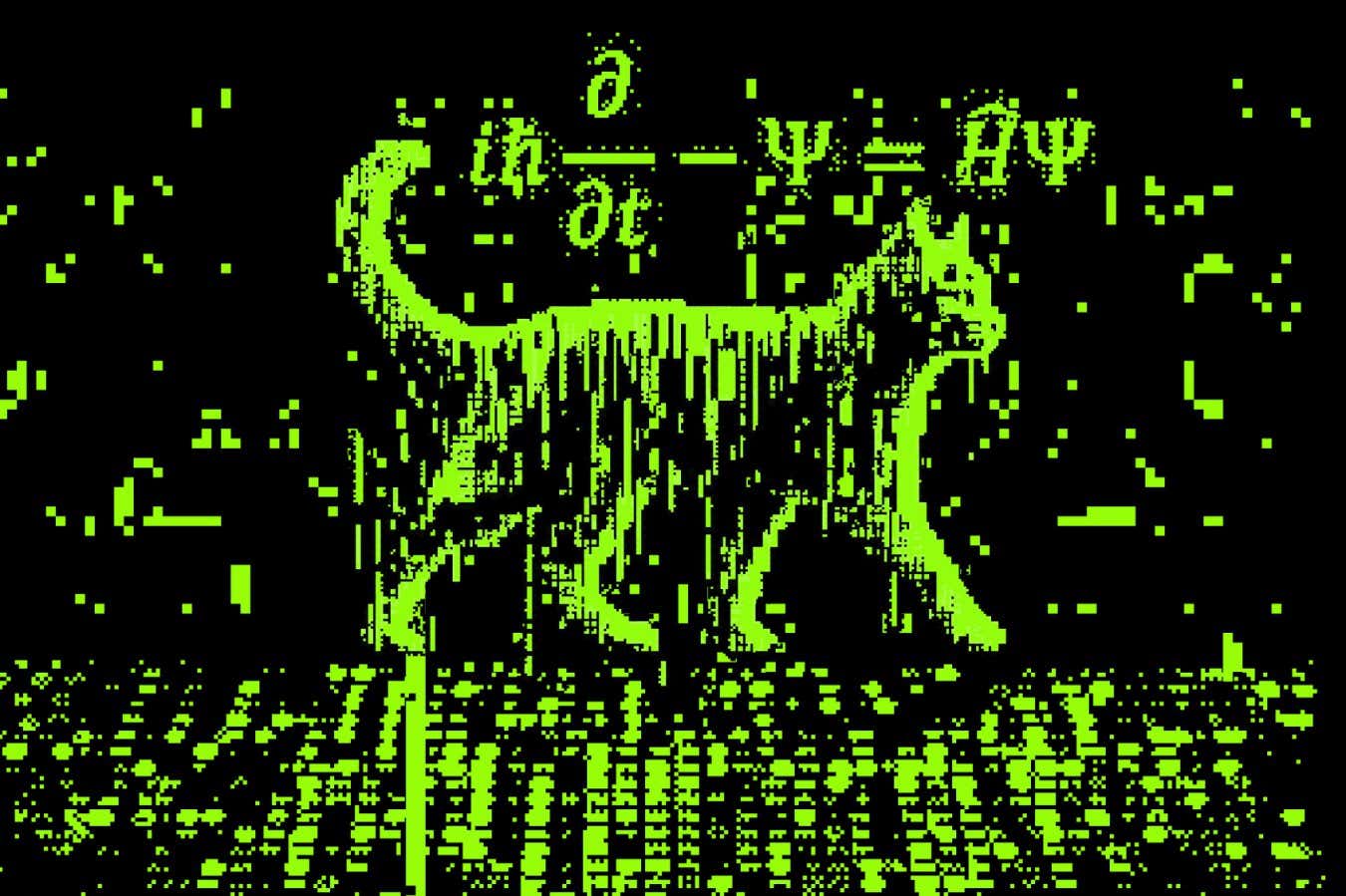
What does interpretation really mean when it comes to quantum theory?
Shutterstock/cybermagician
If you asked a thousand physicists, they would all disagree. This statement could apply to any number of topics – whether the universe is infinite, what dark matter is made of, how to make wires conduct perfectly efficiently – but it isn’t just abstract. A few weeks ago, a team at Nature posed a question that divided the field in precisely this way. They surveyed 1100 physicists to ask their favoured interpretation of quantum mechanics. The result? They “disagree wildly”.
That’s no surprise to me – I encounter physicists who interpret the findings from quantum experiments differently all the time in my reporting. That is to say, they can each look at the same set of equations or experimental results and come away with a different idea of what that tells us about reality.
So, how much does this disagreement, and the issue of interpretation itself, actually matter? First of all, it is strange that it happens regarding quantum mechanics, a branch of physics that we have now spent 100 years subjecting to a relentless battery of tests. There is no way to deny it: the theory of quantum mechanics, a set of often counterintuitive laws of physics that govern the behaviour of everything very small or very cold, is an incredible scientific success. Not only has it passed all our tests with flying colours, but it has let us build technologies like the transistors that power our electronic devices and the fibreoptics that make the internet possible. “Quantum mechanics goes about its business incredibly successfully, both theoretically and in an applied sense,” says Peter Lewis at Dartmouth College in New Hampshire.
Yet, to put it crudely, just because physicists know how to write down equations and build devices, they don’t always know – or agree – on what it all means. They simply can’t agree on how and even whether quantum mechanics captures the objective physical reality of our world. The Nature survey shows as much: the Copenhagen interpretation of quantum mechanics – which discourages physicists from asking about the true nature of quantum objects, such as the electron, and implores them to “shut up and calculate”, because words can’t be unambiguously matched to something objectively real – got the largest share of votes, but still earned the trust of only 36 per cent of respondents. Others put their stock in the many-worlds interpretation, which requires that one subscribe to an infinitely large universe, or superdeterministic theories, which come unnervingly close to eliminating free will and positing that everything is pre-determined, among several possible answers. Strikingly, the percentage of physicists who were confident in their preferred interpretation being correct was a lowly 24 per cent.
Disagreements also arose when physicists were asked about some of the staples of quantum theory: its central mathematical object called the wavefunction, the inextricable link between particles called quantum entanglement, and even the famous double-slit experiment, which established that all matter has a hidden wave-like nature. “What’s more, some scientists who seemed to be in the same camp didn’t give the same answers to follow-up questions, suggesting inconsistent or disparate understandings of the interpretation they chose,” wrote Elizabeth Gibney in her analysis of the survey, underscoring how much not just disagreement but also sheer confusion about the fundamentals of quantum mechanics there is among physicists.
Lewis says that this situation – the combination of stunning technical success and absolute philosophical disarray – is unique in the history of science. What to make of this situation is also unclear. One physicist suggested that it is embarrassing for the field, but another argued that a diversity of views is a positive thing. In trying to make up my mind on whose take I most lean towards, I realised that I was stuck on the word “interpretation”. What does it actually stand for, and what makes an interpretation a plausible or competitive one? So, I went back to the source, for me, anyway: I called up my first quantum mechanics professor.
“When I think about interpretations of quantum mechanics, to me, that means something that isn’t so much physics, but is more philosophy, maybe psychology,” says Jeffrey Harvey at the University of Chicago. I remember his class as having been mathematically challenging, and memories of my excitement at learning that wavefunctions “live” in the mathematically abstract “Hilbert space” are vivid in my mind. But I couldn’t recall explicit discussions of how to interpret the odder consequences of the mathematics that we were grappling with. Harvey says that he is reluctant to teach students about different interpretations because they are competing “mental models”, rather than frameworks that could be distinguished experimentally. If two interpretations stem from the same equations and predict the same set of experimental observations, why prefer one over another? “This is kind of an agnostic point of view. I would rather just keep an open mind about something that I’m not forced by the evidence to make a choice,” says Harvey.
Jonte Hance at Newcastle University in the UK, on the other hand, cautions against using the word interpretation too loosely. Some interpretations are actually extensions of quantum mechanics, as they add or modify equations at the heart of the theory. “Part of the issue here is that people don’t agree on what an interpretation is and what’s required, what exactly the problems that quantum mechanics faces are,” says Lewis. The Nature survey broke down the respondents’ answers across eight interpretations, and Lewis points out that while some add ingredients to the basic rules of quantum mechanics, others take rules away, and some, like the Copenhagen interpretation, deflect the question of needing to interpret these rules at all.
To understand this, it helps to think of the famous Schrödinger equation, which is often the equation that a physicist will attempt to solve to determine or predict, well, anything about a quantum object. Some interpretations of quantum mechanics – for instance, the many-worlds interpretation – use the Schrödinger equation as originally written, without changing it. Another interpretation called spontaneous-collapse theory, which aims to resolve why we don’t see quantum effects in everyday life, does add extra symbols and numbers, which represent a new physical process, to the Schrödinger equation. Hance says that this technically makes the latter an extension rather than an interpretation. In this case, it may then be possible to formulate an experimental test that would ascertain whether our world really calls for the Schrödinger equation to be amended.
This would be the evidence that could force researchers like Harvey to leave agnosticism behind. Hance says that a successful extension of quantum mechanics could explain the many experiments that the theory already matches exceptionally well, but it would also have to make unambiguously different and concretely testable predictions.
At the same time, all three researchers that I spoke to conceded that many physicists can happily and successfully go about their day-to-day work without having to confront issues of interpretations of quantum mechanics – another function of how remarkably successful quantum mechanics is. This is, in part, why my class with Harvey didn’t include a lesson on interpreting quantum mechanics: I was simply being trained to use it. “As far as most kinds of innovation and application of quantum mechanics goes, I don’t see that [interpretation] matters. It only matters from a kind of philosophical perspective,” says Lewis.
But that doesn’t mean that there is no value in thinking about interpretations, even, in the strictest sense of the word, those places where competing interpretations don’t produce competing experimental predictions. “Mental models that physicists have might not be part of physics, but they can be an important part of how people develop new ideas. In that sense, I think a diversity of mental models is probably a good thing in that it helps physicists explore new ideas that come out of quantum mechanics in different ways,” says Harvey.
Beyond that, and especially when it comes to extensions of quantum mechanics, the philosophical perspective is also nothing to sneeze at. For Lewis, this historically unprecedented rift between quantum mechanics’ usefulness and meaning may contain lessons about the limits of science and how we think about what science can and can’t do. The fact that quantum mechanics is a mathematical model of the world that describes it really well, yet we can’t develop and agree upon what it means, is something worth unpacking, he says.
Hance similarly argues that meaning-making is an integral part of physics. When we speak, they ask me whether I’ve seen Elon Musk posting on social media about how there are no researchers, just engineers. I haven’t, but I am struck by how reductive the claim is. “To me… just kind of cranking the equations is just making engineers of us. Some people choose to be engineers, but I definitely didn’t. I am here because I want to figure out what’s really going on,” says Hance. This is not to say that engineers aren’t driven by curiosity, but I too feel like a certain strain of existential unrest, of wanting to know not just how to make a thing work but also what its fundamental thingness is, so to speak. That’s a question that has kept physicists up at night for centuries – and it will almost definitely continue to do so.
Topics:
