


After Joey Zwillinger stepped down as CEO of Allbirds in March 2024, he took three months off—mainly because his wife Liz said she’d divorce him if he jumped into another venture. He had run the sustainable shoe company for 10 years while the couple raised their three young children. “It took a real toll on the family,” Liz says.
(“I would say it developed character in our family,” Zwillinger counters.)
Before long, he was itching to start a new project, an ambition he shyly expressed to his wife. “It was really hard to want to sign up for something like that all over again,” Liz says. But this time, he cofounded the venture with Liz.
It’s also a bold pivot from a sustainable shoe company to an entirely different industry: women’s hormone health supplements.
At a time when health and wellness is big business, it might also be a smart pivot. But it’s an undeniably different world, navigating health regulations and making bold investment choices when such bets didn’t go so well at Allbirds. Revenue and share prices dipped drastically starting in 2022, and have hardly recovered.
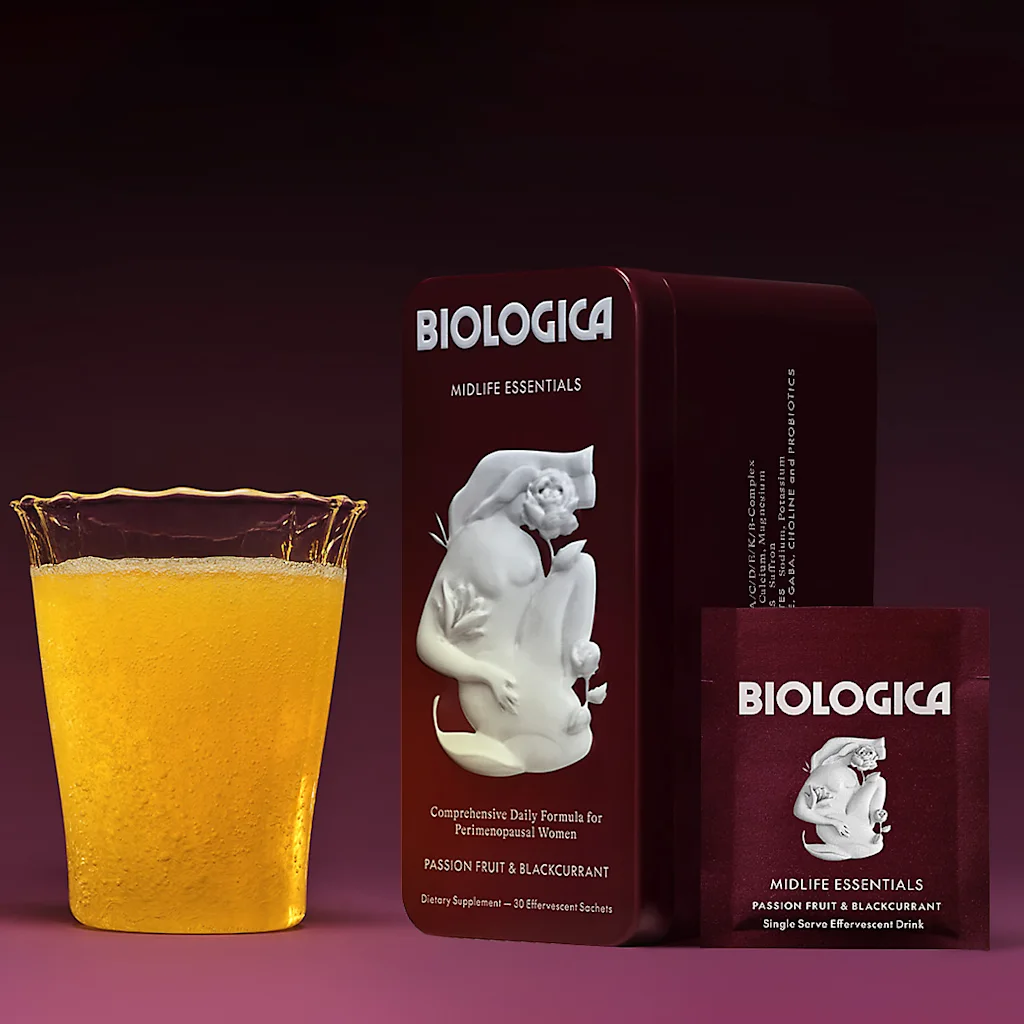
Launching December 9, Biologica is a set of new supplements for women’s health, naturally flavored and powdered to fizz into water. Each single sachet, or separately sealed daily dose to be mixed with eight ounces of water, targets different body functions with ingredients including electrolytes, multivitamins, botanicals, and probiotics.
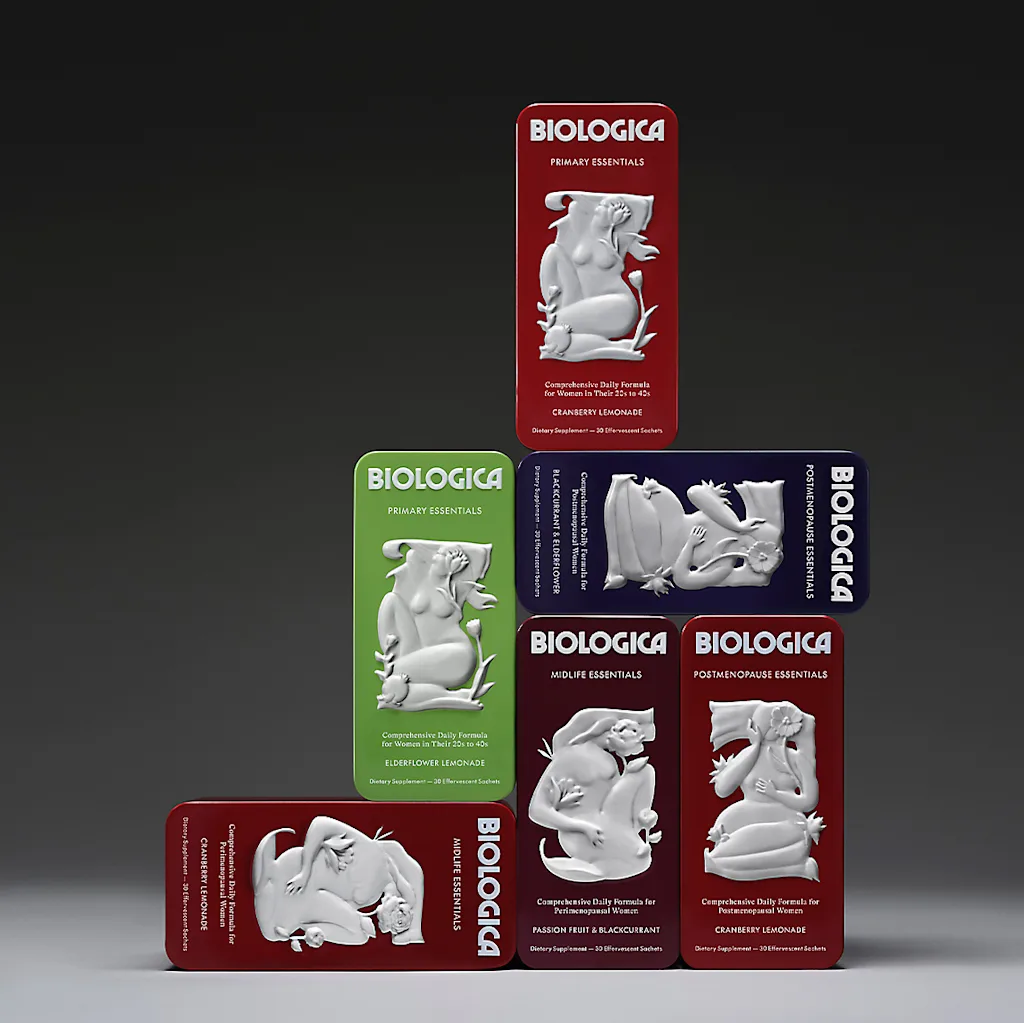
Crucially to the value proposition, there are three products for different life stages: younger reproductive years, perimenopause, and post-menopause. While some share ingredients like Vitamin C and potassium, for different stages you may have dosages of broccoli extract (for detoxification and liver function), pomegranate extract (for skin hydration), or saffron (for mood balance and sleep quality).
The idea came from Liz’s own struggles; she would take different supplements daily for various issues, leading to seven separate pills plus extra vitamins, which became “a super onerous supplement routine that didn’t feel like it was sustainable,” she says.
That was a common issue the couple found in their initial focus groups. Women could only find a one-size-fits-all pill or gummy that promised to do everything. Or, as in Liz’s case, various targeted supplements, which became unsustainable as the cost of living rose. They also found that women of different ages had different concerns. So they set out to create a company with only one product per customer—but narrowed to their hormonal age.
They believe that’s their major selling point.

MAHA movement and ‘changing winds’
The health and wellness sector is “absolutely” an attractive space for founders now, says Matthew Oster, head of health, beauty, and hygiene insights at Euromonitor International.
He says lines are now blurrier than ever between pharma and food and beverage. A trend toward natural and food-based remedies has been “churning in the background culturally over the last 10 or 15 years,” he says, and increasingly linked with medical distrust—and has now become branded as RFK Jr.’s “Make America Healthy Again” movement. “So at the same time that these companies are recognizing that consumers want healthier products,” he says, “there’s this whole movement codifying that.”
Supplements, whether fortified fibers, proteins, or biotics, are no longer just a “hippie, natural, crunchy thing,” Oster says. “It’s a dead-right-in-the-middle mainstream proposition.”
But in the age of TikTokification, “this wellness market is rife with changing winds, on a dime,” Oster says. “Some of these ingredients trends last months as opposed to years.” Longevity is often hard to forecast: CBD was an example of a fleeting fad, but other trends, like protein, are only getting bigger.
Women’s health might be a better bet, especially around life stages. “No one really even talked about perimenopause a few years ago from a product formulation perspective,” Oster says. “In a short amount of time, we had a proliferation of products in that space.”
There are others on the market, but “not a tremendous amount,” Oster says. Perelel is a supplements company that has seen strong growth since August 2024, where you can “shop by stage,” from “trying to conceive,” through “perimenopause.” Health & Her is a British company with capsule products for different life stages, which launched in the U.S. this summer with CVS. Now, he says, it’s just about seeing which products will stick, and which will fizzle out.
The failure rate may be high, but at least it’s a relatively short lead time to get to market versus digital health or pharma products (the Zwillingers have gone from ideation to rollout in a year and a half), and a relatively minimal financial commitment (they raised a $7 million seed round). “This is a low bet from an investment cost,” Oster says, “that if you lose your shirt, you lose your shirt.”
Learning lessons from Allbirds’ fall
But it’s still a risk to navigate a new industry when Zwillinger’s previous venture took an unexpected plunge after its initial success.
In the late 2010s, Allbirds was a phenomenon. Its minimalist running sneakers, made from merino wool and a foam sole of sugar cane, were named the “world’s most comfortable shoes” by Time in 2017. They became almost the official dress code of Silicon Valley, part of the “tech bro starter pack” meme (along with the Patagonia zipper vest, Yeti bottle, and Lime scooter). They were like a cultural snapshot of the era; even Obama was spotted wearing them.
But in March 2024, Zwillinger resigned and handed over the CEO reins after repeated cycles of declining revenue. Even by 2022, The Wall Street Journal assessed, the tech bros had moved on. The media’s Allbirds postmortems blamed overly ambitious expansion beyond their core bestsellers, and too rashly opening numerous brick-and-mortar stores. Today, revenue is still declining, and half its stores are closed.
Zwillinger, still an active board member, says when COVID-19 hit during the company’s peak—eclipsing $200 million in revenue—he and his cofounder, Tim Brown, responded too dramatically to shifting consumer trends, including pivoting too hard from lifestyle to running and hiking. “We were too immature of a company to parse out what was signal and what was noise,” he says, “and we made some really big bets based on that.” They were forced to discount the product to move the inventory.
Allbirds was also known for its eco-friendliness: it’s a certified B Corp, with a core polymer material that’s carbon-negative. Zwillinger says he’s learned you can’t build a business around sustainability alone. “[Consumers] want to make sure that the innovation actually does something that meets their needs,” he says.
In a way, navigating health in the new business is similar to navigating sustainability. Once competing with some rivals that were greenwashing, they now face some wellness brands that make unsubstantiated claims. Companies “feel free to say whatever to make a sale,” Zwillinger says. “It’s a little scary starting a business in a space like that.”
There’s enough leniency from the FDA for some bold claims, and a lack of budget for the agency to do much even when there’s blatant overstepping. You can’t say a supplement cures or prevents a disease, but you can make a claim about the role of an ingredient, like “calcium builds strong bones.” But some of the gray areas can lead to a “freewheeling, cowboy approach to what they claim,” Zwillinger says.
That’s concerning to many medical experts, who have publicly noted their skepticism around supplements, some recommending not to spend money on something that most people can obtain from a healthy diet alone. An independent panel of national experts in 2022 reviewed 84 supplements studies and concluded there was “insufficient evidence” of their efficacy.
The Zwillingers say they have tried to do things right via focus groups, clinical research, and a 1,000-woman study; they have a medical advisory board with two ob-gyns and a breast cancer surgeon specialist (as well as a more Eastern-focused herbalist).
Oster says it’s good to get everything right with the science. But in this social media era, it might not even be science that drives sales for some consumers. “Vibes and feelings are pretty influential,” he says.
DTC as the initial test
Still, from a business strategy perspective, the reliance on data has been helpful, allowing them to be less subjective, and not cater to their own tastes, as Zwillinger and Brown did at Allbirds. “In this situation, I have zero lived experience and no subjectivity,” he says. “Looking back, everyone should do that with every business they run—take themselves out of it.”
Consumer trends have also changed dramatically, as pandemic patterns faded and social media proliferated. Allbirds, along with fellow unicorns Warby Parker and Casper, was a direct-to-consumer (DTC) pioneer. Though assessments that “DTC is dead” are highly exaggerated, Oster says, companies have to get social media marketing right, as people now just buy directly from those platforms. “TikTok Shop has really taken over from a supplements perspective,” Oster says.
Zwillinger knows they will ultimately have to be “predominantly retail-oriented to be successful,” but they have to start with DTC, probably for a year or two (products will be ready to ship to consumers December 9). “I have learned deeply and with some scars,” he says, that you need a robust and popular product before entering wholesale relationships. The DTC launch will be a way to test the product, and iron out issues.
Those could be things like flavors, which they’ve formulated without sugar. Or the price, which is $59 a month, for 30 sachets in a tin, to finance some expensive ingredients like saffron. Or, the branding of the product, which they’ve tried to give a premium feel, with elegant-looking tins to be displayed on a counter or desk, not shoved away in the pantry, and to speak to a sophisticated customer base.
But of course, all remains to be seen as it rolls out. “We think we’re brilliant, [that] we’ve done everything right,” Zwillinger says. “But when we start selling, we’re going to find out we were idiots about lots of things.”
