

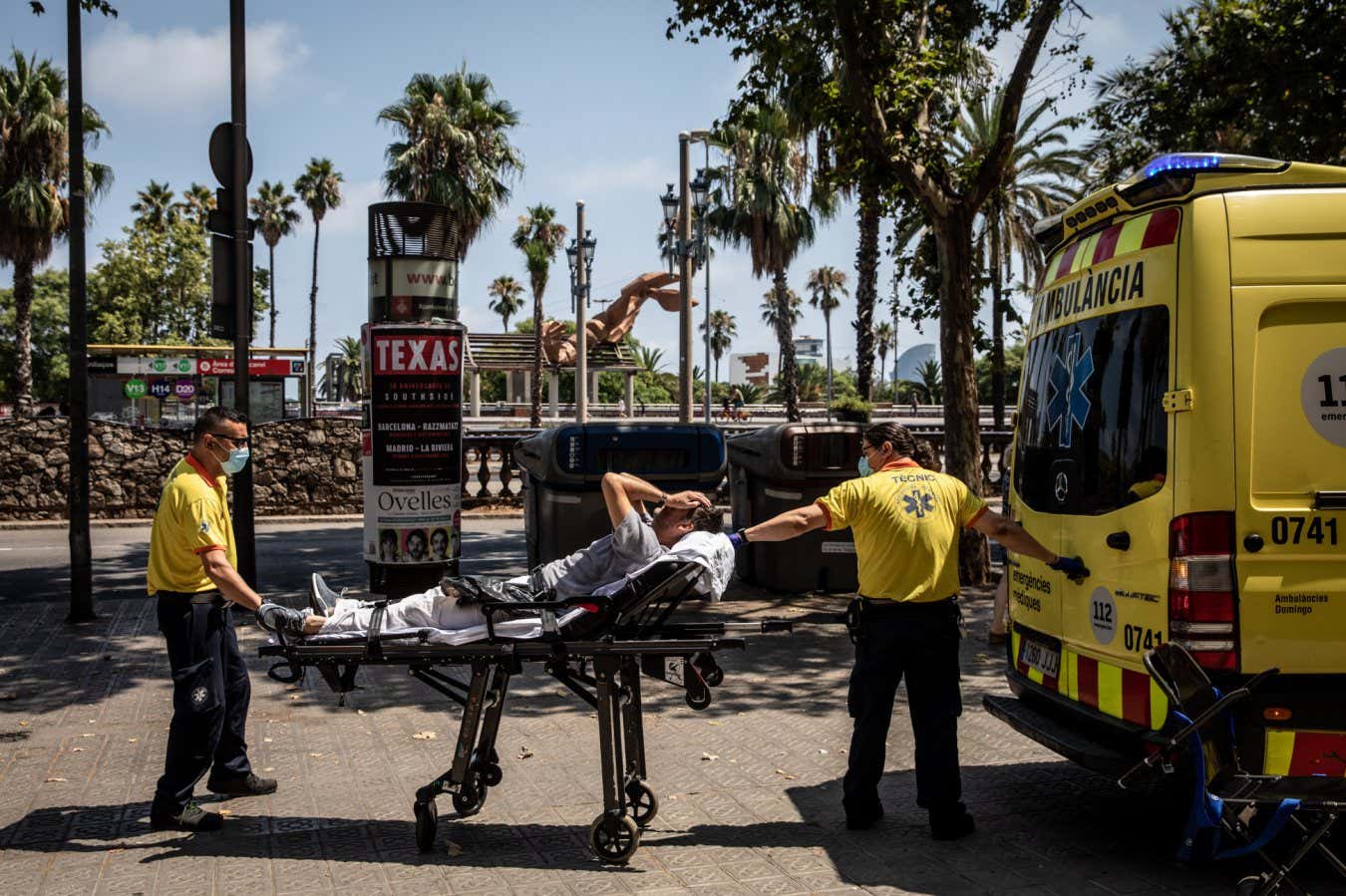
Paramedics help a patient into an ambulance during a heatwave in Barcelona, Spain, in 2022
Angel Garcia/Bloomberg via Getty Images
A heatwave in May set monthly temperature records across Europe; a heatwave in June became the hottest ever observed in western Europe. Now, in July, yet another heatwave is developing. Just 50 years ago, the June heatwave would have been virtually impossible. But global warming is making heatwaves more frequent, longer and more intense.
Worldwide, heat is the deadliest type of weather, killing more than half a million people each year. The number will increase, since even if we reached net zero tomorrow, the carbon dioxide we have already emitted will keep raising temperatures.
“This is just the start,” says Hugh Montgomery at University College London. “Things are unfolding in a very, very major way now, because this isn’t just about it [being] too hot in London, and the long-term effects are going to be savage.”
Outside the tropics, the time of the year in which temperatures above 32°C occur has lengthened by 12 days in the past half-century. In Europe, the fastest-warming continent, the season of strong heat stress now starts on average in June and continues until almost September. Sometimes, like this year, it starts in May.
That increases people’s exposure to hot days and heatwaves. Parts of North America, Europe, South America and Africa now experience up to 50 more days of strong heat stress compared with the 1970s.
“If you’ve got heatwaves that last longer, and then you’ve got more heatwaves, people are going to be in that raised physiological state for longer,” says Neil Maxwell at the University of Brighton, UK. “That can lead to greater inflammatory marker responses, and that ultimately puts a greater stress upon individuals.”
Strong heat stress almost never occurred at night before 1998. But now, nighttime temperatures in western Europe and other places are increasing at double the rate of global warming as a whole.
A drop in body temperature triggers sleep. If the environment is too hot, it is harder to fall asleep, as well as to enter a state of deep sleep. And loss of sleep over several nights in a row can hinder reaction time and boost anxiety and stress.
“If you don’t get cooling periods at night, which we define in this country as less than 20°C at night, sustained temperatures without cooling have worse impacts,” says Montgomery.
The hottest summer ever seen led to apocalyptic scenes in Europe in 2022. Wildfires broke out in France, Portugal and Spain. Italy’s longest river, the Po, ran dry in places, and wrecks of Nazi ships full of explosives were discovered as the Danube fell to record lows. In the UK, temperatures exceeded 40°C (104°F) for the first time.
More than 60,000 people died because of these baking temperatures. The highest mortality rates were in Mediterranean countries, which had some of the biggest temperature anomalies, with temperatures reaching higher than 40°C in Italy, Greece and Spain. These countries also have some of the oldest populations, whose bodies aren’t as resilient to heat and who are more likely to have chronic illnesses.
“You also get inflammatory responses from heat, so heat exposure in itself triggers all sorts of bad biology in your body, basically, that is directly harmful… and in particular in people with diseases,” says Montgomery.
The frequency of a heat stress day followed by a tropical night of at least 20°C has increased 73 per cent in Europe since the 1970s. These are called “compound events” because the body isn’t able to cool down and recover at night, compounding the heat stress.
Europe has also seen prolonged periods of heat stress become more common. And Africa is now almost three times more likely to suffer hot spells lasting three-quarters of the year or more.
Leaders like US President Donald Trump have made pledges to plant millions of trees while increasing CO2 emissions. But in the case of urban heat, trees can make a big difference. They create areas of shade, and they also draw moisture from the soil, which then evaporates from their leaves, cooling the environment. Neighbourhoods with tree canopies can be as much as 10°C cooler than similar places.
But although many cities have started planting trees to deal with heat, a recent study found that many still have swathes of territory below the 30 per cent canopy cover that can reduce dangerous heat island effects. More than 90 per cent of the buildings in Paris and London fall below this threshold.
Topics:
