

July 16, 1945, was a historic and humanity-altering date for the world and for Washington state. This year marks the 80th anniversary of Trinity — the world’s first atomic weapons detonation — which bombarded New Mexico’s Alamogordo Bombing Range with the “Gadget,” a device modeled on the implosion design of the Fat Man bomb. Both used plutonium produced at southeastern Washington’s Hanford Nuclear Site in wartime haste as part of the Manhattan project. The test was deemed a success. Photographs recorded the expansive cloud blossoming above the desert, overtaking the vast sky.
Three weeks later, on Aug. 9, and three days after the dropping of the Little Boy bomb on Hiroshima, Japan, resulting in 140,000 deaths by the end of December 1945, the bomb known as Fat Man was dropped on Nagasaki. At least 70,000 died in the Nagasaki bombing, with thousands who lived at both sites dying later from the effects of radiation. In New Mexico, cancers and birth defects were seen in the Tularosa Basin after the Trinity test. In Hanford’s downwind path, illnesses linked to radioactive releases during the plutonium production period have been documented, and Hanford remains a massive radioactive waste cleanup site.
Wartime production was the tip of an atomic iceberg. After the war, 119 Fat Man bombs were created. The U.S. nuclear arsenal grew during the Cold War of the 1950s, the arms race of the 1980s and is set to expand under the Trump administration. The United States currently has 15,000 nuclear weapons — 2,000 of them on hair-trigger alert. The administration is seeking to increase spending on nuclear arms, including designing and making new weapons, to approximately $25 billion — a 29% increase. Meanwhile, millions of people are set to lose health insurance; environmental protections are gutted; science and health funding is slashed.
The threat of nuclear weapons became apparent when the U.S. bombed Iran’s nuclear site. The Trump administration withdrew from the Iran nuclear deal brokered by President Barack Obama in 2015, and the outcomes of this action are yet to be fully revealed.
The Bulletin of Atomic Scientists’ Doomsday Clock, which warns the public of our proximity to oblivion from nuclear war and climate change, inches closer to midnight. It is now a mere 89 seconds to 12 — the closest it’s ever been. It is time to become a nation that forges nuclear agreements, understands and employs diplomacy, recognizes nuclear war is a horror show that is not winnable and works toward nuclear disarmament.
Both our atomic history, and current nuclear threats, fuel the drive to remember the past and to honor the victims of the atomic bombings in hope that the past is not repeated — that the mushroom cloud remains frozen in history books and never again rises above land or a city.
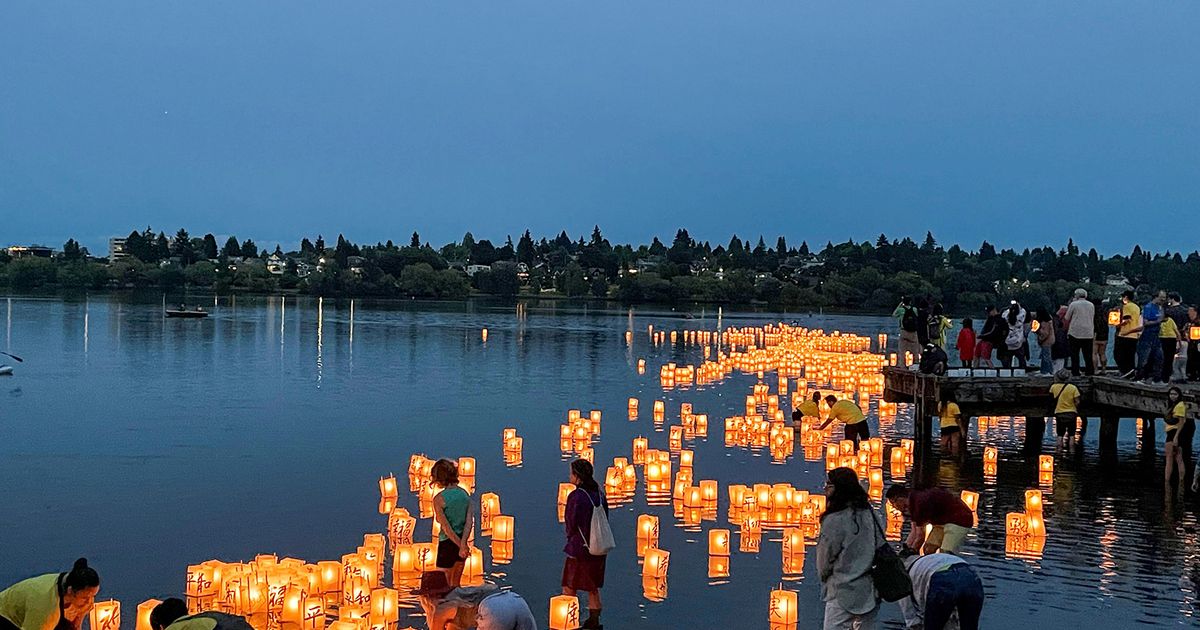
One of the largest commemorations of the atomic bombings held outside of Japan takes place at Seattle’s Green Lake every Aug. 6. From Hiroshima to Hope, incorporates visual pieces, music, poetry and a lantern floating, bringing the past to the present. Historic photographs of the bombings’ aftermath are exhibited. Paper cranes are folded, echoing the hope of Sadako, a Japanese girl who died from leukemia caused by Hiroshima’s bombing, for peace. The sound of traditional Japanese instruments, koto, taiko and shakuhachi, floats to the water.
Participants ready 1,000 lanterns inscribed by calligraphers with messages of hope, peace, justice and healing. Based on the traditional Japanese floating lantern ceremony, toro nagashi, the event begins with a procession to the lake, where participants place candlelit lanterns in the water, expressing the hope that nuclear weapons will never be used again.
The wind carries the lanterns on the water’s back, some edging along the shore and the wild yellow irises. The moon may shine down, its light reflected among the drifting orange lanterns — the hope and call for peace illuminated in the glowing flames.
Information on this year’s From Hiroshima to Hope event: st.news/lantern
