

Google reported its latest financials last week and within the numbers are some of the most material datapoints for publishers in years.
It shows how Google’s monopoly is accelerating and how publishers are hemorrhaging $560,000 a day as regulators dither on remedies.
Hours after Google presented its numbers, it was hit with a $1 billion antitrust fine in Europe, but that’s not putting a dent in Google’s growth.
It had record revenue in the quarter, ads grew at double the rate of the market and YouTube had a huge World Cup.
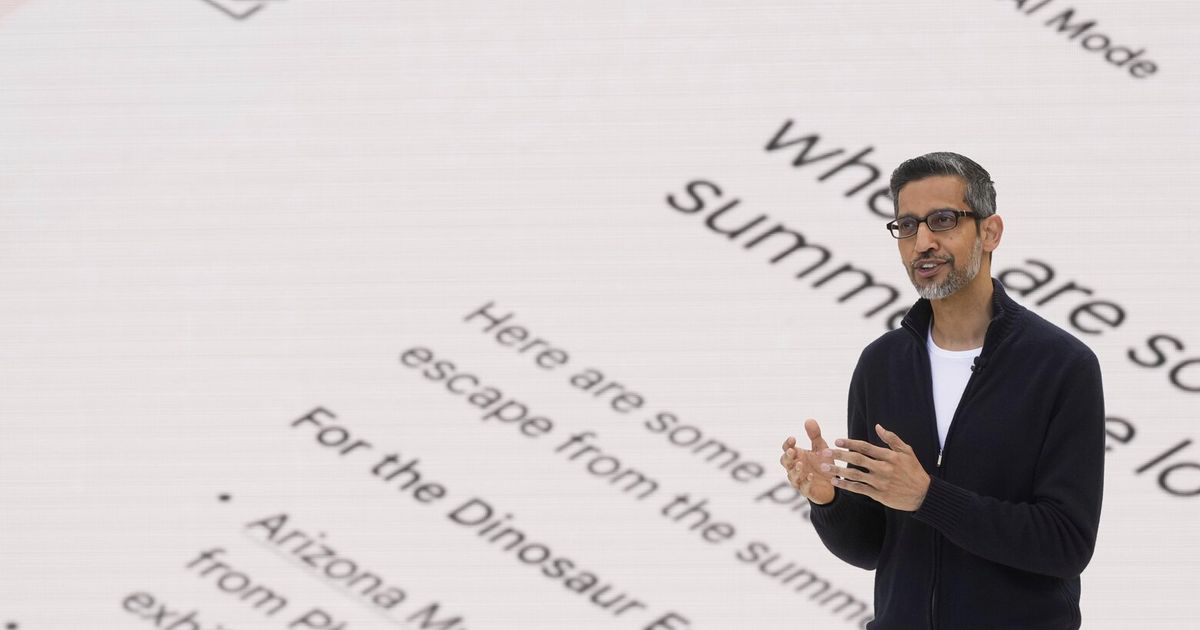
Two months ago, Google announced “the biggest upgrade to search in 25 years” when it merged AI Overviews and AI Mode into what it calls a new “intelligent search box.”
Because Google dominates the search market, it means AI answers are now the default entry point for more than 2 billion users.
Publishers are already seeing page views fall by 40%-80%, though CEO Sundar Pichai was eager on the earnings call to say it was still sending “billions of clicks.”
That referral collapse, combined with 16 consecutive quarters of falling revenue from Google’s ad network, has been brutal.
Over just this past quarter, publishers lost an average of $560,000 a day as Google shifted those ads onto its own properties to fuel its growth.
Some have had enough.
On The Rebooting podcast, USA Today CEO Mike Reed said he was “getting close to the point where we’ll block Google and abandon the search traffic that we get.”
He said Google Search was effectively “dead” as a traffic source for his newsrooms.
The Wall Street Journal reported that Reddit is considering ending its $60 million AI licensing deal with Google in protest at the ad collapse.
Under the headline “Google Was a Lifeline for Publishers. Now Some Are Thinking of Cutting It Off,” it reported:
“It (Reddit) is part of a growing chorus of online media companies expressing frustration with the tech giant as AI changes the way people ask questions, siphons off search traffic and upends publishers’ revenue models.
They say the search engine is no longer a reliable source of visitors, especially after Google expanded its AI search features in recent months.
USA Today, Politico, the Economist, People Inc. and Reuters are all evaluating how, or even if, they will continue to work with Google.”
Google’s process of shifting ads from the open web to its own properties, like search (up 17% this quarter) and YouTube (also up 13%), is known as self preferencing.
It was a focus of the U.S. antitrust case over Google ad technology.
What the latest numbers show is that Google is accelerating its mining of ads for its own profits, while U.S. District Judge Leonie Brinkema ponders how to break its monopoly. I warned it would.
Google’s revenue this quarter was $119.8 billion, up 24% year on year, and the largest revenue quarter in its 28-year history.
That’s $55 million an hour. Does that sound like a monopoly to you?
It’s also enough to cover every fine and settlement it’s ever paid for being busted as the largest anticompetitive monopoly in history in 11 days.
Leaving 80 days in this quarter to spend on AI like a drunken sailor. (Google’s AI CAPEX in the quarter was $44.9 billion, double what it was a year ago.)
Total ad revenue in the quarter grew 14.4% to $81.6 billion. Search ads were $63.3 billion of that.
The growth shows that its scale and multiple monopoly rulings are doing nothing yet to slow its march. Google is growing far faster than the rest of the market.
The World Advertising Research Center estimates Google, Meta and Amazon now control 56.1% of all advertising spend outside China — and rising.
Google’s chief business officer, Philipp Schindler, said “over half of our SMB customers globally use AI to create or automate content.”
He announced new ads in AI Mode with contextual links based on conversations, including “hotels surfacing offers during trip planning.”
AI Max, the AI-powered campaign suite, is now out of beta with half a million advertisers already on it. It’s becoming the default way an ad gets made.
Google also announced advances in agentic commerce, and a way for shoppers to “add items from different retailers across Google and buy in a single checkout.”
YouTube ads climbed from $9.8 billion this quarter last year to $11.1 billion, a 13% gain, also well ahead of market, and its second best quarter ever.
The World Cup was watched on YouTube by 1.7 billion viewers, with 550 million of them watching it on TV screens.
Google also reported massive cloud growth as Fortune 500 companies flocked there to power their AI ambitions.
But among all the things Google was keen to talk about, it had suddenly gone quiet on some others — and what it’s choosing not to share is telling.
Google is required by law to report some data in its earnings reports to the Securities and Exchange Commission, but what it reveals is kinda flexible.
For years, Google reported multiple key metrics to show its growth is sustainably up and to the right. Several of these are more than what the SEC requires but this quarter, Google began keeping some of those locked away.
Google eagerly reported the growth of both its AI answer solutions, AI Overviews and AI Mode, but has since refused to reveal the numbers. This quarter it merged them.
Another was the cost of its ongoing legal battles and losses. Google reported them last year, but now it has rolled them into “compensation and costs related to legal and other matters.”
They were up 24% but no dollar figure was attached to the legal portion. This is notable as there was no mention in the filing, the investor letter or the analysts call about the tidal wave of risk from court cases and regulations Google is facing.
No mention of the pending ad-tech ruling from Judge Brinkema’s court, where Google was found to be a monopolist and the Justice Department wants its ad tech sold off.
Not a word on Judge Amit Mehta’s finding that Google monopolizes search, and where the DOJ has launched an appeal to force it to sell off Chrome.
Nothing on the cases in Europe under the Digital Markets Act, its loss on its app stores, the European AI Overviews investigation or the UK regulatory actions.
None of the analysts asked either. These are the most existential issues Alphabet and its shareholders are facing — and the numbers that were reported are the proof.
