

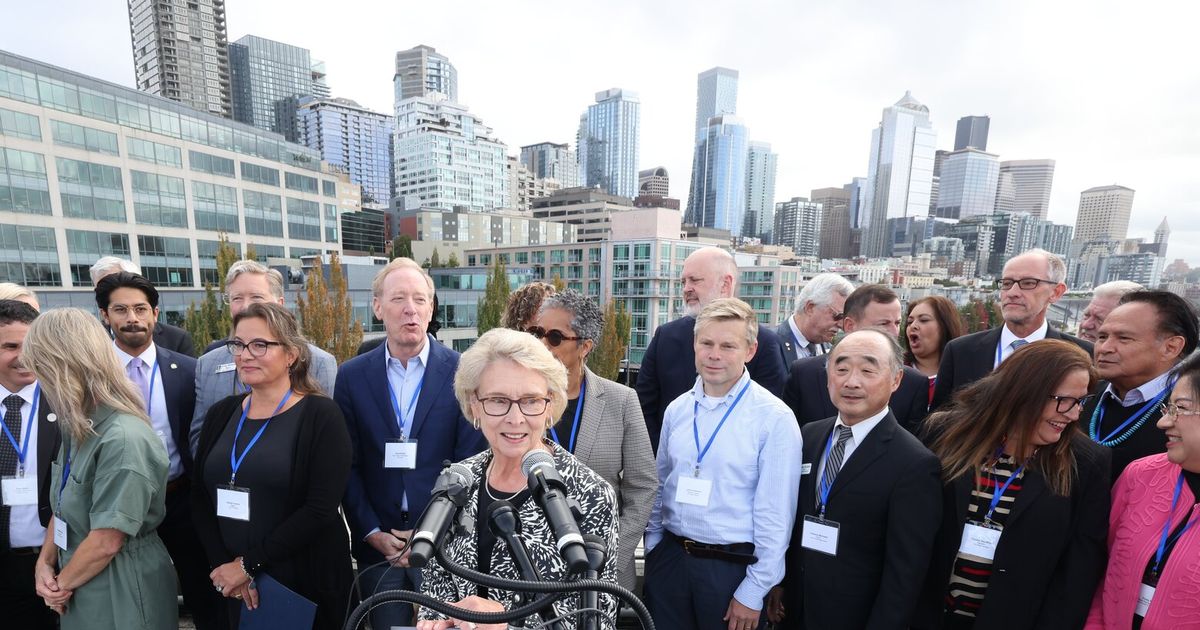
Leave it to Christine Gregoire to convene the economic equivalent of an intervention on Seattle’s waterfront. The state’s former governor has not been shy about the consequences of business-sapping taxes and an apathy toward economic development by too many regional policymakers. So last week, she invited many mayors, state lawmakers and others to rally around a patient with some worsening symptoms: the Puget Sound economy. The Puget Sound Regional Council reported the region lost 7,000 jobs in 2025.
By launching the Partnership for a Competitive Puget Sound, Gregoire placed front and center a 20-point plan to simplify taxes, speed permitting and spur job creation by leveraging the still-powerful economic strengths of the region.
The plan follows Gov. Bob Ferguson’s creation of a state economic development council and Seattle Mayor Katie Wilson’s announcement of a task force aimed at diversifying Seattle’s tech-centric economy. Gregoire’s effort, part of the business partnership Challenge Seattle, is chock-full of ideas drawn from other governments around the country that could make this region more competitive.
Local policymakers could, for example, draw inspiration from a Minnesota model that mandates local governments approve or deny land use and building permits within 60 days, improving construction timelines. They could follow an Oregon law requiring state agencies to review new rules and regulations to test whether they’ve worked as lawmakers intended. They could emulate other regions’ approaches to workforce development in emerging industries; Gregoire’s plan sees that kind of collaboration as ripe within Washington’s emerging fusion and space sectors.
The Puget Sound region has lacked a coherent economic strategy for at least a decade. Part of the void, likely, was that it felt unnecessary: a booming tech sector created prosperity. But accompanying that new wealth was immense pressure on the housing market and some of the highest costs of living in the country.
Meanwhile, in the past quarter century, Washington’s relative low cost of doing business has evolved into one of the nation’s highest. Gregoire didn’t name names but a number of state legislators in attendance couldn’t have missed the message that by raising taxes in 2025 and 2026, they caused some of the malaise the state now faces.
On that point, Brad Smith, Microsoft’s president, was more direct in his criticism than Gregoire, pointing out lobbying in Olympia has become an exercise in limiting lawmakers’ appetite for new business taxes.
“Now, the new session begins and we in the business community band together … we just have one question in mind, that we ask in meeting after meeting,” Smith told those gathered. “What can we do to persuade you to not raise our taxes yet again?”
Other cities and states, such as Nashville, Tenn., are eager to poach jobs from the Puget Sound region. Gregoire and Smith are right that Washington state leaders must vigorously counter those efforts.
Ferguson, for his part, told the editorial board he’s pleased with Gregoire’s work, and speaks frequently with the former governor about the state’s economy. Ferguson believes the state remains among the strongest places to do business, pointing to GDP growth that was fastest in the country to start 2026. But he acknowledged its political leaders have taken some of its strengths for granted, and Gregoire’s call to action is a welcome one.
Robust economic leadership has been lacking in the Puget Sound region, and a former state governor has rushed in to fill it. Godspeed, Gov. Gregoire.
