

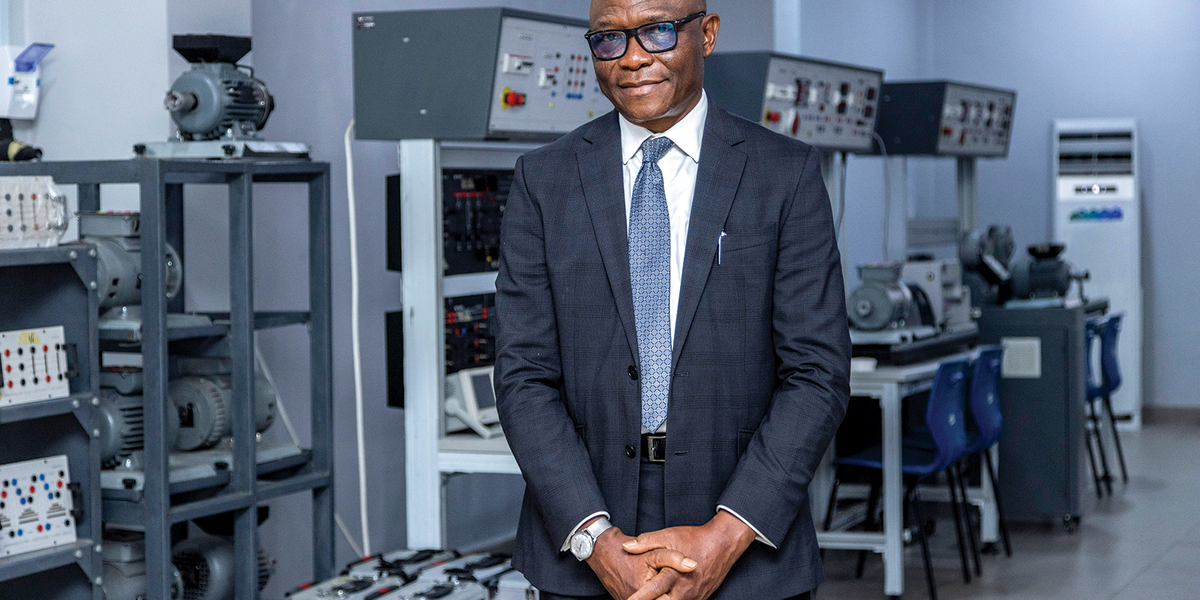
In October 2000, when electrical engineer Steve A. Adeshina joined Nigeria’s Independent National Electoral Commission (INEC) as director of information and communication technology, the country had just held its first successful democratic general elections in 17 years. The 1999 elections were generally peaceful, if not entirely reliable, according to independent observers. They were also technologically old-school: “When I arrived, things were done essentially manually,” Adeshina recalls, with some voters being registered by hand and others by typewriter.
Adeshina, who had been running his own information technology firm, oversaw the transition to machine-readable voter registration forms across 120,000 polling units, many in rural, hard-to-reach places. To complete these forms, applicants fill in bubbles, the way it’s done on many standardized tests.
Steve A. Adeshina
Employer: Nile University of Nigeria
Occupation: Professor of computer vision and engineering
Education: Bachelor’s degree in electrical and electronics engineering, University of Ilorin; Ph.D. in computer vision and engineering, University of Manchester
Over his decade-long tenure at the electoral commission, Nigeria conducted multiple elections with increasing technological sophistication. The 2015 presidential elections, the first to take place after Adeshina had left the electoral commission, earned positive reviews from independent observers and resulted in the first democratic transition of power between political parties in Nigeria.
Now Adeshina, 63, is a professor of computer vision and engineering at Nile University of Nigeria, in Abuja, and his three sons are at the start of their own careers, all in engineering. Like many people his age, Adeshina has reached the point of dispensing advice to younger engineers, his sons included, based on his own long career. “The advice I have for them is to keep their minds open and be creative and innovative,” he says.
That’s because surprises have cropped up throughout Adeshina’s own career. Keeping an open mind allowed him to take advantage of those surprises. Adeshina came to public service from the private sector, having run his own hardware and later software service company, Logica Solutions Limited, for about a decade. When INEC offered him a job, he “didn’t have an open mind about the public sector,” he says. “I didn’t think they did anything or that I would stay more than a few years. But I stayed 10 years.”
Career surprises go back to Adeshina’s university days. Like many engineers, he recalls trying to fix everything that broke at home when he was young. So, he enrolled at the University of Ilorin, also in Nigeria, as a civil engineering student in 1981. That’s where the hot jobs were at the time. “Nigeria was being built; civil engineering was more popular,” he says.
“The advice I have for [younger engineers] is to keep their minds open and be creative and innovative.”
Alongside other aspiring mechanical engineers, Adeshina built a culvert and some small bridges. But on a rotation through the electrical engineering department, a standard component of his course, his professors challenged him to build his own power-supply unit and then design and build the cabling for an entire house on a circuit board, including distribution boards and household wall outlets, all by himself. He was surprised by how much he liked it. “That really, really excited me, and that’s what made up my mind,” Adeshina recalls. He switched to electrical engineering.
Adeshina’s first job involved working on time-sharing computing on an early computer produced by North Star Computers. After three years there, he left to start Logica, where he began by adapting software designed for mainframes to work on less powerful but more affordable microcomputers suitable for the Nigerian market. But he was always looking for new problems to solve.
Modernizing Nigeria’s Voting System
By the time the INEC called Adeshina in to modernize voting in 2000, Nigeria was on the verge of big changes. The military that had ruled the country off and on between 1966 and 1999 had given way to democracy at the same time the Internet was gaining a tenuous foothold across Africa. Adeshina and others saw the potential to use the Internet to reinforce the fledgling civil society. INEC asked him if polling units could report preliminary results in real time, while poll workers finalized and certified ballot counts. The idea was to make the results more trustworthy by making it harder to manipulate results, or at least raise red flags.
By the time Adeshina left INEC, he had helped enable real-time election results through cellular networks. Here, preliminary results are sent on a mobile phone during the 2011 parliamentary election. George Osodi/Panos Pictures/Redux
At the time, 2G cellular networks in Nigeria “hadn’t really penetrated very far, but we were able to deploy radios that had the capacity to send email attachments, even [connect with] fax machines,” Adeshina says. Aid organizations donated Inmarsat satellite terminals for the hardest-to-reach polling units. “There are places that you cannot get to by a car. They use camels and maybe motorbikes to get to those places,” Adeshina says.
In such places, voting occurs over several days to allow more participation. That adds to the challenge: Voting machines must have batteries to handle constant electrical-grid failures. It was a race against time to build the infrastructure for the 2002 elections. “We were posting [collated results] on the Internet and the results were available to anybody,” Adeshina says. By the time of those first off-peak elections, INEC was receiving real-time results from perhaps 80 percent of Nigerians, Adeshina estimates, and thus had pioneered a new technology.
INEC’s new chairman then asked Adeshina to embark on a fresh registration drive. The challenge was to see if Adeshina and his team could improve the accuracy of voting rolls using fingerprints and photos. They discovered as many as 10 million duplicate registrations at a time when the entire population was around 126 million. He also came up with the predecessor to the country’s current voter-identification cards, which included photos of the voter and were machine readable.
From Public Service to Academia
By the time his INEC term ended in 2011, Adeshina found a perch at Nile University of Nigeria, in Abuja, the federal capital. There he has worked on a wide range of problems, including using inexpensive medical imaging to diagnose COVID-19 and exploring standards for 6G telecommunications. “He’s a respected voice in the digital world in Nigeria,” says Biodun Omoniyi, CEO of the broadband company VDT Communications and a former university classmate of Adeshina’s.
Even years after leaving INEC, Adeshina finds himself thinking about the challenges of elections. Due to its similar infrastructure and literacy levels, he looks to India for how to incorporate fully electronic voting one day in Nigeria. “The time to start preparing for the 2031 election is now.… You need to build trust, to have several off-peak elections and see that it works,” Adeshina says.
He now advises his sons and any young engineers to consider how they can apply their skills for their own country’s improvement. “I don’t want everyone to leave Nigeria,” he says. “I would like to have a world-class lab so we can keep some of our students.” If they are lucky, those students may get to apply their own engineering skills to the range of problems Adeshina has wrestled with.
With a wealth of experience across subjects and sectors, Adeshina continues to find fulfillment in his work. “It seems to me I’ve lived three kinds of life: private sector, public sector, and now academia,” he says. “Looking back, I’m really very happy, but I’m not done yet.”
From Your Site Articles
Related Articles Around the Web
