

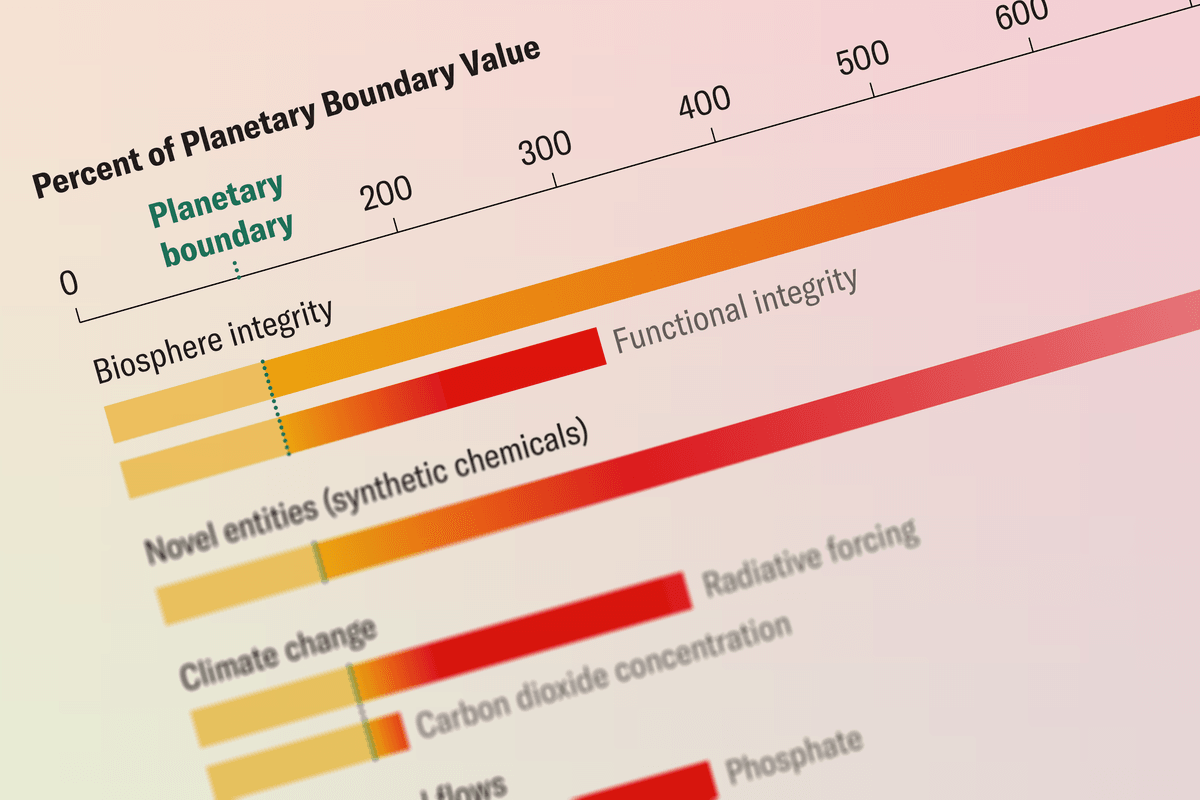
Humans are continuing to push Earth beyond livable levels of heat, pollution and other conditions—both for us and for millions of species.
That’s the upshot of the annual Planetary Health Check, released on Monday by the Planetary Boundaries Science Lab at the Potsdam Institute for Climate Impact Research (PIK) in Germany.
The report shows that seven of the nine chemical and physical “boundaries” we need to stay within to keep the planet habitable are at their worst recorded values since scientists first conceived of them in 2009.
On supporting science journalism
If you’re enjoying this article, consider supporting our award-winning journalism by subscribing. By purchasing a subscription you are helping to ensure the future of impactful stories about the discoveries and ideas shaping our world today.
“The diagnosis is unambiguous. Pressure is rising across every Planetary Boundary already outside the safe operating space,” said lead author of the report and PIK scientist Boris Sakschewski in a statement. “It means that the risk of large-scale, persistent and potentially irreversible change is increasing, while our margin for error in tackling these problems is shrinking.”
Sakschewski and other PIK researchers came up with these measures as a key to a sort of planetary life-support system—keeping within the boundaries they laid out is crucial to maintaining the environment we and other species have adapted to it over eons.
When they published the first Planetary Health Check in 2023, they found that human actions, from fossil fuel burning to excess fertilizer use, had pushed Earth past six of the nine boundaries. Last year we breached a seventh—ocean acidification.
Surpassing one of these limits isn’t a recipe for automatic doom, like flipping a switch. Rather “it’s like blood pressure,” said Katherine Richardson, an Earth systems scientist at the University of Copenhagen and lead author of the 2023 report, to Scientific American at the time of that report’s release. A high value is “not a guarantee that you’re going to have a heart attack,” but it raises the risks of one, she said.
Each measure is compared against a preindustrial baseline, or the period before humans began burning fossil fuels in earnest—roughly the mid-19th century. Beyond each boundary is a “zone of increasing risk,” in which the odds of moving away from those preindustrial conditions rise.
Amanda Montañez; Source: Planetary Health Check 2026. Planetary Boundaries Science Lab, Potsdam Institute for Climate Impact Research, 2026 (data)
Among the boundaries that have been breached, according to the new report, are carbon dioxide concentrations, which reached a record 426 parts per million (ppm) because fossil fuel burning had not decreased at nearly the needed pace. That is compared with 280 ppm, which was the concentration prior to the industrial revolution, and 350 ppm, which many scientists consider a “safe” limit (and was surpassed in 1987).
Those rising CO2 levels are rapidly changing the planet’s climate, leading to weather extremes such as the unprecedented heat waves in Europe and other areas of the world this summer. Research has shown that many of these would not have happened without the influence of climate change. Earlier this month the United Nations acknowledged that global temperatures would blow past the goal of Paris Agreement’s target of no more than 1.5 degrees Celsius (2.7 degrees Fahrenheit) of warming.
Fossil fuels and the CO2 they release are also what pushed the planet past the ocean acidification boundary last year because the ocean absorbs some of the excess gas from the atmosphere, lowering the water’s pH. That increasing acidity can make it hard for shell-building organisms to develop their protective dwellings and could even causes shells and corals to dissolve. This would be a blow not only to biodiversity but also to economically valuable ecosystems; a 2020 report by the U.S. National Oceanic and Atmospheric Administration found that ocean acidification would cost the country’s economy billions of dollars.
Humans are putting pressure on other aspects of the environment as well. Excess phosphorus and nitrogen from widespread fertilizer use flows into rivers and seas where they can spark toxic algal blooms. Artificial chemicals, such as plastics, dichlorodiphenyltrichloroethane (DDT) and “forever chemical,” or perfluoroalkyl and polyfluoroalkyl substances (PFAS) , disruptively accumulate in food chains.
Just two of the nine limits remain intact: ozone depletion and aerosol pollution in the atmosphere. Only ozone shows clear progress away from the planetary boundary as a result of the success of the Montreal Protocol, which set up the phasing out of the chemicals that erode Earth’s protective ozone layer. Aerosol emissions have declined globally—partly from efforts to reduce pollution from global shipping—but are still high in some regions.
The new report’s authors underscored the urgency of maintaining momentum to keep below the boundaries where we are seeing progress and to reverse course where we are not.
“We do not have the luxury of time, but we do have the knowledge, capacity and solutions to change course,” said Johan Rockström, PIK’s director and a co-author of the report, in a statement. “Accelerating action to return to the safe operating space across all Planetary Boundaries is essential to protect lives and livelihoods, and to deliver on the promise of shared future prosperity.”
Subscribe to Support Independent Journalism
Great science journalism requires human expertise, time, effort and creativity. And it costs money. That’s why I and the journalists here at Scientific American hope you’ll join our community.
When you subscribe, you are supporting staff and freelance journalists who are passionate about telling science stories that are true, important and compelling. Our editors and reporters are often experts in their fields, which means they understand the nuances of big discoveries and can untangle the breakthroughs from the hype. With a subscription, you are also supporting rigorous fact-checking to ensure the words we publish are precise and accurate. And you’re supporting original illustrations, graphics and photos that bring you closer to an advanced laboratory, an ice sheet in Antarctica or a space mission in orbit. You’re helping us craft other types of high-quality journalism as well: Our newsletters are carefully written, edited and curated by staffers you have or will come to know and love. Our Science Quickly podcast is based on original reporting, collaboration with editors and scientists and exacting production.
Subscriptions keep this engine running so we can continue to deliver thoughtful, rigorous and independent science journalism to you. In an era of viral misinformation, this work is crucial. If you value what we do, I hope you’ll consider joining us as a subscriber
