

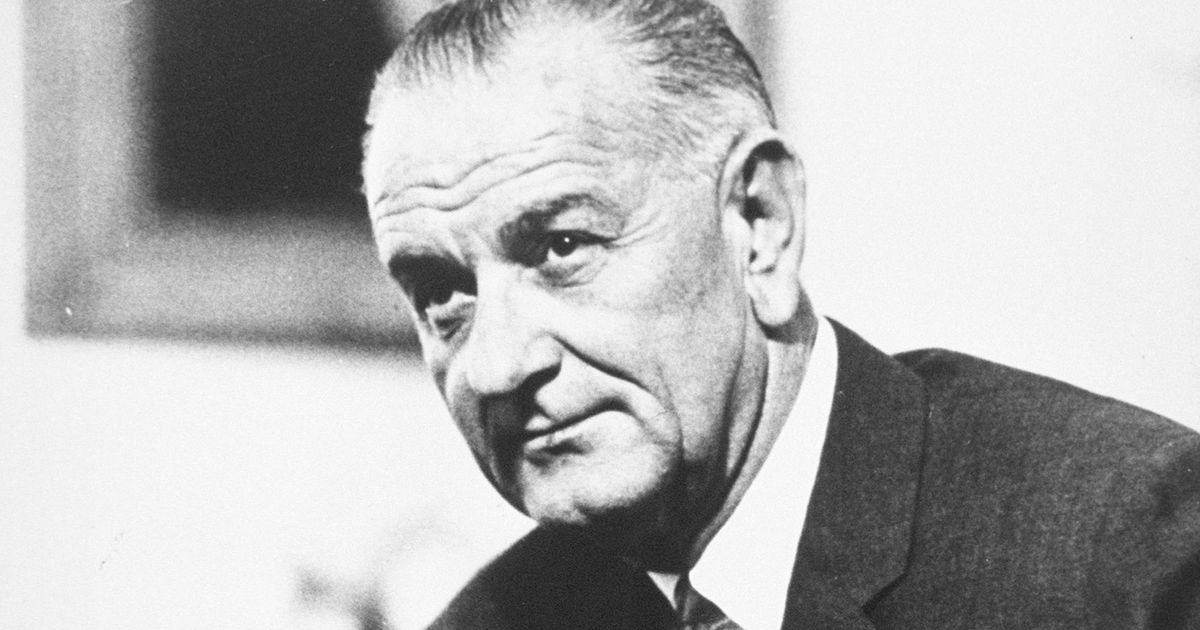
The shocking results of the 1966 midterm elections offer timely lessons on both the purpose of off-year voting in the democratic process and the toxic impact of declining trust in a president’s personal credibility. Collectively, the lessons reflect the beauty of the framers’ vision of electorally accountable executive and legislative branches of government.
More personally, the 1966 midterms tell of the rapid fall from grace of Lyndon B. Johnson, one of the most consequential presidents in U.S. history who was responsible for the country’s most critical civil rights legislation.
By Election Day 1966, almost two years had passed since Johnson was elected to the presidency by a huge margin of victory. The spirit of optimism sparked by the John F. Kennedy administration’s “New Frontier” had transitioned into national pride for the legislative achievements of the Johnson administration’s “Great Society.” But the United States of autumn 1966 was descending into the destabilizing throes of massive social and cultural change, and of an increasingly costly and unpopular war in Southeast Asia. And that would be reflected in the decisive results of the looming midterm elections.
The seeds of public distrust of Johnson were rooted in his 1964 campaign pledge: “We are not about to send American boys nine or 10,000 miles away from home to do what Asian boys should be doing themselves.” Yet during 1966, troop levels in Vietnam dramatically escalated to almost 400,000 soldiers, with both draft calls and casualty levels significantly higher as well. And the subsequent release of the Pentagon Papers in 1971 would reveal that Johnson had also misled Congress on the scope of U.S. involvement in Vietnam in order to obtain the authority of the Gulf of Tonkin Resolution.
Johnson’s decision to escalate Vietnam involvement acknowledged the competing political options: pursuing his predecessor’s foreign policy or retreating from the perceived challenges of the Cold War. In choosing the former, Johnson knew the risks it posed to his cherished social policy goals. He thus embarked on de-emphasizing, if not actually distorting, his public statements on the war: its rationale, its progress and the prospects for peace. From this came his “guns and butter” strategy of continuing the Great Society while fighting in Vietnam.
The problem was that the country couldn’t do both, at least not without a tax increase. Famed author David Halberstam reported that Johnson withheld from the people and his own economic advisers the true cost of the war. This led to significant economic stress, an increase in inflation and a delay in pursuing the necessary tax legislation. As Johnson later lamented, “The b—h of a war killed the lady I loved — The Great Society.”
As Johnson’s strategy evolved, his spoken words increasingly contrasted with what voters, and Congress, could read in the papers and watch on television. This contrast peaked with the February 1966 hearings of the Senate Foreign Relations Committee on Johnson’s Vietnam strategy. Frustrated by what he perceived as obfuscation by administration officials, the committee chairman, Sen. J. William Fulbright, applied the term “credibility gap” to describe the growing lack of public trust in the president’s war policies and in his prior pledge to keep the country out of an Asian land war.
The description stuck, and the ultimate election verdict was harsh. The ruling Democratic Party was dealt a major blow, losing to the Republicans 47 seats in the House of Representatives, three seats in the Senate and eight governorships. Johnson’s credibility would remain an issue for the balance of his presidency and was a major factor in his decision not to run for reelection. The experience convinced Fulbright of the risks involved when relying on the good faith of the chief executive.
In that sense, the 1966 midterm elections served their intended purpose. In the democratic system, the off-year election process is intended to tie members of the House of Representatives more closely to the public and also to provide tangible messages of accountability to the Senate and the executive branch. In 1966, those ties were confirmed, and those messages were sent — if not also received.
Johnson’s “credibility gap” not only changed the balance of political power; it also weakened his capacity to govern, undermined his foreign policy and prompted a decline in public trust in government that continues to this day. According to a 2025 Pew Research Center poll, only 17% of Americans now say they trust the federal government to “do what is right,” one of the lowest levels in nearly seven decades of asking the question. It is a most unattractive commentary on the ongoing sustainability of democratic principles.
Yet the possibility remains that honesty and trustworthiness are characteristics still considered by voters when going to the polls and that candor remains, to some, a prerequisite for public office. No matter the candidate nor the timing of the election.
