

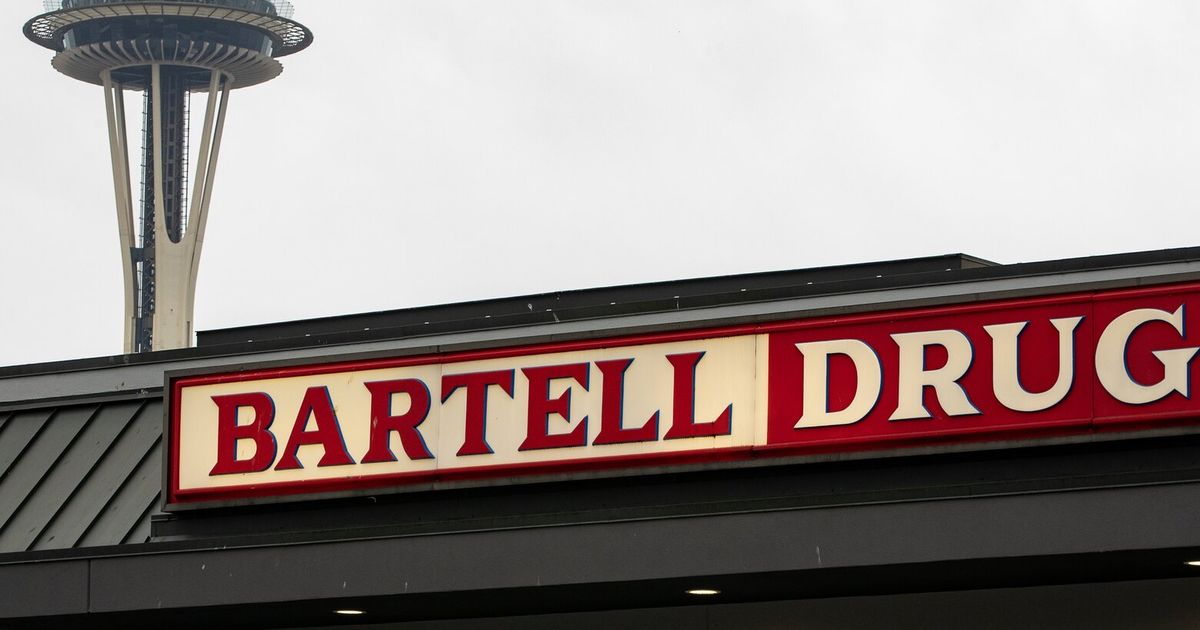
It’s time to raise a glass (or orca-emblazoned travel mug) to Bartell Drugs, the mighty Seattle drugstore chain that has become another casualty at the intersection of corporate gamesmanship and consolidation. It was purchased by Rite Aid in 2020 — the twice-bankrupt chain — and has now sold to CVS, which just announced a rebranding of the remaining 20 or so stores with the Bartell name.
Even newcomers catch on quickly to the lore of Bartell Drugs, founded in 1890 in Seattle by George Bartell Sr. and nurtured into what was reportedly the nation’s oldest family-owned drugstore chain. Those newcomers soon learn to call it “Bartell’s” for short. No one calls it “Bartell Drugs”; that’s akin to referring to the Market as “Pike’s Place.”
Behind the recognizable red-and-white sign is a story deeply intertwined with the history of Seattle and the Northwest, which makes the rebrand feel more significant than just a “local chain swallowed up” tale.
Born in Kansas in 1878 but not cut out for farming, Bartell Sr. left home as a teenager. A pharmacist by 18, he went west, landed at the Lake Washington Pharmacy in Seattle and two weeks later, bought the shop for $3,000 (mostly borrowed, according to HistoryLink). He went north to the Klondike Gold Rush, returned and opened a new pharmacy. The history hits just kept coming: Bartell opened one of the first soda fountains in Seattle in 1902 and was early to hire female pharmacists. He opened a candy factory, a photo lab and a store shaped like a triangle. Elvis Presley was a customer during the 1962 World’s Fair. One of the first Bartell-owned stores was on the streetcar route; the “triangle store” was at the terminus of the monorail. One of his stores was leveled to make room for the Smith Tower, which opened in 1914, and another made way for the Westlake development. There is little daylight between where Bartell stores stood and Seattle’s history was written.
The chain fell on hard times in the 1960s and was forced to close stores, but rebounded in the 1970s. By 2020, Bartell Drugs counted 67 stores in King, Snohomish and Pierce counties. But a 135-year legacy was no match for the pandemic. The slide was due to some of these things, or all of these things, depending on who is doing the opining: Downtowns that didn’t rebound. A customer base that went from working from home to working from another state. The rise of pharmacy benefit management that controls a big chunk of the market. A dearth of pharmacists. The hollowing out of downtown cores, such that even the most mundane items are kept in drugstores’ locked cases, forcing shoppers to look for one of the very few employees still there to unlock the razors. The shortage of primary care docs and the corresponding boom in telehealth services and prescriptions.
The new owner can talk about “retaining the local flavor” all it wants, but it won’t taste the same. Who has not “stopped off at Bartell’s for a minute” and emerged after a half-hour? Who didn’t stuff stockings with the annual Christmas ornament and famous local treats like Almond Roca and MarketSpice Tea? What about all that Seahawks-branded merch that symbolized residency in the big city? Maybe, Bartell’s shopper, you received a ghostly tap on the shoulder from George Bartell Sr., who ditched the farm, went to town and found gold along the way.
The Bartell departure, like a milestone birthday, signifies a kind of mortality. It was one of the landmarks that made this region our region rather than some generic strip mall. One more company is no longer making decisions for the good of the communities where customers live. CVS is the world’s second-largest health care company. It has the power to close hundreds of stores at a time and influences health care costs (it owns Aetna). A shrinking number of companies have a great deal of say over our everyday lives; 50,000 local residents just lost access to UW Medicine because it couldn’t reach an agreement with Aetna. If shoppers want Xanax and a chocolate bar that celebrates the Sounders and a cheese board shaped like Washington all in one familiar, right-sized store, it’s up to CVS, headquartered in Woonsocket, R.I.
We’re losing choices and jobs and some of our tax base because of Rite Aid’s bad choices. It took on more debt than it could handle trying to compete with Walgreens and CVS, gambled it all and lost. George Bartell Sr.’s company got trampled in the process. It feels like far more than the loss of one more familiar name.
