

We spend a lot of time scolding Americans for failing at their civic duty. Everyone should be speaking at town halls, voting in every election and setting daily reminders to call their elected representatives. This isn’t bad advice, of course, but it may not persuade someone who has ever considered going to a town hall where the outcome seemed preordained, voted for a candidate who seemed merely the least bad or received a canned email reply from a government official. We need more innovative civic advice than “do more of what isn’t working.”
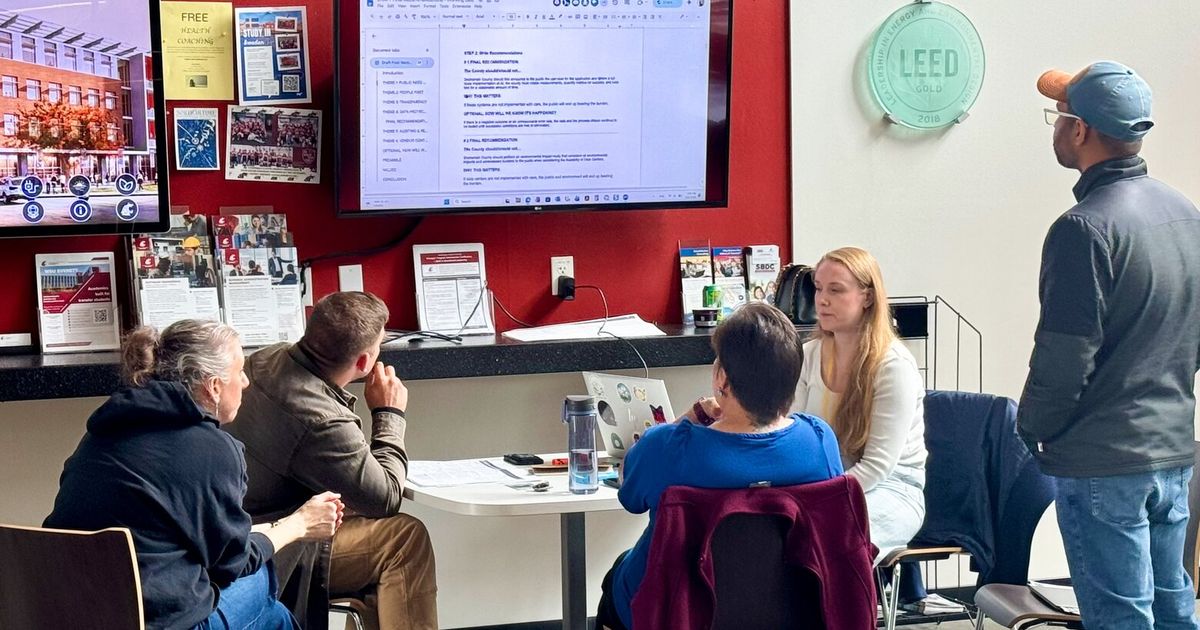
Right now, Snohomish County is showing us what the next era of civic innovation looks like with the Snohomish County Civic Assembly. The assembly brings together a randomly selected, demographically representative group of residents to advise the county council on government use of artificial intelligence. Over three weekends in May and June, the group discussed shared values, heard from subject matter experts and deliberated on different policy approaches. This past weekend, the assembly continued refining its proposals and finalized a set of recommendations for the county council, the culmination of roughly 40 hours of work.
What may sound like a zany experiment (a few dozen random people creating public policy?) is in fact a well-validated model for decision-making. Governments around the world have deployed the assembly process more than a thousand times on issues from abortion to urban planning. While assemblies are common throughout Europe, Australia, Latin America and beyond, they have only begun making their way to the U.S. in recent years. Civic Genius, a program of the National Civic League, is one of the very few American organizations designing and facilitating these processes, including in Snohomish County.
A few elements make the civic assembly model different than traditional civic engagement. First, the participants mirror the local population in terms of age, race, gender and geography, some of which is almost never the case in a traditional public input process. Because participants are selected by lottery, they include not just activists and political junkies but everyone else: People who can’t fit a weeknight forum into their schedules or find politics aggravating or fear public speaking — or are simply introverts.
Second, participants have access to a wide range of information and opinion. During the learning phase of a civic assembly, they hear from a variety of subject matter experts and ask questions.
Third, participants have the luxury of time. Our information ecosystem runs on hot takes. To make wise policy decisions, we need to slow down, consider an issue from all angles, reflect on its interaction with our values and assess its impact on ourselves and others. We need to be realistic about costs and benefits, and weigh the trade-offs of one imperfect approach over another.
The final element is impact. Assembly members have an upfront commitment from government to formally receive and respond to the group’s recommendations. Governments generally accept most or all of the recommendations, demonstrating to participants that their work had consequence. It also fuels a rare, honest conversation between governments and residents. Government officials do not have to accept the full set of recommendations wholesale, but they can’t just quietly put recommendations on a shelf, either. They must explain why those recommendations are not becoming policy. Research on civic assemblies around the world finds that assembly members are broadly satisfied with this transparent and collaborative approach.
Serving as a civic assembly member is a big commitment. Assembly sessions take place over weeks or months and participants generally need to attend all of them. Removing barriers to participation is critical so the assembly’s final report reflects the full community, not just those with spare time and resources. The Snohomish County Civic Assembly, like other assemblies, offered meals and provided stipends for transportation, child or elder care, and the participants’ time. Our team has a dedicated participant concierge who assembly members could text anytime during the process.
In Snohomish County, the assembly brought people who work in tech together with those who have never used an AI tool. It brought together people who have never engaged in policy or politics with those who keep close watch on the issues. While they did not agree on everything, they found a degree of common ground that seems impossible within our traditional public input structures.
The Snohomish County Civic Assembly will present its final recommendations to the County Council in the coming weeks and will make its full report available to the public. If this report looks anything like those of other civic assemblies, it will be profoundly reasonable and reflect earnest negotiations among peers. This assembly should serve as a proof of concept for civic assemblies in Washington. Our next innovation should be to scale them so people across our state can be a part of what comes next.
