

To the Editor:
Re “I Want to Hold Her Hand,” by Roger Rosenblatt (Opinion guest essay, Sept. 29):
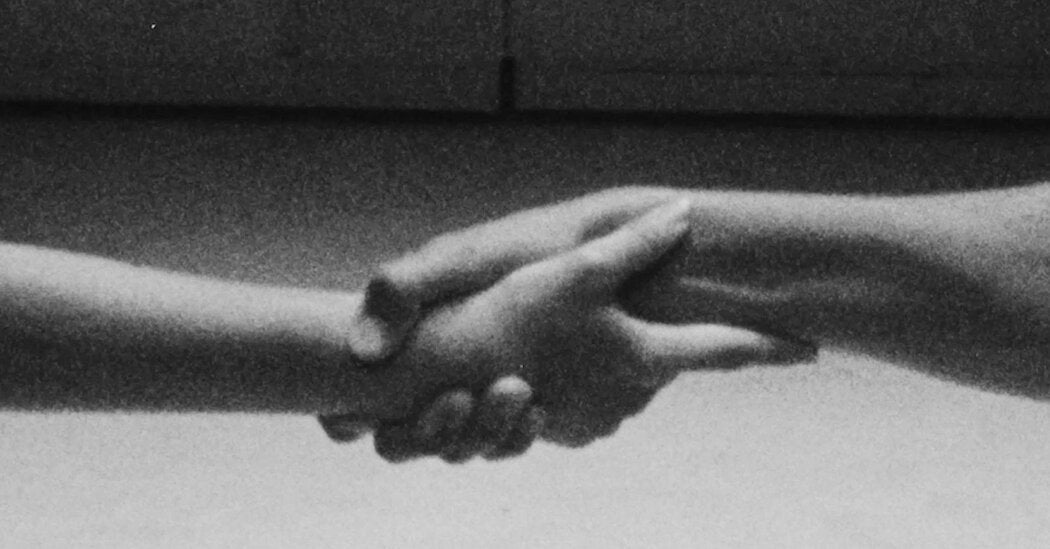
Hands talk.
I am a dermatologist, and I care for children living with ichthyosis, a group of genetic conditions that affect their skin. Their hands can be rough, fragile or visibly different.
Sometimes the children learn, very early, that other people hesitate to touch them. They may become aware that their hands are not always welcomed and that even the simple gesture of caressing someone can feel out of reach.
When these children come to see me, often holding their parents’ hands, I hold theirs.
Not to examine them. Not to ask them how they feel about being touched. Not to make a statement in the clinical record. I hold their hands simply because I want them to know that I care.
Sometimes hands speak when words cannot.
Angela Hernández-Martín
Madrid
To the Editor:
Roger Rosenblatt eloquently captures how the hand heals and conveys affection. I would add that inscribed hands have long been instruments of knowing.
Medieval singers used the Guidonian hand as a way to learn to read music. Bede taught monks to calculate the date of Easter through finger reckoning. Renaissance readers in the West and the East consulted images in palmistry treatises to divine fortune in the lines of their hands.
Mnemonics, calculation, teaching, divination: In each, the hand thinks. While Mr. Rosenblatt’s clasped hands convey tenderness, these epistemic hands convey knowledge.
Both remind us that the hand is not merely what we touch with, but also how we learn, calculate, remember, understand and make sense of the world.
Susan Forscher Weiss
Baltimore
The writer is a professor emerita of musicology and modern languages and literature at Johns Hopkins University.
To the Editor:
We elders can really appreciate Roger Rosenblatt’s description of the importance of hand holding, a touch of the hand or lending a hand. These simple acts are the paste that unites us to others. I hope that those younger may be learning this too.
If our diplomats and elected leaders sincerely shook hands more often, perhaps we wouldn’t be in the turmoil that now exists in so many parts of our world.
Miriam Kagan Margoshes
Hastings-on-Hudson, N.Y.
Ads Praising Trump
To the Editor:
Re “Trump Ordered Public Funding for Praise Ads” (front page, Oct. 4):
President Trump no longer even pretends to govern. He has converted his entire presidency into an ongoing vanity project, nothing more.
The advertisements he’s buying are not really for public consumption; he is his own intended audience. He testifies every day about his own neediness.
Don L. Doernberg
Penn Valley, Calif.
My Phones, Smart and Dumb
To the Editor:
Re “I Love My Dumbphone. My Family Hates It,” by Stephanie H. Murray (Opinion guest essay, Sept. 20):
Ms. Murray frames the choice between smartphones and dumb ones as love it or leave it. I’ve found a different arrangement that works well for me. Call it a technological throuple.
Monday through Friday, I enjoy my smartphone. It’s brilliant and useful, but a little needy. Then at week’s end, I long-press it off and power up my flip, which doesn’t need me. It’s not clever. It leaves me alone and doesn’t vie for my attention.
Our relationship is more physical, more tactile. Sure, texting’s a chore, but that’s really the point: no scrolling, no staring, no checking my feeds.
I’m not militant. My wife, kids and the few people who genuinely might need me in an emergency have the number. And like most good things, it works better with balance and some flexibility.
If I need directions, a rideshare or tickets, or if I want to listen to an audiobook or a playlist, I’ll bring my smartphone along. Otherwise, it’s my flip phone and me.
Come Monday, I’ll switch back again. I love my smartphone and my dumbphone too. We’re all just better together when we spend some time apart.
Peter Marcus
Los Angeles
