

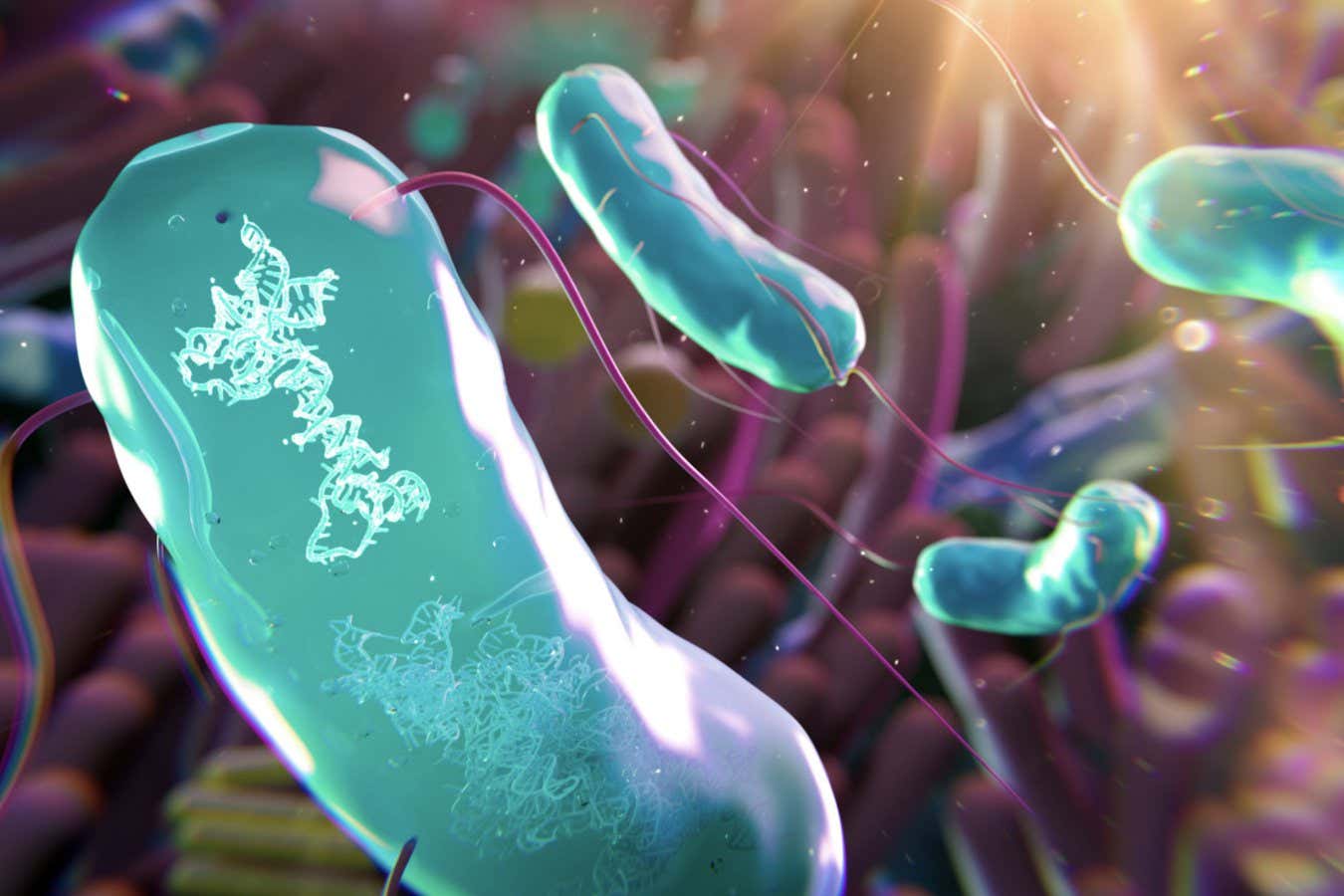
The human gut microbiome has a big influence on health
Science Photo Library/Alamy
Genetically engineered gut bacteria can break down the compounds that contribute to kidney stones. Tailoring bacteria to tweak the gut microbiome in this way could go beyond treating kidney stones and lead to new treatments for a range of conditions, including inflammatory bowel disease and colon cancer.
“The gut microbiota has a big influence on our health and being able to manipulate that is a promising avenue,” says Weston Whitaker at Stanford University in California. But previous attempts to do so ran into a problem. Bacteria introduced into the gut, whether those are naturally-occurring probiotics or genetically modified strains, often struggle to colonise the large intestine, because they have to compete with existing microbes.
So Whitaker and his colleagues took a slightly different approach. They genetically modified a bacterium already abundant in most people’s guts, called Phocaeicola vulgatus. “We wanted something that was going to be compatible with colonising the gut,” he says.
The team made three genetic changes. The first enabled the bacterium to break down compounds in food called oxalates, which contribute to kidney stones. The second allowed it to digest a carbohydrate found in red seaweeds known as porphyran. This gave the bacterium a competitive edge over existing gut microbes, most of which cannot utilise porphyran. The final tweak made a gene essential for the bacterium’s survival dependent upon porphyran. Together, these changes allowed the researchers to control the growth of the microbe – adding porphyran encouraged the bacterium’s spread, while restricting porphyran killed it off.
The researchers fed 12 rats a high-oxalate diet for four days, then treated half of them with the genetically modified bacteria and the other half with a strain that couldn’t break down oxalates. Porphyran was added to all of the animals’ daily diets. After six days, the rats treated with the engineered bacteria had, on average, 47 per cent less oxalate in their urine compared with the control group.
The team then tested the engineered microbes in nine people with enteric hyperoxaluria, a condition in which the body absorbs too much oxalate, causing recurrent kidney stones. All participants consumed 10 grams of porphyran daily for 28 days. Compared with three people who have the condition but didn’t undergo treatment, those who did had 27 per cent less oxalate in their urine, on average.
This reduction wasn’t statistically significant, probably due to the small sample size, says Whitaker. But there is still reason to believe the bacterium could prevent kidney stones, as other clinical trials suggest a 20 per cent reduction in oxalate is enough to reduce symptoms, he says.
While none of the participants experienced serious side effects, those treated with the genetically engineered gut microbe were more likely to have abdominal pain, diarrhoea and other mild gastrointestinal problems.
A bigger issue is genetic analysis of the human participants’ gut microbiomes revealed, eight weeks after stopping the supplement, only four of them still had bacteria capable of digesting porphyran. This indicates the engineered bacteria had swapped genetic material with existing gut microbes. This shouldn’t cause any safety concerns for the participants, but it is an issue that will have to be ironed out in future studies, says Whitaker.
“I think this [approach] is a real breakthrough,” says Christoph Thaiss, also at Stanford University, who wasn’t involved with the research. He says the work shows it is possible to engineer gut microbes with therapeutic effects and get them to reliably colonise the gut – a strategy that could treat a range of conditions.
“We know that our gut microbiota is associated with many different diseases – diabetes, heart disease, cancer,” says Whitaker. “But we don’t know exactly what it is about the microbiota that is causing or preventing disease.” Untangling those relationships will be necessary in order for researchers to take full advantage of this approach, he says.
Topics:
