

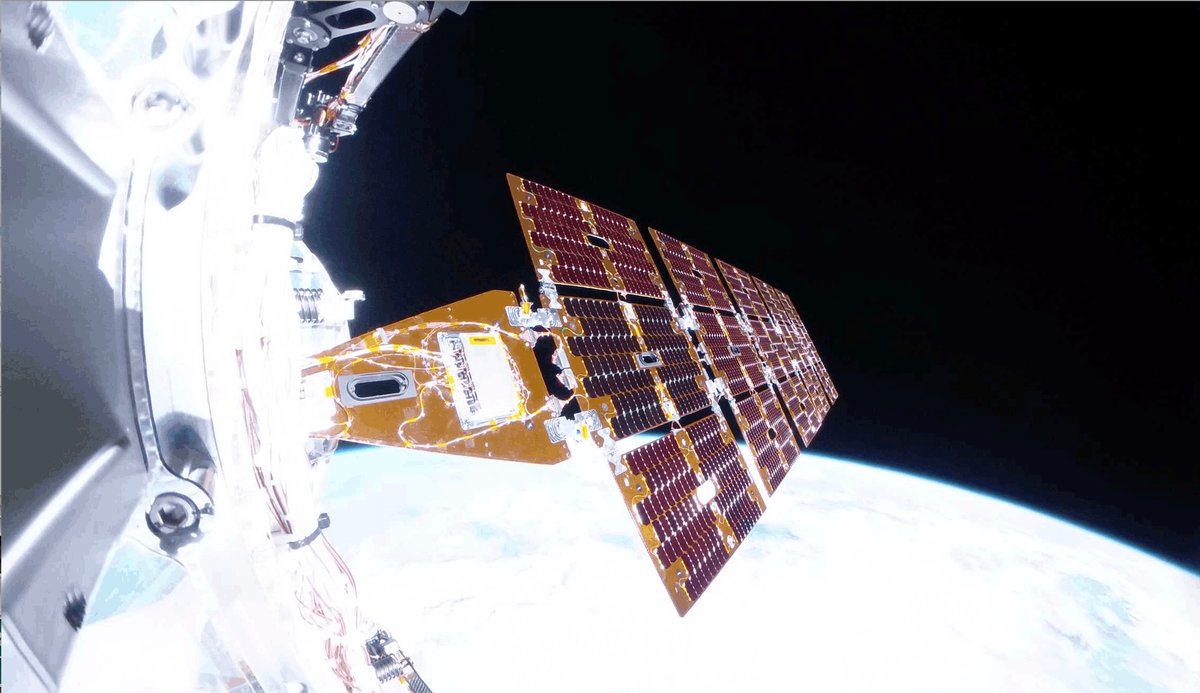
After more than two decades contributing to humanity’s knowledge of the cosmos, NASA’s Neils Gehrels Swift Observatory will soon suffer a fiery end, as a rescue attempt has failed before it truly began.
The satellite, launched in 2004 carrying instruments to study gamma-ray bursts across the universe, will likely plunge into Earth’s atmosphere and burn up later this year. That’s despite the space agency spending $30 million in hopes of giving the observatory a life-extending orbital boost using the Lightweight In-Space Navigation and Kinematics (LINK) spacecraft, a rescue mission custom-built and operated by the private U.S. company Katalyst Space Technologies.
It was a rush job from the start, as NASA had realized the observatory’s orbit was decaying faster than anticipated, putting a hard deadline on any efforts to save Swift. That gave Katalyst just nine months to design, build and launch LINK, which was planned to grab Swift with robotic arms and lift it to a higher orbit.
On supporting science journalism
If you’re enjoying this article, consider supporting our award-winning journalism by subscribing. By purchasing a subscription you are helping to ensure the future of impactful stories about the discoveries and ideas shaping our world today.
But the mission ran into trouble weeks after its early-July launch as it prepared for an eventual rendezvous with Swift. On July 28, NASA said hardware malfunctions had sent LINK spinning out of control and that communications with the spacecraft were sporadic. While efforts were made to correct its spin using the same xenon-gas thrusters meant to boost Swift back to life, it now appears the mission is a failure.
The observatory had already paused operations in advance of the rescue attempt—now, the doomed space telescope will leave a gaping hole in astronomers’ observations of the high-energy cosmos that’s unlikely to be patched anytime soon.
In a LinkedIn post, Katalyst said the company and NASA had agreed that, due to ongoing spacecraft control issues, “the mission will not include the capture and boost of NASA’s Neil Gehrels Swift Observatory.”
The company is not abandoning LINK just yet, as it aims to continue gathering data that could be valuable in future missions. While a failure, there could be much to learn as space agencies and private companies begin leaning into the idea of repairing failing orbiting satellites.
“Katalyst designed, developed, and launched an experimental spacecraft to go after an ambitious mission on an aggressive timeline,” company CEO Ghonhee Lee in the social media post. “We took on this high-risk, high-reward challenge and are proud of the milestones we reached along the way. We have already learned a tremendous amount, and now our job is to turn those lessons into something durable—building a repeatable playbook to inform future rendezvous and proximity operations and satellite servicing.”
In a statement, NASA Administrator Jared Isaacman acknowledged the outcome is not what was hoped for, “but it does not change why this mission was worth attempting.”
“The team moved with extraordinary speed to give Swift a chance to carry out more science while advancing capabilities America will need for satellite servicing in the future,” Isaacman said. “We are going to learn everything we can from LINK’s rendezvous attempt and put those lessons to work on the missions that follow.”
It’s Time to Stand Up for Science
If you enjoyed this article, I’d like to ask for your support. Scientific American has served as an advocate for science and industry for 180 years, and right now may be the most critical moment in that two-century history.
SciAm always educates and delights me, and inspires a sense of awe for our vast, beautiful universe. I hope it does that for you, too.
If you subscribe to Scientific American, you help ensure that our coverage is centered on meaningful research and discovery; that we have the resources to report on the decisions that threaten labs across the U.S.; and that we support both budding and working scientists at a time when the value of science itself too often goes unrecognized.
In return, you get essential news, captivating podcasts, brilliant infographics, can’t-miss newsletters, must-watch videos, challenging games, and the science world’s best writing and reporting. You can even gift someone a subscription.
There has never been a more important time for us to stand up and show why science matters. I hope you’ll support us in that mission.
