

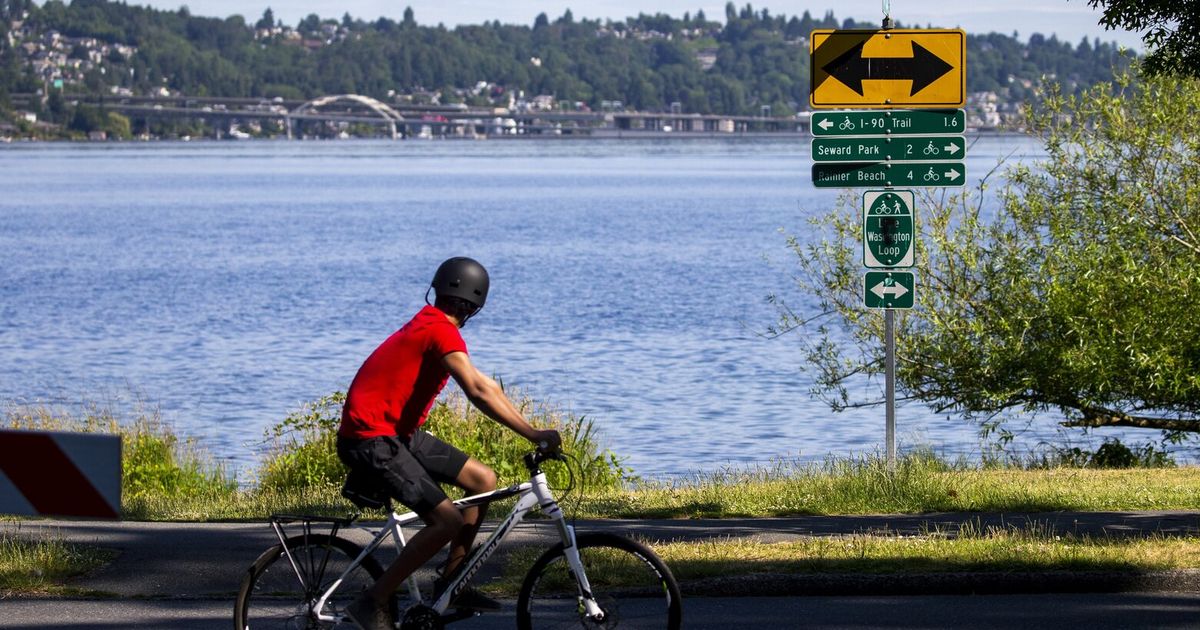
I’ve lost track of how many times I’ve been passed by speeding cars (or been in near head-on collisions) while driving 25 mph on the beautiful 3-mile Seattle Parks section of Lake Washington Boulevard, between Mount Baker Beach and Seward Park. So these days, I drive alternative routes, except when I get to travel the glorious stretch with new speed cushions between Mount Baker Rowing and Sailing Center in Stan Sayres Park, and Seward Park. I also avoid walking alongside the stretch without traffic-calming measures.
Recently, I felt hopeful knowing Seattle planned to extend traffic calming all the way north to Mount Baker Beach. So it was a gut punch when Seattle Parks announced watered-down plans, most notably halting additional speed-cushion implementation until further study. To protect those who live, drive, walk, take transit and/or bike through Southeast Seattle, Seattle must recommit to implementing the full traffic-calming and pedestrian infrastructure plans this year.
Seattle provided minimal justification for this about-face, though King 5 reported last week the city called speed cushions “polarizing.” Sure, I’ve heard folks complain that speed cushions slow them down too much. But that’s precisely the point: to ensure people drive the speed limit (i.e., save lives). And cushions do so without enforcement-based solutions that can disproportionately harm communities of color.
As a parent of young kids, I’m especially crushed that these lifesaving measures, previously planned at the very northern barrier of the 3-mile parks stretch (Lake Park Drive/Mount Baker Beach), were cut from the plans, perhaps permanently. This is a high-volume, confusing, pedestrian intersection where many families cross between Mount Baker Park and the beach. The city planned to install a three-way stop there, which many applauded, myself included. That plan was inexplicably abandoned, according to the project’s engineer. And now, the speed cushion concession is in question. I often take my kids on the Metro 50 to Seward Park, so I’m also disappointed that Orcas intersection improvements in Columbia City were shelved. Both segments need state-of-the-art traffic-calming and pedestrian infrastructure.
Speeding is rampant on the boulevard. In a 2023 study, one driver was found to be going over 70 mph. There have been about 14 crashes annually from 2015-2022 on this stretch of the boulevard. Already this summer, there have been terrifying collisions, including one where a teen narrowly escaped serious injury as the victim of a hit-and-run. Reckless drivers end up in the lake, including at Mount Baker Beach.
Despite this data and five years of process, Seattle now says more study is needed before implementing speed cushions. This will only waste resources and ignore what study after study has already pointed to: traffic calming.
Some argue speed cushions slow emergency vehicles but studies show that’s not true. Others may feel they need to drive over 25 mph, given demands on their time. Those stresses are real, but they can’t be resolved at the expense of others’ safety. Instead, solutions like improving public transportation access should be considered. (How awesome would a new Metro route be, that hits beaches/parks from South to Central Seattle along the Boulevard?).
Some say slowing traffic on the boulevard will push speeding traffic elsewhere. Seattle should therefore calm traffic on parallel arterials: Martin Luther King Jr. Way, 38th Avenue South and Rainier Avenue South. Such changes align with many community members’ priorities. For example, in a University of Washington study I co-led, Seattle youth of color advocated for more traffic calming, better pedestrian infrastructure and improved public transit access throughout South Seattle.
No matter what transportation mode you’re using on the boulevard, it’s hard to ignore how treacherous it can be. If you agree, you can write letters supporting traffic calming on the boulevard (and also on Rainier Avenue South). Although highly unlikely, even if a majority of Seattleites abhor speed cushions, that shouldn’t impede implementation of evidence-based, lifesaving infrastructure. City leaders: Do what’s right and protect the well-being of Seattleites by making this treasured space accessible and safe for all.
The views expressed are those of the author and do not necessarily represent those of the University of Washington.
