

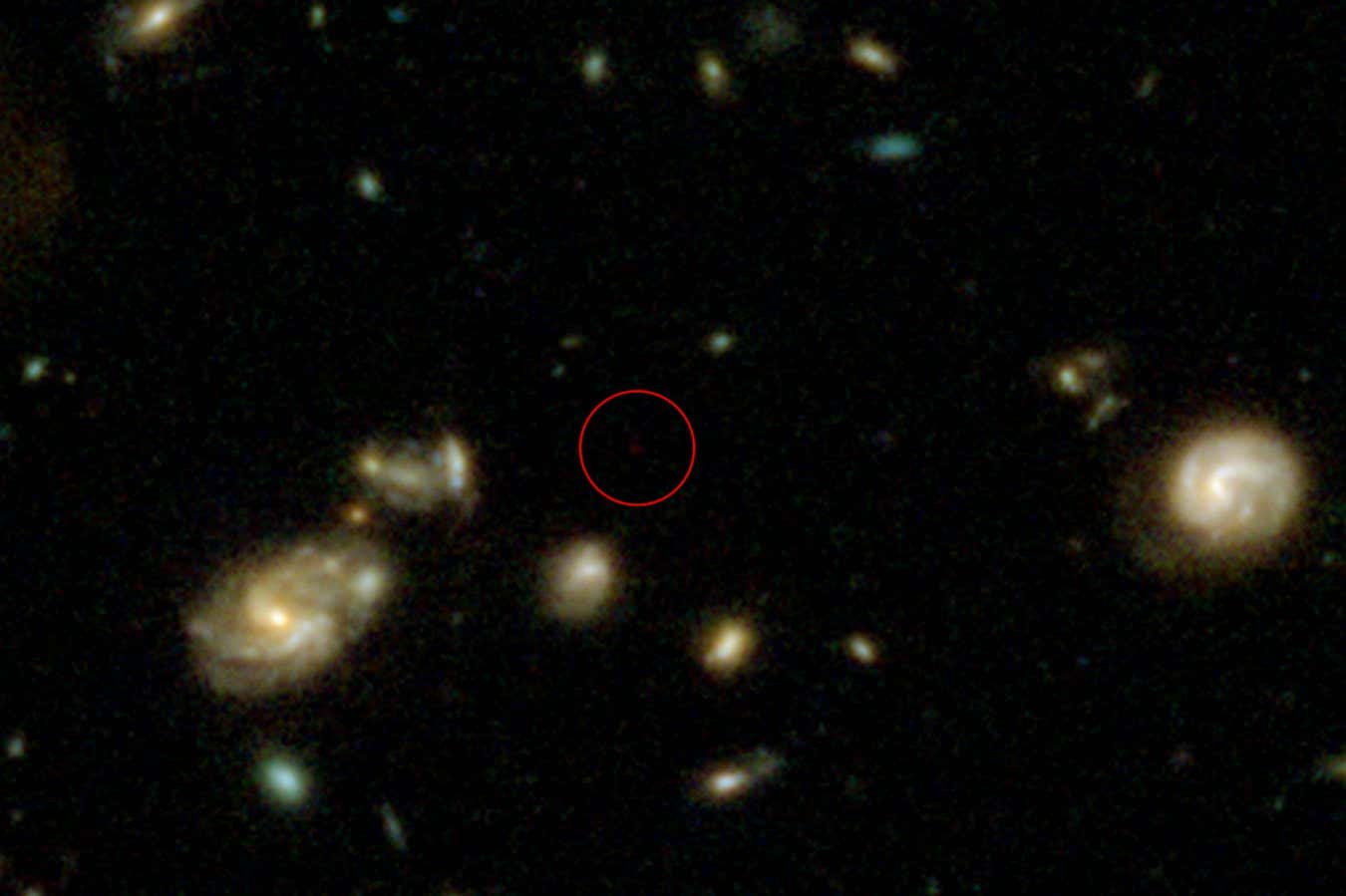
The possible galaxy in an image from the James Webb Space Telescope
NASA, ESA, CSA, CEERS, G. Gandolfi
Astronomers might have discovered a galaxy that formed extremely early in the universe, nearly 200 million years before its closest competitor, but they caution there could be other explanations too.
Giovanni Gandolfi at the University of Padua in Italy and his colleagues probed data from the James Webb Space Telescope (JWST) to look for distant objects that formed early in our universe’s 13.8-billion-year history.
The further away a galaxy is from Earth, the longer its light will have taken to reach us and the more it will be shifted to the red end of the spectrum by the expansion of space, a property known as redshift.
To date, the earliest confirmed galaxy – which was spotted by JWST and is called MoM-z14 – has a redshift of 14.4, meaning the light now reaching us from it began travelling towards us when the universe was 280 million years old. Gandolfi and his team, however, have reported an astonishing object with a redshift of 32, implying that we are viewing it as it was when the universe was just 90 million years old. They named it Capotauro, after a mountain in Italy.
“Capotauro could be the farthest galaxy ever seen,” says Gandolfi, at a “timescale that is compatible with the first stars and black holes to form in the universe”.
The team arrived at this conclusion by noticing a small blip in a deep JWST survey of the sky that appeared to be a distant galaxy. Using different filters on the telescope, the team could then calculate how much light from the galaxy would have been redshifted, arriving at a figure of 32.
If correct, the object might be an extremely young galaxy in the process of formation, or something more unusual like a primordial black hole surrounded by a dense atmosphere – a hypothesised object known as a black hole star.
However, the supposed galaxy appears unusually bright, similar to galaxies seen at later redshifts like MoM-z14, giving it a suspected mass of around a billion times that of the sun – beyond what our models suggest should be possible at this age of the universe.
To achieve such a mass, the efficiency at which the galaxy turned gas into stars would have to be close to 100 per cent, says Nicha Leethochawalit at the National Astronomical Research Institute of Thailand: “It means no stars can explode.” But modelling suggests no more than 10 to 20 per cent is possible. “I think there’s something wrong,” she says.
If it isn’t a galaxy, Gandolfi and his team say the object could instead be explained by a brown dwarf – a failed star – or a rogue planet in our galaxy drifting through JWST’s field of view, appearing similar to the distant blob of a galaxy. Both those explanations are interesting too, says Gandolfi, because it would be a particularly remote and cold brown dwarf or planet, up to 6000 light years away and at room temperature.
“It could be one of the first substellar objects ever formed in our galaxy,” says Gandolfi.
To find out for certain, the team would need follow-up time on JWST to pick apart the object’s light in finer detail. Leethochawalit says that while she favours the explanation that this isn’t a galaxy, such a follow-up might still be worth doing.
“If it’s a galaxy with a redshift of 32, many things that we have thought so far would be wrong,” she says.
Experience the astronomical highlights of Chile. Visit some of the world’s most technologically advanced observatories and stargaze beneath some of the clearest skies on earth. Topics:
The world capital of astronomy: Chile
