
Close Menu
    National News Brief
    Friday, September 4
    • Home
    • Business
    • Lifestyle
    • Science
    • Technology
    • International
    • Arts & Entertainment
    • Sports
    National News Brief
    Home » Possible galaxy spotted by JWST could be the earliest we’ve ever seen

    Possible galaxy spotted by JWST could be the earliest we’ve ever seen

    Team_NationalNewsBriefBy Team_NationalNewsBriefSeptember 5, 2025 Science No Comments4 Mins Read
    Share
    Facebook Twitter LinkedIn Pinterest Email


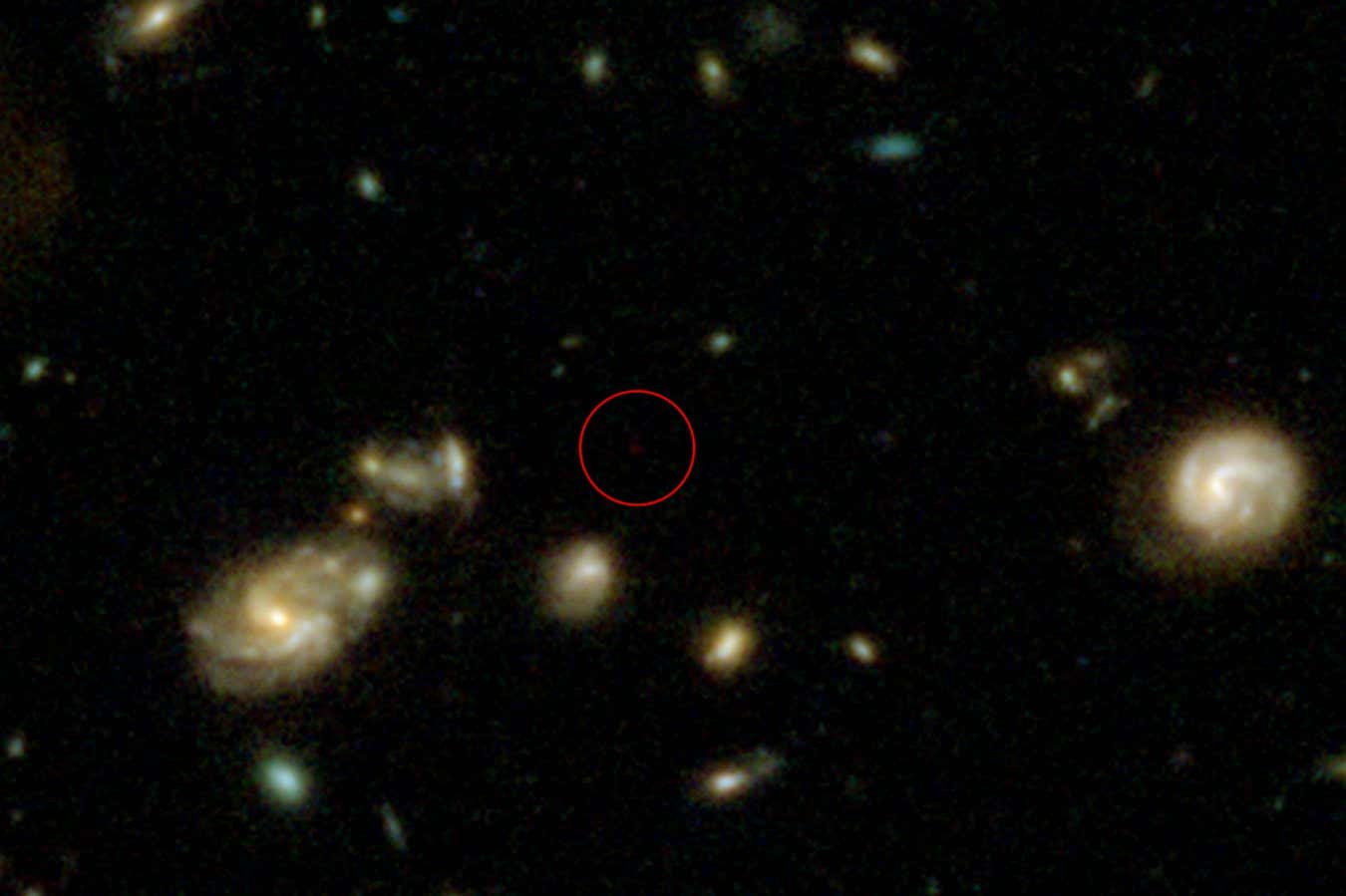
    The possible galaxy in an image from the James Webb Space Telescope

    NASA, ESA, CSA, CEERS, G. Gandolfi

    Astronomers might have discovered a galaxy that formed extremely early in the universe, nearly 200 million years before its closest competitor, but they caution there could be other explanations too.

    Giovanni Gandolfi at the University of Padua in Italy and his colleagues probed data from the James Webb Space Telescope (JWST) to look for distant objects that formed early in our universe’s 13.8-billion-year history.

    The further away a galaxy is from Earth, the longer its light will have taken to reach us and the more it will be shifted to the red end of the spectrum by the expansion of space, a property known as redshift.

    To date, the earliest confirmed galaxy – which was spotted by JWST and is called MoM-z14 – has a redshift of 14.4, meaning the light now reaching us from it began travelling towards us when the universe was 280 million years old. Gandolfi and his team, however, have reported an astonishing object with a redshift of 32, implying that we are viewing it as it was when the universe was just 90 million years old. They named it Capotauro, after a mountain in Italy.

    “Capotauro could be the farthest galaxy ever seen,” says Gandolfi, at a “timescale that is compatible with the first stars and black holes to form in the universe”.

    The team arrived at this conclusion by noticing a small blip in a deep JWST survey of the sky that appeared to be a distant galaxy. Using different filters on the telescope, the team could then calculate how much light from the galaxy would have been redshifted, arriving at a figure of 32.

    If correct, the object might be an extremely young galaxy in the process of formation, or something more unusual like a primordial black hole surrounded by a dense atmosphere – a hypothesised object known as a black hole star.

    However, the supposed galaxy appears unusually bright, similar to galaxies seen at later redshifts like MoM-z14, giving it a suspected mass of around a billion times that of the sun – beyond what our models suggest should be possible at this age of the universe.

    To achieve such a mass, the efficiency at which the galaxy turned gas into stars would have to be close to 100 per cent, says Nicha Leethochawalit at the National Astronomical Research Institute of Thailand: “It means no stars can explode.” But modelling suggests no more than 10 to 20 per cent is possible. “I think there’s something wrong,” she says.

    If it isn’t a galaxy, Gandolfi and his team say the object could instead be explained by a brown dwarf – a failed star – or a rogue planet in our galaxy drifting through JWST’s field of view, appearing similar to the distant blob of a galaxy. Both those explanations are interesting too, says Gandolfi, because it would be a particularly remote and cold brown dwarf or planet, up to 6000 light years away and at room temperature.

    “It could be one of the first substellar objects ever formed in our galaxy,” says Gandolfi.

    To find out for certain, the team would need follow-up time on JWST to pick apart the object’s light in finer detail. Leethochawalit says that while she favours the explanation that this isn’t a galaxy, such a follow-up might still be worth doing.

    “If it’s a galaxy with a redshift of 32, many things that we have thought so far would be wrong,” she says.

    New Scientist. Science news and long reads from expert journalists, covering developments in science, technology, health and the environment on the website and the magazine.

    The world capital of astronomy: Chile

    Experience the astronomical highlights of Chile. Visit some of the world’s most technologically advanced observatories and stargaze beneath some of the clearest skies on earth.

    Topics:


    Source link

    Team_NationalNewsBrief
    • Website

    Keep Reading

    GLP-1 weight-loss medication could slow aging and extend lifespan

    The spacecraft BepiColombo is finally nearing Mercury after 8 years in space

    ‘Unparalleled’ study finds psilocybin protects against nerve damage from chemotherapy

    An endangered pygmy raccoon turned trash into toys—and taught her family how, too

    Scientists discover a mysterious wave shaped like a decagon in Saturn’s atmosphere

    How the super El Niño could turbocharge warming in the Himalayas

    Add A Comment

    Comments are closed.

    Editors Picks

    The first brown dwarf ever found was the strangest – now we know why

    October 20, 2024

    JD Vance puts Europe, China on notice at AI summit

    February 11, 2025

    International travelers are dramatically reducing their cross-border visits to the U.S. Here’s why.

    April 18, 2025

    ‘Grim Reaper’ Hospital Prank Ends In Jail

    August 6, 2026

    Portuguese Conservatives Turn On Nationalist Candidate

    February 4, 2026
    Categories
    • Arts & Entertainment
    • Business
    • International
    • Latest News
    • Lifestyle
    • Opinions
    • Politics
    • Science
    • Sports
    • Technology
    • Top Stories
    • Trending News
    • World Economy
    About us

    Welcome to National News Brief, your one-stop destination for staying informed on the latest developments from around the globe. Our mission is to provide readers with up-to-the-minute coverage across a wide range of topics, ensuring you never miss out on the stories that matter most.

    At National News Brief, we cover World News, delivering accurate and insightful reports on global events and issues shaping the future. Our Tech News section keeps you informed about cutting-edge technologies, trends in AI, and innovations transforming industries. Stay ahead of the curve with updates on the World Economy, including financial markets, economic policies, and international trade.

    Editors Picks

    Indian farmers struggle to meet the demand for avocados

    September 4, 2026

    The Ukraine Money Pit — Estonia’s €70 Million Scandal

    September 4, 2026

    Priyanka Chopra Dominates Trending Sounds With Love and Confidence

    September 4, 2026

    Jennifer Lawrence Finally Comes Clean About Cosmetic Work

    September 4, 2026
    Categories
    • Arts & Entertainment
    • Business
    • International
    • Latest News
    • Lifestyle
    • Opinions
    • Politics
    • Science
    • Sports
    • Technology
    • Top Stories
    • Trending News
    • World Economy
    • Privacy Policy
    • Disclaimer
    • Terms and Conditions
    • About us
    • Contact us
    Copyright © 2024 Nationalnewsbrief.com All Rights Reserved.

    Type above and press Enter to search. Press Esc to cancel.