

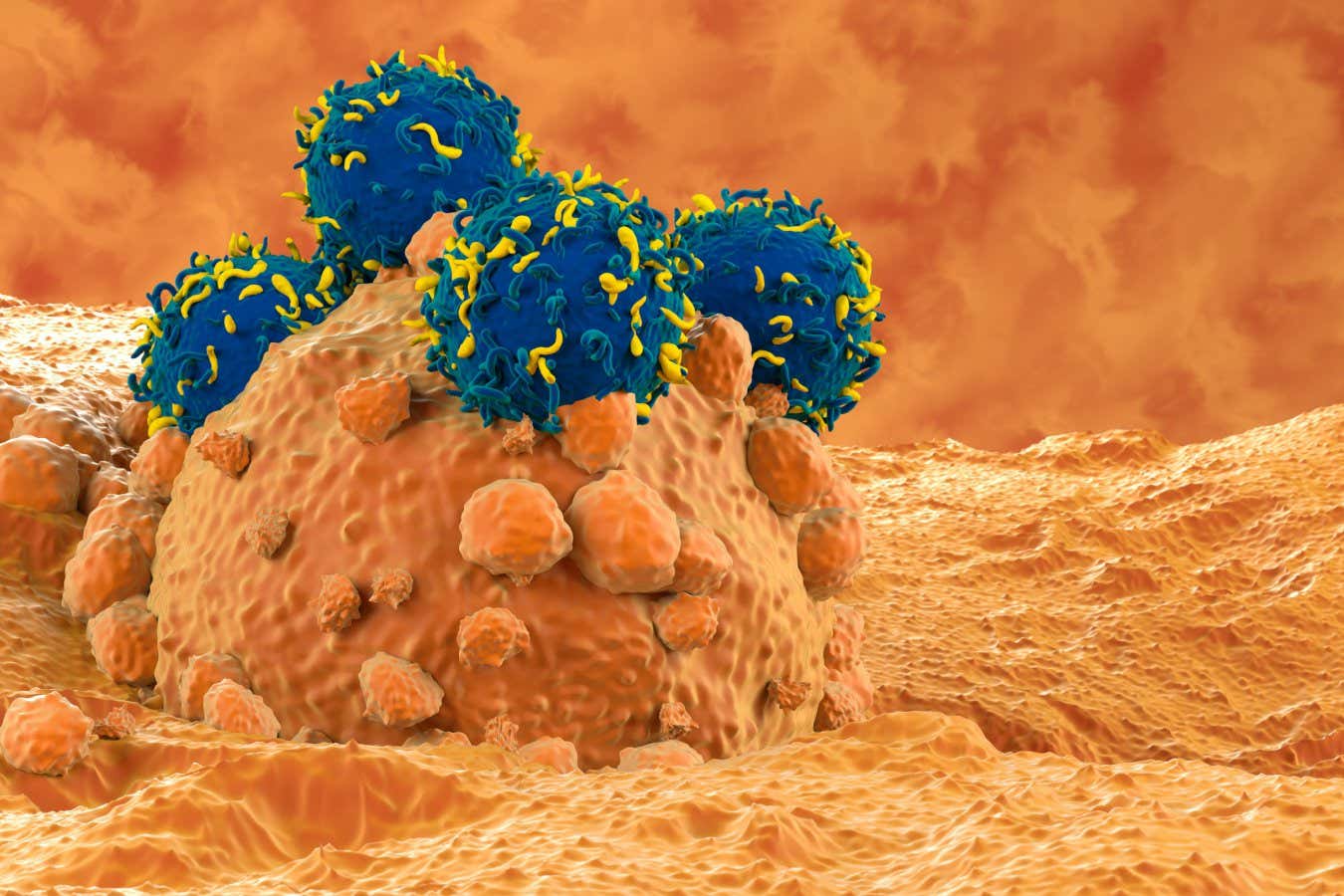
An illustration of CAR T-cell therapy treating melanoma, a form of skin cancer
Nemes Laszlo/Shutterstock
A therapy that has revolutionised how we treat blood and skin cancers could become even more effective. Making cancer cells stiffer bolstered the effects of immunotherapy, when the immune system is manipulated to kill off tumours, in mice with the most serious form of skin cancer. The impressive results have scientists optimistic that a similar approach could improve survival rates in people being treated with immunotherapies like CAR T-cell therapy.
“It’s a completely new concept,” says Yi Sui at Queen Mary University of London, who wasn’t involved in the research. “It’s really tackling a medical problem from a physical point of view. I think it’s highly promising.”
Cancer cells are often softer than healthy cells. This could be a problem, because T-cells – a part of the immune system with cancer-killing potential – can sense the stiffness of their surroundings.
“We were very curious about whether the softness of cancer cells may help them evade the immune system, and how T-cells’ mechanical sensing may influence their response to cancer,” says Li Tang at the Swiss Federal Technology Institute of Lausanne in Switzerland, who presented the research on 11 May at the Biophysical immunoengineering: from insight to clinical application conference in London.
To explore this, the researchers first tried to uncover why cancer cells are softer by comparing their membranes, or outer surfaces, against those of healthy ones. This revealed that cancer cells, whether from mice or people, tend to be softer because their membranes contain more cholesterol.
Next, the team grew tumours in 24 mice by injecting melanoma cells, the deadliest form of skin cancer, near one of their thighs. Nine days later, the mice received an infusion of T-cells that had been genetically engineered to recognise the tumours, mimicking a form of immunotherapy called CAR T-cell therapy, which is approved for treating cancers such as acute lymphoblastic leukaemia and B-cell lymphoma.
The mice also received three infusions of IL-15, a protein that boosts the cancer-killing ability of tumour-specific T-cells, over five days.
Crucially, only half of the mice had a third treatment, where methyl β-cyclodextrin (meβCD), a compound that reduces cholesterol levels in cell membranes, was injected directly into the tumours. This was done daily from days 9 to 18 after the cancer cells were injected. The remaining mice received saline injections.
About a month later, all of the 12 mice that didn’t receive meβCD had died due to rapidly growing tumours. In contrast, only seven mice in the meβCD group had died, while five saw their tumours completely disappear. “The numbers are great; it’s quite impressive,” says Lance Kam at Columbia University in New York.
Further analysis suggests that by stiffening cancer cells, meβCD helped tumour-specific T-cells latch onto tumour cells more strongly. The T-cells then delivered toxic molecules, such as perforin, which destroys cancerous cells by puncturing holes in them, to their targets more efficiently, says Tang.
The team hopes to test the approach against a wider range of tumour types in mice, says Tang. “Then the big challenge is always going to be getting it into people,” says Kam. Very few drugs that successfully target immune proteins in mice work well in people, which is partly due to differences in their immune systems, he says. But he adds that drugs that alter the stiffness of cancer cells may stand a better chance, as cancer cells tend to be softer in both humans and mice.
The researchers are also working to develop drugs that have a similar effect to meβCD that can be delivered in a single injection.
Topics:
