

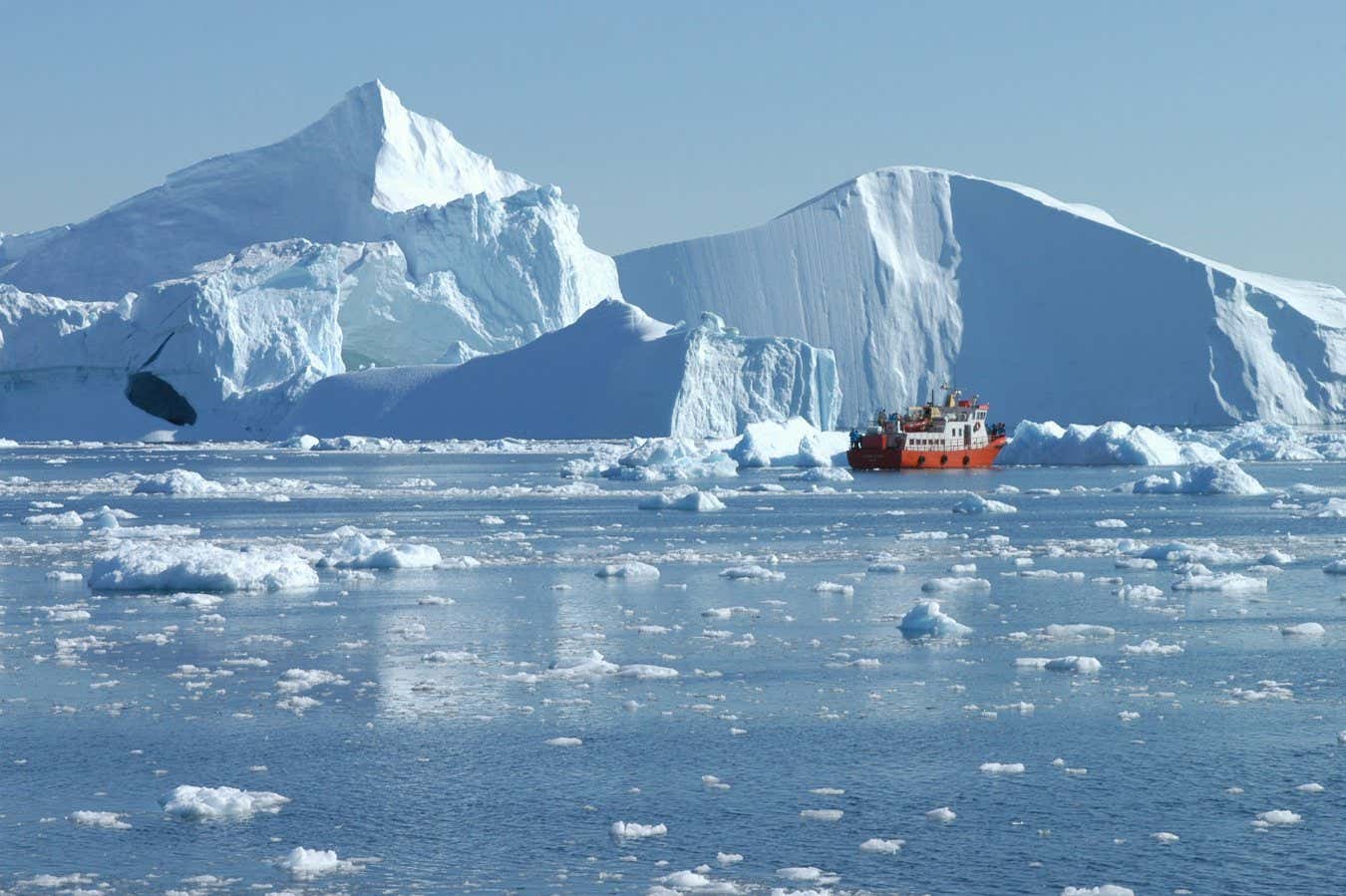
Melting glaciers, like the one in Ilulissat Icefjord, could release vast stores of methane
Gerald Wetzel, Karlsruhe Institute of Technology, Germany
Meltwater flushed frozen methane hydrates out of the sediment at the edge of the Greenland ice sheet after the last glacial maximum, which occurred 29,000 to 19,000 years ago, raising fears that melting glaciers could soon release huge amounts of this planet-warming gas.
Methane hydrates form when gas molecules are trapped in a cage of water molecules, freezing into an ice-like substance. They are sometimes called “fire ice” because they can burn despite being 85 per cent water.
They form under the high pressure and low temperature found in sediments beneath the ocean, permafrost or glaciers. Some estimates suggest methane hydrates contain twice as much carbon as all coal, oil and conventional gas on Earth.
But global warming is disrupting some of the cold, pressurised conditions in which methane hydrates exist. For example, some scientists think a mysterious 50-metre-deep crater discovered in the Russian Arctic in 2014 was caused when permafrost thaw suddenly relieved the pressure on a methane hydrate. This would have released it in a “violent physical explosion”, wrote the authors of a 2024 study.
Now, researchers have found that flows of glacial meltwater in Greenland can also unleash methane hydrates. “We found a new way of releasing methane that we thought was in the bank,” says Mads Huuse at the University of Manchester, UK, who led the research. “It is methane we thought was stable.”
Huuse and his colleagues knew methane hydrates were common in the spaces between grains of sediment at the bottom of Melville Bay in north-western Greenland. In seismic surveys done by oil and gas companies in 2011 and 2013, they noticed 50 large pockmarks in the seafloor, each up to 37 metres deep, clustered near a long berm of earth called a grounding zone wedge. During the last glacial maximum, this wedge was where the floating tongue of the ice sheet met the ocean bottom.
The researchers initially thought the pockmarks had been scoured by overturning icebergs. But when they drilled sediment cores in the area, they found the top layers of sediment were mostly free of methane, even though the temperature and pressure were perfect for methane hydrates.
They also found large volumes of fresh water in the sediments, rather than the seawater they expected. This could only have come from ice sheet melt. The team thinks that during the last glacial maximum, meltwater flowing under the glaciers in Melville Bay was forced through the grounding zone wedge, flushing out the methane hydrates.
In the future, meltwater could wash out hydrates at the edges of other glaciers as they retreat under climate change, says Huuse. Similar grounding zone wedges exist across the Arctic.
“In the not-so-distant past – could be 12,000, could be 15,000 years ago – a large amount of methane was released, and that same thing could happen tomorrow or in the next century, basically, of receding ice sheets,” he says. “And that’s bad news, because it’s not something we’d considered before.”
The research didn’t include an estimate of how much methane was released in Melville Bay, but Huuse figures it could have been on the order of 130 million tonnes. That’s the equivalent of about two years of fossil fuel emissions from the US, although he notes this methane could have been released over the course of a century, rather than a year or two, and it was a one-time emission.
In addition, the methane would have been dissolved in seawater and, depending on the saturation, it may not all have been emitted to the atmosphere, he says.
The Antarctic ice sheet probably sits on top of even more methane hydrates than Greenland. The polar regions as a whole are estimated to hold anywhere between 100 billion to 760 billion tonnes of methane in subglacial and marine hydrates. The release of even a fraction of that could rival the 48.7 million tonnes of methane currently released by the Arctic and boreal biomes each year – mostly from wetlands, lakes and streams – and speed up climate change.
Methane is already being unlocked from under the Greenland ice sheet. A study published this month found meltwater streams across western Greenland are emitting an estimated 715 tonnes of methane per year. While some of this could be coming from hydrates, it is more likely to come from ancient plant carbon converted to methane gas by bacteria under the ice, says Jade Hatton at the UK Centre for Ecology and Hydrology, who led the study. This will probably increase.
“If you’re getting enhanced melt, you’re potentially tapping into areas of subglacial system that… have got well-preserved organic carbon stocks that then have the potential to be converted into methane,” she says. “There is the potential of relatively large future release.”
Topics:
