

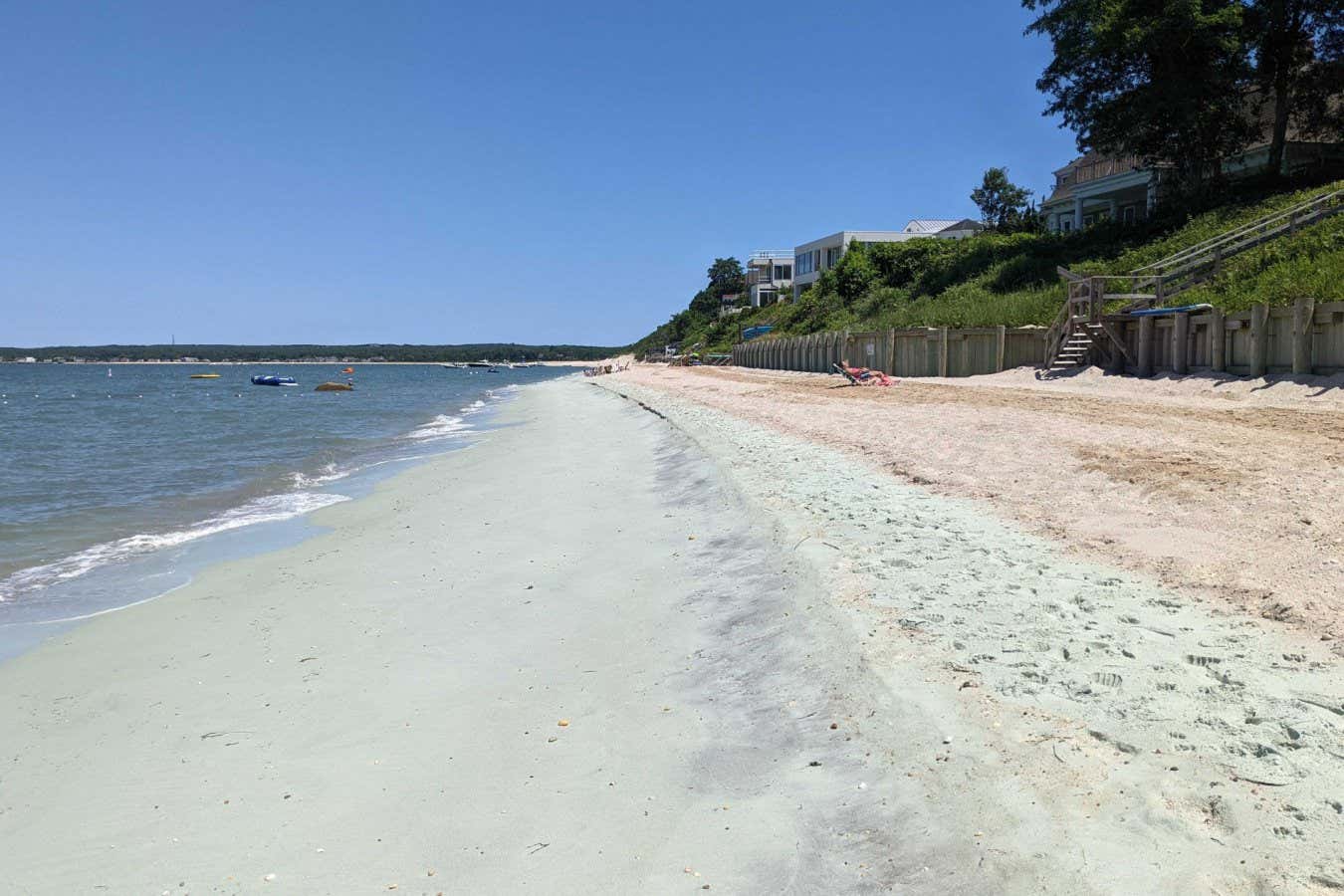
A beach in Southampton, New York, treated with olivine sand
Chayenne Moreau
The first trial to absorb atmospheric carbon dioxide by adding crushed olivine to the ocean had no adverse effects on the seafloor ecosystem in its first year.
While the results of the trial in New York state are promising for this carbon-removal technique, researcherss warn they may not have captured all potential negative impacts.
The addition of olivine to the ocean should still be carefully regulated, “but there might be ways that it could work and have a minimal effect”, says Emilia Jankowska at the non-profit group Hourglass Climate, who led the study.
The United Nations climate body has said the world will need carbon removal methods, which range from planting trees to filtering out CO2 from the air with giant machines, to reach net-zero greenhouse gas emissions. As emissions continue to rise and the goal of limiting global warming to 1.5°C above preindustrial levels slips out of reach, many hope these technologies could someday help cool the planet back down.
Olivine, or magnesium iron silicate, is a greenish mineral common in Earth’s mantle. Once it comes to the surface, it tends to react with the CO2 dissolved in rainwater to form metals, silicates and bicarbonate, a stable compound that eventually flows into the ocean, locking CO2 away for thousands of years.
Spreading crushed olivine and other silicates on farm fields could speed up this process and remove up to 1.1 billion tonnes of CO2 annually, recent research found. But US start-up Vesta plans to add olivine directly to the ocean, where it would turn dissolved CO2 into bicarbonate and allow the ocean to absorb more CO2 from the atmosphere.
Olivine typically contains trace amounts of heavy metals, however, and lab studies have found elevated levels of nickel and chromium in crustaceans and molluscs exposed to it. Researchers have also been concerned that the sand could smother bottom-dwellers like crustaceans, molluscs, snails and worms.
In 2022, Vesta deposited 650 tonnes of olivine sand along a beach in Long Island, New York state, on top of 13,500 tonnes of regular sand added to bolster the shore, which is being swept away as storms intensify. The tide and waves carried the olivine out to sea.
Researchers scooped up sediment from the shallows out to 160 metres offshore before and after the olivine addition and again a year later. They compared this to sediments near sections of the beach where only normal sand was added and where no sand was added.
Of dozens of species, only a tiny worm called the fringed blood worm significantly declined in the olivine area, and the overall abundance and diversity of bottom-dwelling species recovered within two months. While the species composition changed, it also changed in the area where only normal sand was added, which suggests the common practice of beach nourishment was to blame.
Most importantly, concentrations of nickel, chromium cobalt and manganese in the organisms remained low. “The natural system is just so dynamic that any dissolving constituents are very rapidly diluted,” says Jankowska.
Vesta conducted the environmental monitoring of the field trial, and Jankowska and the founder of Hourglass formerly worked for the company. But Hourglass received philanthropic funding from the Grantham Foundation to independently analyse the monitoring data.
Dissolving olivine in the ocean can encourage the calcium carbonate to precipitate out of seawater, locking away the trace metals, according to Christopher Pearce at the National Oceanography Centre in the UK. That can also cut down on how much additional CO2 the seawater can absorb, however.
“It’s a really critical study to move from lab-based understanding to real-world interactions,” he says. “Further trials… will be important for understanding different biological responses… and different rates of [CO2] uptake.”
But the study’s claim of no adverse effects is “stronger than what the evidence shows”, says James Kerry at the non-profit group OceanCare. Fluctuations of olivine concentrations due to what the study called “burial–re-exposure cycles” meant the olivine might have been buried much of the time under the far larger quantity of normal sand deposited, he says.
“The lack of accumulation that’s apparent may reflect limited exposure, not necessarily that the material is intrinsically safe,” he says.
Hourglass Climate is now monitoring the impacts of a larger trial in which Vesta sank 8200 tonnes of olivine 450 metres off the coast of Duck, North Carolina, in 2024. Preliminary results suggest species abundance and diversity recovered, while Hourglass is still analysing metal accumulation, according to Jankowska.
Topics:
