

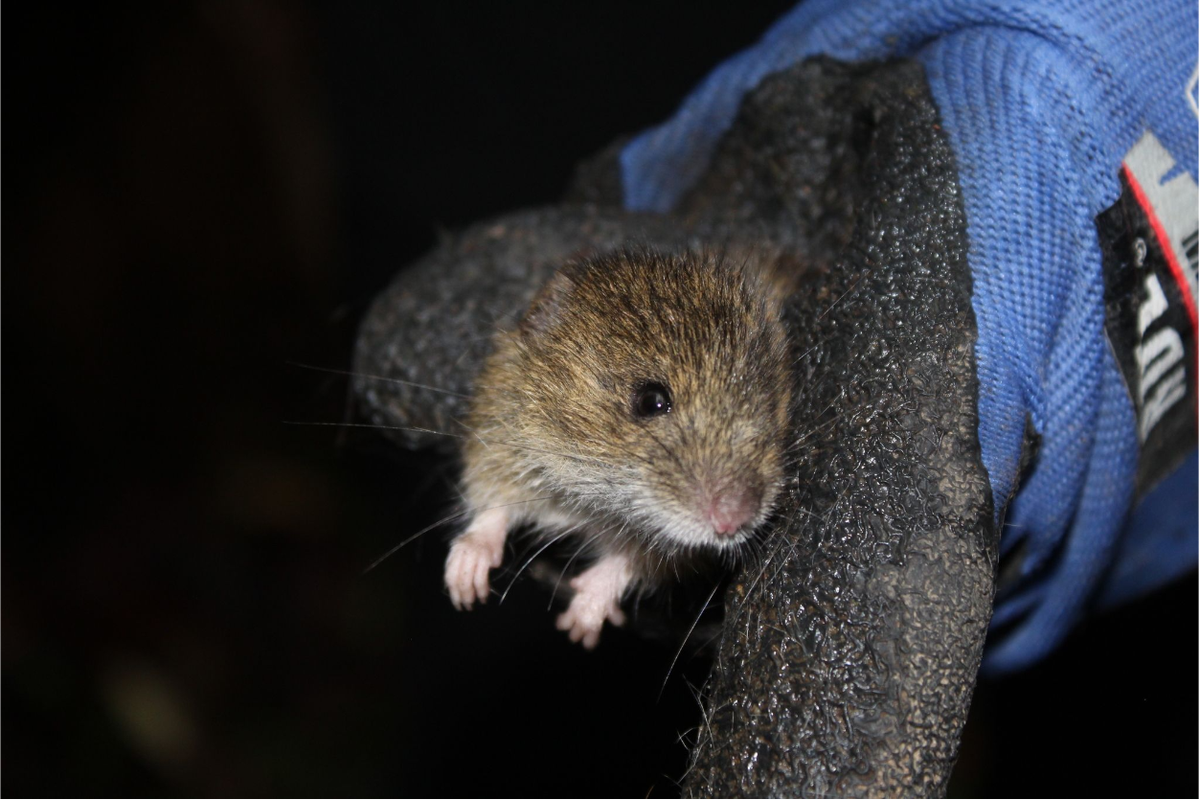
Andes virus, a type of hantavirus, has sparked global concern in recent weeks after causing the death of three passengers and sickening at least eight others aboard the MV Hondius, a cruise ship traveling from Argentina across the Atlantic. It’s still unclear how, or where, the outbreak started. But some health officials are pointing the finger at a tiny South American rodent: the long-tailed pygmy rice rat, a common host of Andes virus.
By one estimate, nearly 10 percent of long-tailed pygmy rice rats in some areas carry the pathogen. Andes virus largely spreads to humans who breathe in viral particles found in rodents’ feces, urine, and saliva, and is the only hantavirus known to transmit between people.
Although U.S. officials stress that the risk to the public is low at this time, the Andes virus has raised alarms in part because of its high fatality rate: Hantavirus pulmonary syndrome (HPS), a disease caused by hantaviruses, can be fatal in as high as 50 percent of cases, according to the World Health Organization (WHO).
On supporting science journalism
If you’re enjoying this article, consider supporting our award-winning journalism by subscribing. By purchasing a subscription you are helping to ensure the future of impactful stories about the discoveries and ideas shaping our world today.
To help narrow down the exact origin point of this particular outbreak, officials are planning to analyze hantavirus genome sequences found in rodents in South America to understand how the virus is circulating—that will also help to prevent “spillover” in the future, epidemiologist Maria Van Kerkhove said at a WHO press conference on Friday. Officials suspect that the first known infected individuals of the current outbreak—a Dutch couple on the cruise who died in April after falling ill—may have been exposed to Andes virus in areas where the rat lives in South America.
Experts who study hantaviruses say the episode highlights how little we know about these pathogens’ circulation in the wild—and why more research is necessary to head off an outbreak before it begins. “Most of the studies that you’re going to see in the literature are reactive. Once there is an outbreak, people try to study what’s going on,” says Luis Escobar, an associate professor in the Department of Fish and Wildlife Conservation at Virginia Tech. “We need more research on the understanding hantavirus in the wild.”
There are, however, some things scientists do know about the long-tailed pygmy rice rat, or Oligoryzomys longicaudatus. It’s much smaller than the rats you might see scurrying around the streets of, say, New York City: It’s body is often a little more than the size of a AAA battery, Escobar says, although they can be bigger. The species is also an “ecological generalist,” meaning it can thrive in both forests and grasslands, and can even live near houses in rural areas. “It shows tolerance to different habitats,” he says.
While the rodent appears to be the Andes virus’ primary “reservoir”—that means it’s most prevalent in this species—other rodents in South America can pick it up, too. In a 2018 study, for instance, Escobar and colleagues identified other rodent species in Chile and Argentina that can carry Andes hantavirus and may pose a risk to humans, including the southern big-eared mouse, the long-haired grass mouse, and olive grass mouse. It’s unclear why the long-tailed pygmy rice rat is such a good host; researchers aren’t sure whether that has to do with the rats’ behavior, biology, or something else, he says.
The relationship between the virus and host is a “a co-evolutionary process,” says Fernando Torres Perez, a professor at the Institute of Biology, at the Pontifical Catholic University of Valparaíso, in Chile. “The virus has been in the host population for a while”—probably thousands of years, he says, and doesn’t seem to sicken the rats. (Interestingly, hamsters infected with Andes virus can develop a version of hantavirus pulmonary syndrome.)
That evolution is also ongoing: As climate change warms the planet—and humans further encroach on wild places—researchers worry it could lead to more human-rodent overlap, such as in higher elevations or in areas that may get greater rainfall. In South America, for example, periods of high rainfall can create “booms” in rodent populations known as “ratadas” that have been linked to hantavirus outbreaks, Torres Perez says.
“We know that [climate change] is going to impact rodent populations,” Torres Perez says. “One of those impacts may be getting closer to populations and increasing the contact with humans.”
Which is all the more reason to track and study rodent-virus dynamics now, Escobar argues. “If we only conduct research after outbreaks occur, we fail to capture that baseline telling us how the virus was in the wild.”
“That’s why we need this baseline—to understand [the] ingredients needed for these spillover events to happen in the first place.”
It’s Time to Stand Up for Science
If you enjoyed this article, I’d like to ask for your support. Scientific American has served as an advocate for science and industry for 180 years, and right now may be the most critical moment in that two-century history.
I’ve been a Scientific American subscriber since I was 12 years old, and it helped shape the way I look at the world. SciAm always educates and delights me, and inspires a sense of awe for our vast, beautiful universe. I hope it does that for you, too.
If you subscribe to Scientific American, you help ensure that our coverage is centered on meaningful research and discovery; that we have the resources to report on the decisions that threaten labs across the U.S.; and that we support both budding and working scientists at a time when the value of science itself too often goes unrecognized.
In return, you get essential news, captivating podcasts, brilliant infographics, can’t-miss newsletters, must-watch videos, challenging games, and the science world’s best writing and reporting. You can even gift someone a subscription.
There has never been a more important time for us to stand up and show why science matters. I hope you’ll support us in that mission.
