

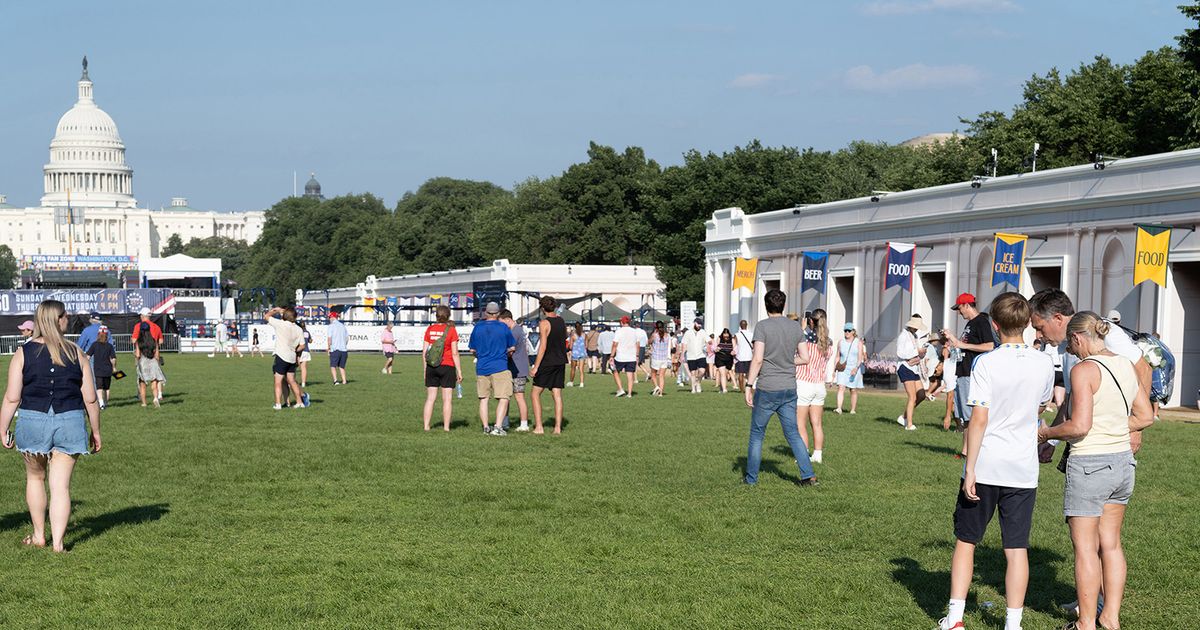
Our 250th birthday party seemed to me as divisive, troubled and angst-ridden as America itself.
The evacuation of crowds from the Washington Mall because of extreme weather captured the moment: President Donald Trump tries to defy and deny natural forces of climate change even as they shape our lives. Under Trump, America is doubling down on fossil fuels and allowing China to dominate green energy technologies that will be central to the 21st-century economy. Myopia squared and not a good omen.
In that sense, our unsettled birthday makes me ponder the fates of some places I’ve visited over the years.
Kaifeng is today a sleepy Chinese city on the Yellow River, but a millennium ago it was probably the most important place in the world. It was then China’s capital and was crowded with a population of about 1 million. (London’s population was then about 15,000.)
Other contenders for global leadership in the year 1000 were the Byzantine Empire based in Constantinople, the Abbasid caliphate based in Baghdad and the Ghaznavid Empire in West Asia, headquartered in what is now Ghazni, Afghanistan. None were able to adapt and preserve themselves.
So I wonder: Can the United States hold on? Will the United States still be vibrant on our 500th birthday? Or will we go the way of Byzantium and the Abbasids?
Our vulnerabilities are obvious, with two-thirds of Americans saying we’re “pretty seriously off on the wrong track.”
I worry in particular that we are undermining the tripartite approach that has made the United States dominant, starting with heavy investments in human capital such as education. The United States was a world leader in mass education in the 19th and 20th centuries, but we now rank ninth in reading, 16th in science and 34th in math, according to the PISA global ranking of student test scores.
Human capital is also about our health and well-being, and that likewise is discouraging: The United States now ranks 61st in life expectancy globally, according to the World Bank.
A second prong of America’s growth path was the welcome we (inconsistently and imperfectly) at times offered immigrants. When my father was on a ship in New York Harbor, arriving as a refugee in 1952, a Boston woman next to him on the deck welcomed him as a “young American.” He was awed that he — a refugee who couldn’t even speak English — was being hailed as an American before he even set foot on American soil.
For now, that welcome mat has mostly been removed (except perhaps for white “refugees” from South Africa). The number of foreign graduate students studying at American universities last fall fell 12% from the year before, and further declines are expected.
The third element of America’s growth formula — a reliance on free markets — remains largely intact, at least by international standards. But inequality appears to have soared since 1980, and there’s evidence that while some inequality is necessary for growth, too much dampens it. The dollar remains overwhelmingly the world’s currency but has weakened, and its supremacy is being challenged at the edges.
And it’s more than that.
“What do we mean by the Revolution?” John Adams asked in an 1815 letter to Thomas Jefferson. He answered his own question, saying that the revolution was not a war but rather something that unfolded “in the minds of the people.”
Yes! True, our animating ideas — of equality, of opportunity, of openness to immigration — were in part rhetorical flourishes, for they don’t explain Jim Crow, the Chinese Exclusion Acts or tight curbs on Jewish immigration. But these ideas were aspirational, and over the centuries they inspired real progress. Now I fear we’ve retreated even from the aspirations.
As I see it, we’ve lost two wars in the past half-dozen years — one against the Afghan Taliban and one against Iran just this year — not to mention last year losing a trade war with China. We may be retreating from NATO and from efforts to buttress Taiwan.
Our position — divided at home and weakening abroad — is reminiscent of the decline of great powers in the past, not just the Abbasids and Ghaznavids but also Spain in 1588 and Britain in the late 19th century.
Still, for all the uncertainties about our trajectory, I think I’m a bit more optimistic than many of my fellow Americans.
Maybe that’s because my wife and I were in small-town America — Ashland, Ore., for a theater festival — on July 4. Ashland’s annual Independence Day parade was an uplifting celebration that included free American flags and Popsicles, a military flyover and parade participants calling for universal healthcare and welcoming immigrants. Far from the toxicity of Washington, D.C., it captured all the contradictions and beauty of our country.
My very guarded optimism about America’s long-run prospects is based on three factors:
First, we appear to have maintained an edge (partly by importing scientists) in technology, which since the dawn of the Industrial Revolution has been a driver of progress and global leadership. Then it was the steam engine and spinning jenny. Now it is artificial intelligence, materials science and biotechnology. And our technological sophistication pairs well with the world’s deepest financial markets, with American stocks accounting for roughly two-thirds of global stock value, compared with less than 30% in 1988.
Second, other nations have their own problems. Our principal competitor for now is China, which has enormous strengths but also is aging fast and declining in population and is led by an aging dictator.
Third, prophecies of American decline are nothing new. “My hopes of the long continuance of this Union are extinct,” John Quincy Adams wrote in 1834, during a crisis in South Carolina. In the 1980s and ’90s, when I was a foreign correspondent in Asia, it was “Japan as No. 1,” and in the 2000s experts debated in which year China’s economy would surpass America’s. Now some believe that may never happen. And the United States has not seen the collapse of population growth that many other industrial countries have. Our more youthful population, partly because of immigration, confers vitality and vigor.
So I don’t believe that our decline is inevitable. But much will depend on whether we have the wisdom to revert to our proven strategy of investing in human capital, welcoming immigrants and embracing free markets against a backdrop of some equality.
Onward to the 500th!
