

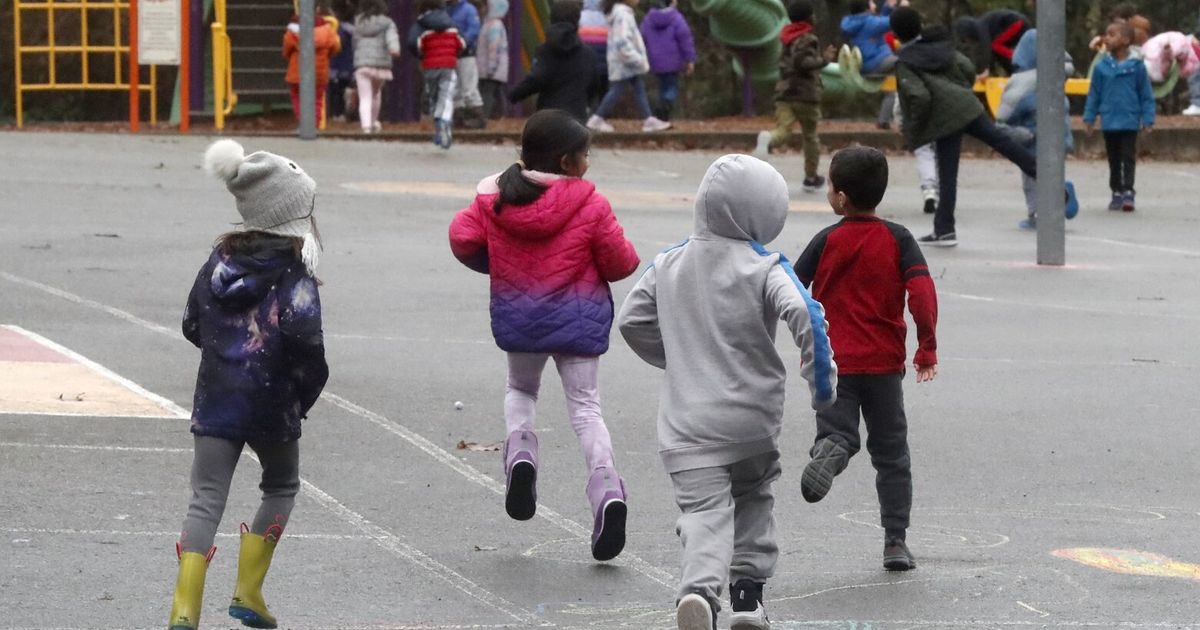
“Are you wondering why recess has just gone by in a snap of your fingers?”
That’s the question fifth graders at Seattle’s Thurgood Marshall Elementary posed in their school newspaper, The Bullpup Times, after new district scheduling requirements forced the school to shorten their daily recess.
Seattle Public Schools has tightened enforcement of instructional schedules, forcing some schools to reduce recess to 30 minutes daily — the minimum required by Washington state law.
Seattle Schools Superintendent Ben Shuldiner has defended the cuts as necessary for consistent academic instruction. But if a student submitted an argument that disregarded as much evidence as Shuldiner’s does, educators would send it back for revision.
Decades of scientific research have documented profound benefits of recess. A 2019 study of 728 elementary students found improved math scores after daily recess doubled from 15 to 30 minutes. Another study examined 405 students and found significant improvements in attention and reductions in distracted behavior when one school introduced four 15-minute recess periods.
And the benefits extend far beyond academics. As the American Academy of Pediatrics explains, unstructured play develops problem-solving, cooperation, conflict resolution, emotional self-regulation and perseverance. Its 2026 statement declares, “Recess is not a luxury — it is a developmental necessity and a child right.”
Many of the countries praised for outperforming the U.S. understand this right. Finnish children receive approximately 75 minutes of recess daily. In Japan, elementary students commonly receive a 20-minute morning recess, another 20-to-30-minute break after lunch, and additional 5–to-10-minute breaks between classes, adding up to roughly an hour or more of breaks throughout the school day. Some Danish schools provide 40 to 60 minutes or more. Just across Lake Washington, Juanita Elementary provides 55 minutes of recess on most school days — nearly twice Seattle’s minimum. And more recess clearly isn’t incompatible with academic success: In 2023, 74% of Lake Washington School District students met math proficiency standards, compared with 57% in Seattle.
In 2014, as my oldest son prepared for kindergarten, I learned recess was disappearing from Seattle schools. A KUOW investigation revealed that elementary schools offering 20 minutes or less of daily recess had skyrocketed from one to 11 in four years, disproportionately affecting children of color. A 2019 follow-up exposed stark racial disparities: Most white kindergartners received at least 45 minutes daily, while most Black kindergartners received the minimum of 30.
Rather than expanding recess for children historically denied sufficient playtime, Seattle Public Schools is demanding that schools offering more give their students less. The language of equity is being weaponized to justify taking recess away from children rather than expanding it for all.
As I wrote in 2015, pressure to raise standardized test scores was driving schools to replace recess with test preparation. At the time, I brought a resolution to my union, the Seattle Education Association, calling for expanded recess. I also helped launch Lunch and Recess Are Essential. Together, we organized petitions, packed school board meetings and rallied with our children who made signs declaring, “Let us play!”
In 2015, our union demanded 45 minutes of mandatory daily recess. It took organizing by parents, students and educators — and the threat of a strike — to win a 30-minute guarantee. Eleven years later, Seattle Public Schools is treating that compromise as a ceiling rather than a floor.
Thurgood Marshall students responded to their shortened recess by becoming investigative journalists — identifying a problem, gathering evidence and publishing their findings. If only district administrators would follow their example: Listen to students, examine the evidence and let research guide their decisions.
As beloved children’s educator Mister Rogers reminded us, “For children, play is serious learning.” Or as today’s beloved children’s educator Ms. Rachel put it, “Play has so many benefits … it helps them with their language and it literally builds the brains of little ones.” Yet Seattle Public Schools treats recess as expendable.
The right to play should not be a privilege reserved for some children. It should be a promise we make to all of them. The science is clear. The children have spoken.
It’s time for Seattle Public Schools to let the kids play.
