

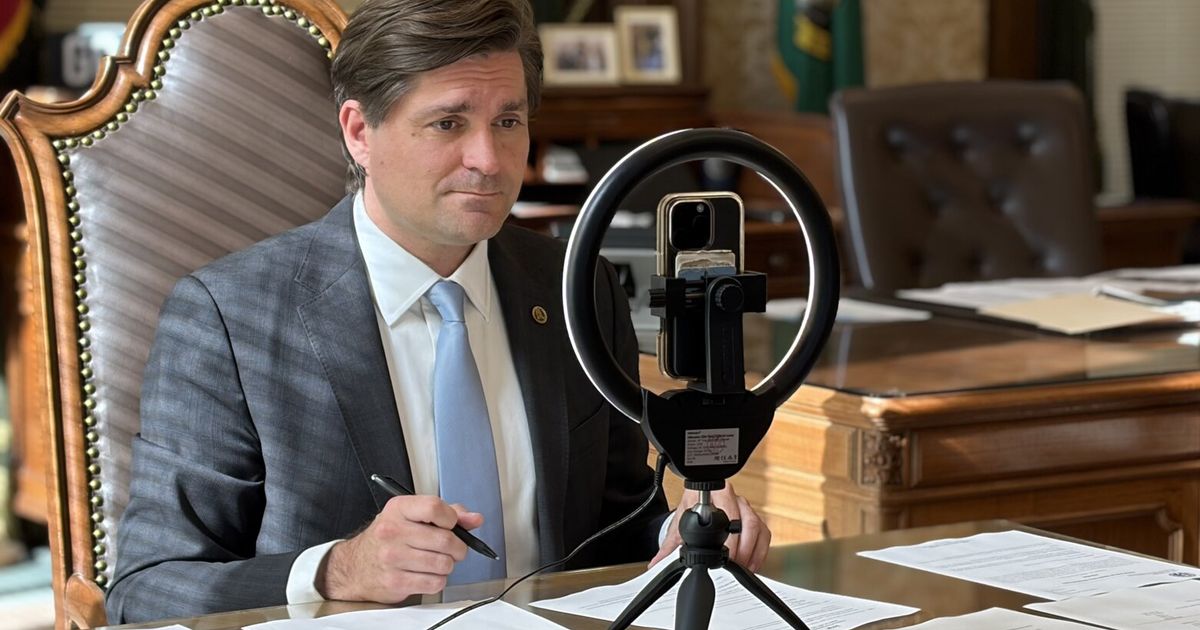
From his corner office in the state Capitol, state Treasurer Mike Pellicciotti sees two distinct paths lawmakers could soon take that will determine the course of the state’s financial health for years to come.
The first is to continue funding a budget that lacks the tax revenues to support it, drawing on dwindling reserves that endanger the state’s ability to borrow money.
The second is to end such fiscal recklessness. Replenish state reserves that now total the lowest level among any state in the U.S. Stop shuffling one-time money between government accounts to make it appear the state has more money for ongoing programs.
That choice is for Gov. Bob Ferguson and the Democrats who control the Legislature. The resulting difference is stark, Pellicciotti implores his fellow Democrats.
“We will either return to a positive economic spiral, where there is more money, more investment and better credit,” he said in an interview. “Or we will continue toward a negative economic spiral, with less money, less investment and higher borrowing costs.”
The strategy of papering over a structural fiscal imbalance — a tax revenue base that isn’t growing fast enough to satiate legislators’ spending habits — must stop. And 2027 is the precipice.
To understand why, consider the framed uncut sheet of $1 bills from the federal Bureau of Engraving and Printing near Pellicciotti’s desk. It totals $32, the weekly amount he says it used to cost to feed a young child in 2021, the year he was sworn into office.
It’s the treasurer’s visual reminder of the immense amount of money — a quarter of a trillion dollars — that flows through his office each year. For that total, you could extend the sheet of George Washingtons all the way around the world.
Then travel to the moon. And back.
And take one more trip halfway around the globe.
But these days, his office has far less margin for error with those flowing dollars. Ferguson and state lawmakers have drawn down the state’s reserves to precariously low levels. Washington state would last less than two weeks on its rainy-day fund. The average around the country is about seven weeks.
Those dwindling sums have already spooked some of the credit ratings agencies. Moody’s and Fitch have given Washington a negative outlook, a warning the state’s bond rating could be downgraded if lawmakers don’t change their ways. That means higher interest rates, which means the state’s ability to borrow money for things like critical transportation projects will cost more.
Right now, thanks to past fiscal prudence, those projects have been costing less. Since his 2020 election, Pellicciotti’s office has been able to refinance and issue new debt at interest rates so low, his office officially surpassed $1 billion in savings this past week. That’s real money, made by sound, long-term financial decisions.
But because this year, Democratic state lawmakers and the governor drew down the state’s cash balances, as well as its reserves, the treasurer’s office has less money to operate. Because property taxes are collected only twice a year, for example, the general fund has at times run at nearly $4 billion in the red until those receipts come in.
Why does that matter? First, that’s less money the treasurer’s office can invest within markets and generate a rate of return.
Second, higher state interest payments would pull more money directly out of the state’s general fund.
Finally, lawmakers must recognize that a financial cushion is critical to weather emergencies — including the Trump administration’s all-too-frequent interruptions of federal funding to Washington state.
It’s already a turbulent time in bond markets, whose yields are rising due to global inflation and rising energy prices, a gold rush for AI dollars and growing mistrust in government. This makes a solid state bond rating all the more important.
Even if the state’s new income tax on millionaires is upheld by both voters and the state’s supreme court, those new revenues won’t support the state budget until 2029. Lawmakers must exercise restraint and bring the state’s finances back into balance in the meantime.
A bipartisan group of lawmakers, including the governor’s office budget staff, is attempting to find solutions to the state’s funding imbalance. The Joint Legislative-Executive Committee on Budget Transparency and Fiscal Sustainability can make common sense recommendations for budget writers, including the idea of setting aside rainy-day funds from the yearly budget process, as a way to better keep those funds off-limits. That work should act as a springboard into a session that will be filled with hard choices.
But ultimately, some cuts will be necessary.
Lawmakers, to continue irresponsible budgeting is to turn a cold into pneumonia. Take the medicine as prescribed by Pellicciotti and the joint committee. The results, depending on the direction you choose, will be felt in every corner of Washington state.
