

In September of 2023, I wrote in these pages about using a Raspberry Pi–based seismometer—a Raspberry Shake—to record earthquakes. But as time went by, I found the results disappointing. In retrospect, I realize that my creation was struggling to overcome a fundamental hurdle.
I live on the tectonically stable U.S. East Coast, so the only earthquakes I could hope to detect would be ones taking place far away. Unfortunately, the signals from distant quakes have relatively low vibrational frequencies, and the compact geophone sensor in a Raspberry Shake is meant for higher frequencies.
I had initially considered other sorts of DIY seismometers, and I was put off by how large and ungainly they were. But my disappointment with the Raspberry Shake drove me to construct a seismometer that represents a good compromise: It’s not so large (about 60 centimeters across), and its resonant frequency (about 0.2 Hertz) is low enough to make it better at sensing distant earthquakes.
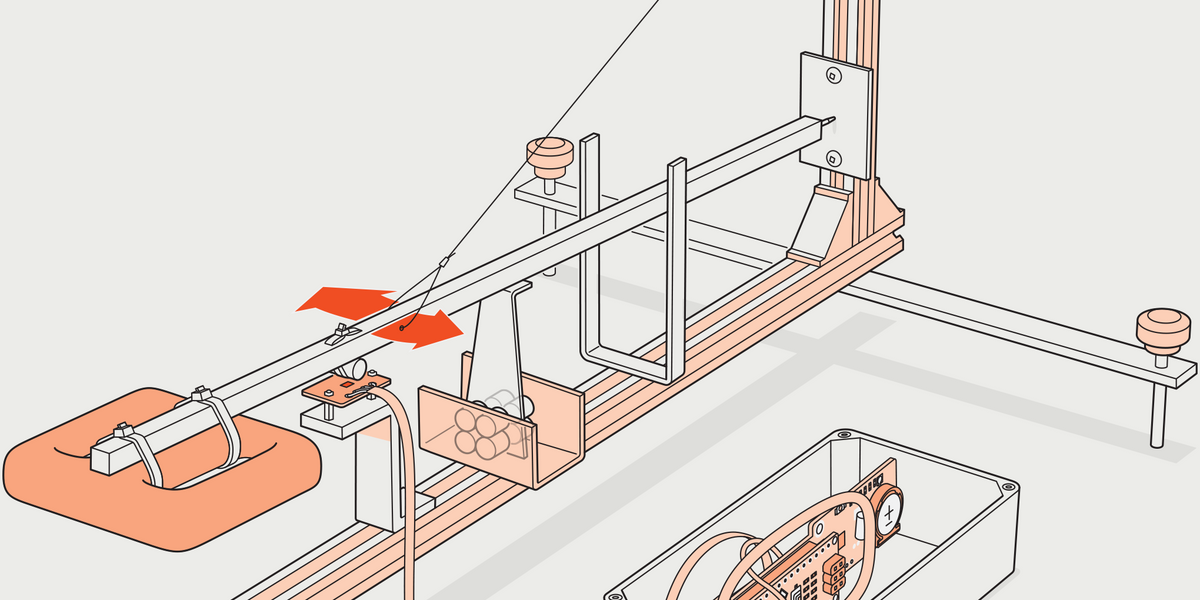
My new design is for a horizontal-pendulum seismometer, which contains a pendulum that swings horizontally—or almost so, being inclined just a smidge. Think of a fence gate with its two hinges not quite aligned vertically. It has a stable position in the middle, but when it’s nudged, the restoring force is very weak, so the gate makes slow oscillations back and forth.
The backbone of my seismometer is a 60-cm-long aluminum extrusion. Or maybe I should call it the keel, as this seismometer also has what I would describe as a mast, another piece of aluminum extrusion about 25 cm long, attached to the end of the keel and sticking straight up. Beneath the mast and attached to the bottom of the keel is an aluminum cross piece, which prevents the seismometer from toppling over.
The pendulum—let’s call it a boom, to stick with my nautical analogies—is a 60-cm-long bar cut from 0.375-inch-square aluminum stock. At one end, I attached a 2-pound lead weight (one intended for a diving belt), using plastic cable ties.
To allow the boom to swing without undue friction, I drilled a hole in the unweighted end and inserted the carbide-steel tip of a scribing tool. That sharp tip rests against a shallow dimple in a small steel plate screwed to the mast. To support the boom, I used some shifter cable from a bicycle, attached by looping it through a couple of strategically drilled holes and then locking things down using metal sleeves crimped onto the ends of the cable.
Establishing the response of the seismometer to vibrations is the role of the end weight [top left] and dampening magnets [top right]. A magnet is also used with a Hall effect sensor [middle right] that is read by a microcontroller [middle left]. Data is stored on a logging board with a real-time clock [bottom]. James Provost
I fabricated a few other small physical bits, including leveling feet and a U-shaped bracket to prevent the boom from swinging too far from equilibrium. But the main challenges were how to sense earthquake-induced motions of the boom and how to prevent it from oscillating indefinitely.
Most DIY seismometers use a magnet and coil to sense motion as the moving magnet induces a current in the fixed coil. That’s a tricky proposition in a long-period seismometer, because the relative motion of the magnet is so slow that only very faint electrical signals are induced in the coil. One of the more sophisticated designs I saw online called for an LVDT (linear variable differential transformer), but such devices seem hard to come by. Instead, I adopted a strategy I hadn’t seen used in any other homebrewed seismometer: employing a Hall-effect magnetometer to sense position. All I needed was a small neodymium magnet attached to the boom and an inexpensive Hall-effect sensor board positioned beneath it. It worked just great.
I figured the immense excursions must reflect some sort of gross malfunction!
The final challenge was damping. Without that, the pendulum, once excited, would oscillate for too long. My initial solution was to attach to the boom an aluminum vane immersed in a viscous liquid (namely, oil). That worked, but I could just see the messy oil spills coming.
So I tacked in the other direction and built a magnetic damper, which works by having the aluminum vane pass through a strong magnetic field. This induces eddy currents in the vane that oppose its motion. To the eye, it looks like the metal is caught in a viscous liquid. The challenge here is making a nice strong magnetic field. For that, I collected all the neodymium magnets I had on hand, kludged together a U-shaped steel frame, and attached the magnets to the frame, mimicking a horseshoe magnet. This worked pretty well, although my seismometer is still somewhat underdamped.
Compared with the fussy mechanics, the electronics were a breeze to construct. I used a US $9 data-logging board that was designed to accept an Arduino Nano and that includes both a real-time clock chip and an SD card socket. This allowed me to record the digital output of the Hall sensor at 0.1-second intervals and store the time-stamped data on a microSD card.
 My homebrew seismometer recorded the trace of an earthquake occurring roughly 1,500 kilometers away, beginning at approximately 17:27 and ending at 17:37.James Provost
The first good test came on 10 November 2024, when a magnitude-6.8 earthquake struck just off the coast of Cuba. Consulting the global repository of shared Raspberry Shake data, I could see that units in Florida and South Carolina picked up that quake easily. But ones located farther north, including one close to where I live in North Carolina, did not.
Yet my horizontal-pendulum seismometer had no trouble registering that 6.8 earthquake. In fact, when I first looked at my data, I figured the immense excursions must reflect some sort of gross malfunction! But a comparison with the trace of a research-grade seismometer located nearby revealed that the waves arrived in my garage at the very same time. I could even make out a precursor 5.9 earthquake about an hour before the big one.
My new seismometer is not too big and awkward, as many long-period instruments are. Nor is it too small, which would make it less sensitive to far-off seismic signals. In my view, this Goldilocks design is just right.
