


 Getty Images
This is the third feature in a six-part series that is looking at how AI is changing medical research and treatments.
Ovarian cancer is “rare, underfunded, and deadly”, says Audra Moran, head of the Ovarian Cancer Research Alliance (Ocra), a global charity based in New York.
Like all cancers, the earlier it is detected the better.
Most ovarian cancer starts in the fallopian tubes, so by the time it gets to the ovaries, it may have already spread elsewhere too.
“Five years prior to ever having a symptom is when you might have to detect ovarian cancer, to affect mortality,” says Ms Moran.
But new blood tests are emerging that use the power of artificial intelligence (AI) to spot signs of the cancer in its very early stages.
And it’s not just cancer, AI can also speed up other blood tests for potentially deadly infections like pneumonia.

 Memorial Sloan Kettering Cancer Center
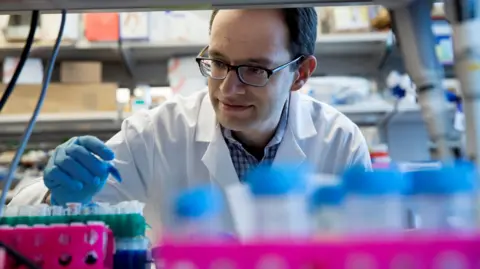
Dr Daniel Heller is a biomedical engineer at Memorial Sloan Kettering Cancer Center in New York.
His team have been developed a testing technology which uses nanotubes – tiny tubes of carbon which are around 50,000 times smaller than the diameter of a human hair.
About 20 years ago, scientists began discovering nanotubes that can emit fluorescent light.
In the past decade, researchers learned how to change these nanotubes’ properties so they respond to almost anything in the blood.
Now it is possible to put millions of nanotubes into a blood sample and have them emit different wavelengths of light based on what sticks to them.
But that still left the question of interpreting the signal, which Dr Heller likens to finding a match for a fingerprint.
In this case the fingerprint is a pattern of molecules binding to sensors, with different sensitivities and binding strengths.
But the patterns are too subtle for a human to pick out.
“We can look at the data and we will not make sense of it at all,” he says. “We can only see the patterns that are different with AI.”
Decoding the nanotube data meant loading the data into a machine-learning algorithm, and telling the algorithm which samples came from patients with ovarian cancer, and which from people without it.
These included blood from people with other forms of cancer, or other gynaecological disease that might be confused with ovarian cancer.

A big challenge in using AI to develop blood tests for ovarian cancer research is that it is relatively rare, which limits the data for training algorithms.
And much of even that data is siloed in hospitals that treated them, with minimal data sharing for researchers.
Dr Heller describes training the algorithm on available data from just a few 100 patients as a “Hail Mary pass”.
But he says the AI was able to get better accuracy than the best cancer biomarkers that are available today – and that was just the first try.
The system is undergoing further studies to see if it can be improved using larger sets of sensors, and samples from many more patients. More data can improve the algorithm, just as algorithms for self-driving cars can improve with more testing on the street.
Dr Heller has high hopes for the tech.
“What we’d like to do is triage all gynaecological disease – so when someone comes in with a complaint, can we give doctors a tool that quickly tells them it’s more likely to be a cancer or not, or this cancer than that.”
Dr Heller says this may be “three to five years” away.
 Karius
It’s not just early detection that AI is potentially useful for, it is also speeding up other blood tests.
For a cancer patient, catching pneumonia can be deadly and, as there are around 600 different organisms that can cause pneumonia, doctors have to conduct multiple tests to identify the infection.
But new types of blood tests are simplifying and speeding up the process.
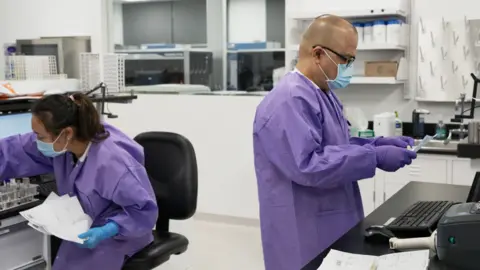
Karuis, based in California uses artificial intelligence (AI) to help identify the precise pneumonia pathogen in 24 hours, and select the right antibiotic for it.
“Before our test, a patient with pneumonia would have 15 to 20 different tests to identify their infection in just in their first week in hospital – that’s about $20,000 in testing,” says Karius chief executive Alec Ford.
Karius has a database of microbial DNA which has tens of billions of data points. Test samples from patients can be compared to that database to identify the exact pathogen.
Mr Ford says that would have been impossible without AI.
One challenge is that researchers don’t necessarily currently understand all the connections that an AI might make between the test biomarkers and the diseases.
Over the last two years Dr Slavé Petrovski has developed an AI platform called Milton that, using biomarkers in the UK biobank data to identify 120 diseases with a success rate of over 90%.
Finding patterns in such a mass of data is only something that AI can do.
“These are often complex patterns, where there may not be one biomarker, but you have to take into consideration the whole pattern,” says Dr Petrovski, whose is a researcher at pharmaceuticals giant AstraZeneca.
Dr Heller uses a similar pattern matching technique in his work on ovarian cancer.
“We know that the sensor binds and responds to proteins and small molecules in the blood, but we don’t know which of the proteins or molecules are specific to cancer,” he says.
More broadly data, or the lack of it, is still a drawback.
“People aren’t sharing their data, or there’s not a mechanism to do it,” says Ms Moran.
Ocra is funding a large-scale patient registry, with electronic medical records of patients who’ve allowed researchers to train algorithms on their data.
“It’s early days – we’re still in the wild west of AI now,” says Ms Moran.
