

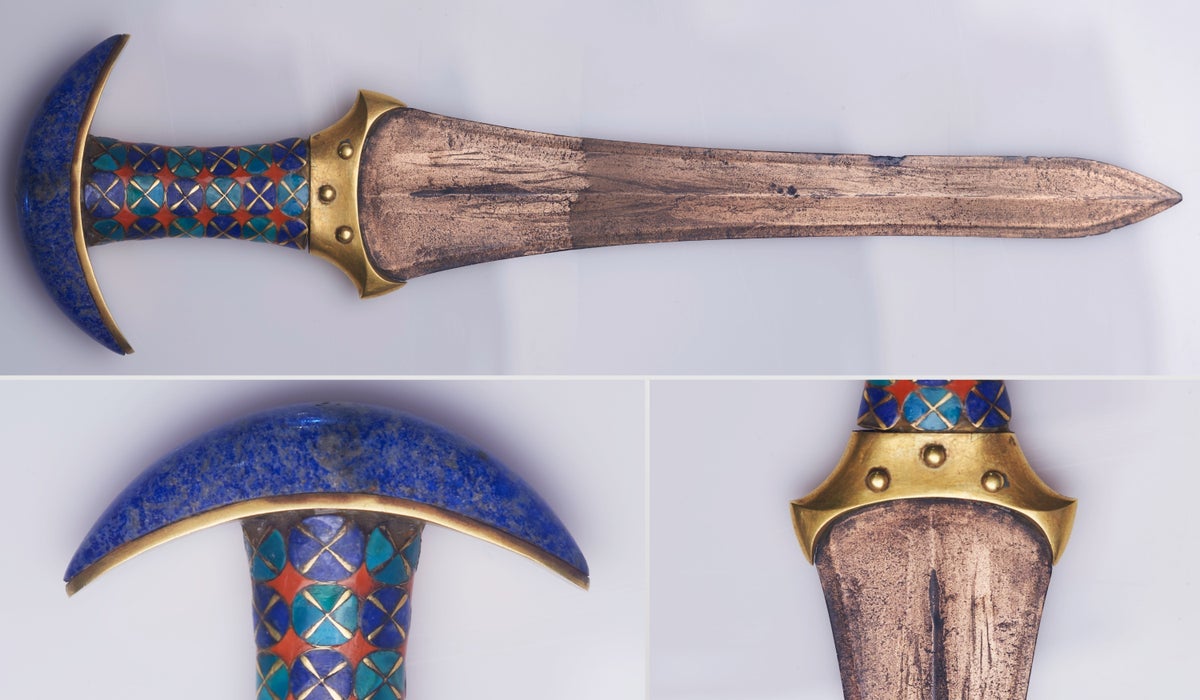
The dagger of Princess Ita is stunning. Embellished with gold and lapis lazuli, it was found in the Egyptian princess’s tomb at the site of Dahshur, south of Cairo, and dates to some 4,000 years ago, around 1900 B.C.E. Historians have long classified the dagger as a ceremonial object and likely not a tool, let alone a weapon wielded by a princess.
But a new archeological analysis suggests some royal women in ancient Egypt such as Princess Ita may have been more skilled with weaponry than historians once believed.
“These findings challenge the traditional view that elite Egyptian women led passive, sedentary lives,” says Zeinab Hashesh, lead author of the new analysis and an associate professor in the department of Egyptology at Beni-Suef University in Egypt. “[The study] reveals a royal court that was a disciplined environment where women were resilient, trained and powerful actors.”
On supporting science journalism
If you’re enjoying this article, consider supporting our award-winning journalism by subscribing. By purchasing a subscription you are helping to ensure the future of impactful stories about the discoveries and ideas shaping our world today.
When Princess Ita’s final resting place was first excavated by French archeologist Jacques de Morgan in the late 1800s, Ita was somewhat of an afterthought, Hashesh says. While the remains of neighboring royals King Hor and Princess Noub-Hotep were “briefly examined anthropologically,” she says, Ita’s remains, as well as those of Princesses Itaweret and Khenmet and an unknown female individual buried at Dahshur, “remained unstudied for over 130 years.” In fact, some of these remains were only recently “rediscovered” when they turned up in the basement of the Egyptian Museum in Cairo in 2020, Hashesh adds.
Hashesh and her team, however, saw the rediscovery as an opportunity to reconstruct how these princesses may have lived based on their skeletal remains, information that she refers to as their “osteobiographies.”
“We wanted to see if the skeletons themselves supported the presence of the weapons found beside them,” she says.
By looking at the princesses’ internal bone structure and muscle attachment sites, as well as by analyzing chemical signatures left on the remains, Hashesh and her team began to piece together a picture of what the princesses’ daily lives and burials may have looked like.
“Our big takeaway is that these women were ‘active ritual agents’ whose lives involved disciplined physical strength,” she says, participating in activities that possibly included archery or the use of daggers.
In Princess Ita’s case, her muscle attachments “strongly reflect the habitual gripping of weapons like daggers or maces,” Hashesh says.
Even more clear was Princess Noub-Hotep, whose skeleton, she says, “provides the most definitive evidence for the ‘archer’s grip,’” including “a unique bowing” of a hand bone, a feature that Hashesh sees as evidence of having to drawing a bow.
Meanwhile, she adds, Princess Itaweret appeared to have survived “significant trauma” to her ribs and feet bones, “indicating a high-risk, active lifestyle.”
Sébastien Villotte, a researcher at the French National Center for Scientific Research (CNRS), is more skeptical of the findings. In a statement to Scientific American and other media outlets, he said he found the study “interesting” and noted that the analysis provides “a far more comprehensive understanding than earlier studies.” But he argued that the key finding—that these individuals were involved with martial or archery-related activities—“remains speculative.”
“Although the presence of funerary artifacts (e.g., arrows, daggers) makes the princesses’ involvement in such activities plausible, the authors provide limited biomechanical or biomedical evidence to substantiate this claim,” Villotte said.
Future work might compare these princesses remains with those of nonelites who lived in the same region and during the same period to make sure that the princesses’ skeletal features were unique to them, he suggested.
“It is worth noting that this article presents only a single interpretation without any critical reassessment,” Villotte said.
To Hashesh, the findings defy what has historically been another single interpretation about weapons in female graves. Under a “long-standing archaeological tradition,” she argues, they were typically seen as “symbolic or votive tokens for the afterlife rather than functional tools used in life,” she says.
“This interpretation was often based on outdated gender stereotypes that restricted martial activities to the male sphere,” she says. Now the picture is much more complicated.
It’s Time to Stand Up for Science
If you enjoyed this article, I’d like to ask for your support. Scientific American has served as an advocate for science and industry for 180 years, and right now may be the most critical moment in that two-century history.
I’ve been a Scientific American subscriber since I was 12 years old, and it helped shape the way I look at the world. SciAm always educates and delights me, and inspires a sense of awe for our vast, beautiful universe. I hope it does that for you, too.
If you subscribe to Scientific American, you help ensure that our coverage is centered on meaningful research and discovery; that we have the resources to report on the decisions that threaten labs across the U.S.; and that we support both budding and working scientists at a time when the value of science itself too often goes unrecognized.
In return, you get essential news, captivating podcasts, brilliant infographics, can’t-miss newsletters, must-watch videos, challenging games, and the science world’s best writing and reporting. You can even gift someone a subscription.
There has never been a more important time for us to stand up and show why science matters. I hope you’ll support us in that mission.
