

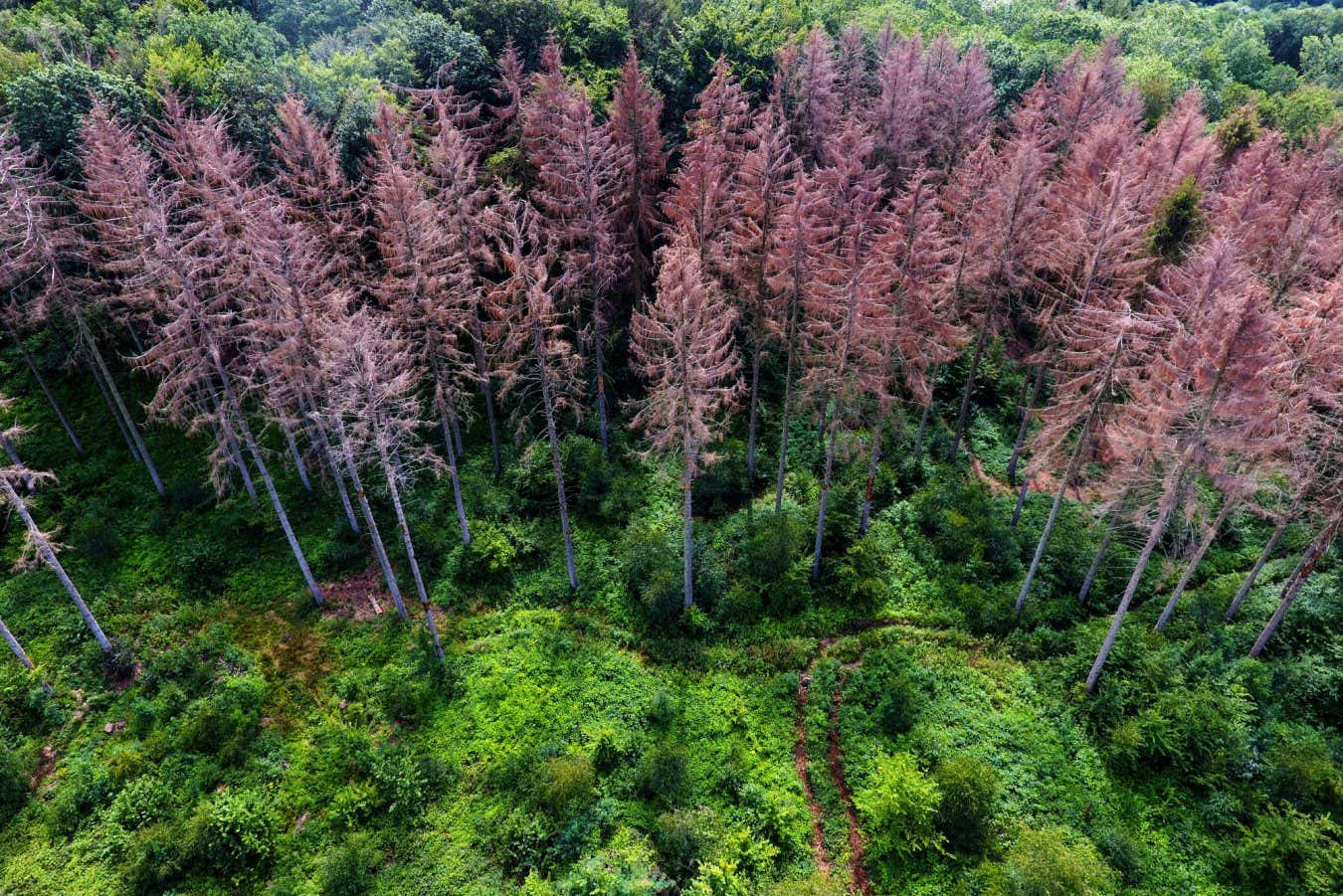
Global warming is causing forest die-offs today, just as it did during the Permian-Triassic extinction event
INA FASSBENDER/AFP via Getty Images
After a sharp rise in atmospheric carbon dioxide levels 252 million years ago, the death of forests led to a long-term shift in Earth’s climate, with greenhouse conditions persisting for millions of years.
Scientists working to understand this event, which caused the biggest mass extinction in Earth’s history, warn that a similar story may unfold if we continue emitting greenhouse gases.
The Permian-Triassic extinction event is thought to have been triggered by massive volcanic activity in the region that is now Siberia, which raised CO2 levels in the atmosphere.
The planet’s surface temperature increased by up to 10°C and, in equatorial regions, the average surface temperature soared to 34°C (93°F) – 8°C higher than the average today.
These conditions persisted for around 5 million years, resulting in the extinction of more than 80 per cent of marine species and 70 per cent of terrestrial vertebrate families, according to some estimates.
While some researchers have recently argued that these mass extinction events actually had minimal effects on terrestrial ecosystems, Andrew Merdith at the University of Adelaide in Australia is convinced that, starting 252 million years ago, life was brought to its knees.
“Pockets of life might survive through a mass extinction in little enclaves or oases here and there, but you can go to many of the Permian-Triassic sections of the fossil record and see that whole ecosystems died out,” says Merdith.
He and his colleagues studied the fossil record to understand why the super greenhouse event driving the mass extinction lasted 5 million years instead of the 100,000 years that climate models predict it should have.
They found that, across huge swathes of Earth, forests with canopies that were up to 50 metres high were replaced by hardy ground cover plants just 5 centimetres to 2 metres in height. Peat bogs, another ecosystem that stores large amounts of carbon, were also wiped out in tropical regions.
Using a computer model of Earth’s climate and geochemistry, the researchers showed that the loss of these ecosystems meant that CO2 levels stayed high for millions of years. This is mainly because vegetation has a big impact on weathering, a process that draws carbon out of the atmosphere and stores it in rocks and soil over long timescales.
There are strong parallels with the present, says Merdith, as the levels of CO2 in the atmosphere are increasing rapidly. If temperatures continue to rise, then tropical and subtropical forests may struggle to adapt, crossing a threshold where vegetation can no longer play its crucial role in balancing the climate.
Merdith says the new work shows you don’t get a “ping-pong effect”, where the atmosphere can quickly recover after equatorial forests are lost.
“It’s not like you’re in an icehouse, then you go to a greenhouse for a little bit, then drop straight back down into an icehouse,” he says. “Once you start the ball rolling, the Earth just finds its new equilibrium point, which is not necessarily what it was before.”
Katrin Meissner at the University of New South Wales in Sydney, Australia, who wasn’t involved in the study, says reconstructing these events is like “putting a puzzle together with many missing pieces”, but that the team’s argument is “plausible”.
However, there is still a lot of uncertainty over what was happening in the oceans at this time, she says. “The oceans hold much more carbon than the land and atmosphere combined, and we really have no idea what happened to ocean biology, chemistry and physical circulation during that event,” says Meissner.
Topics:
