

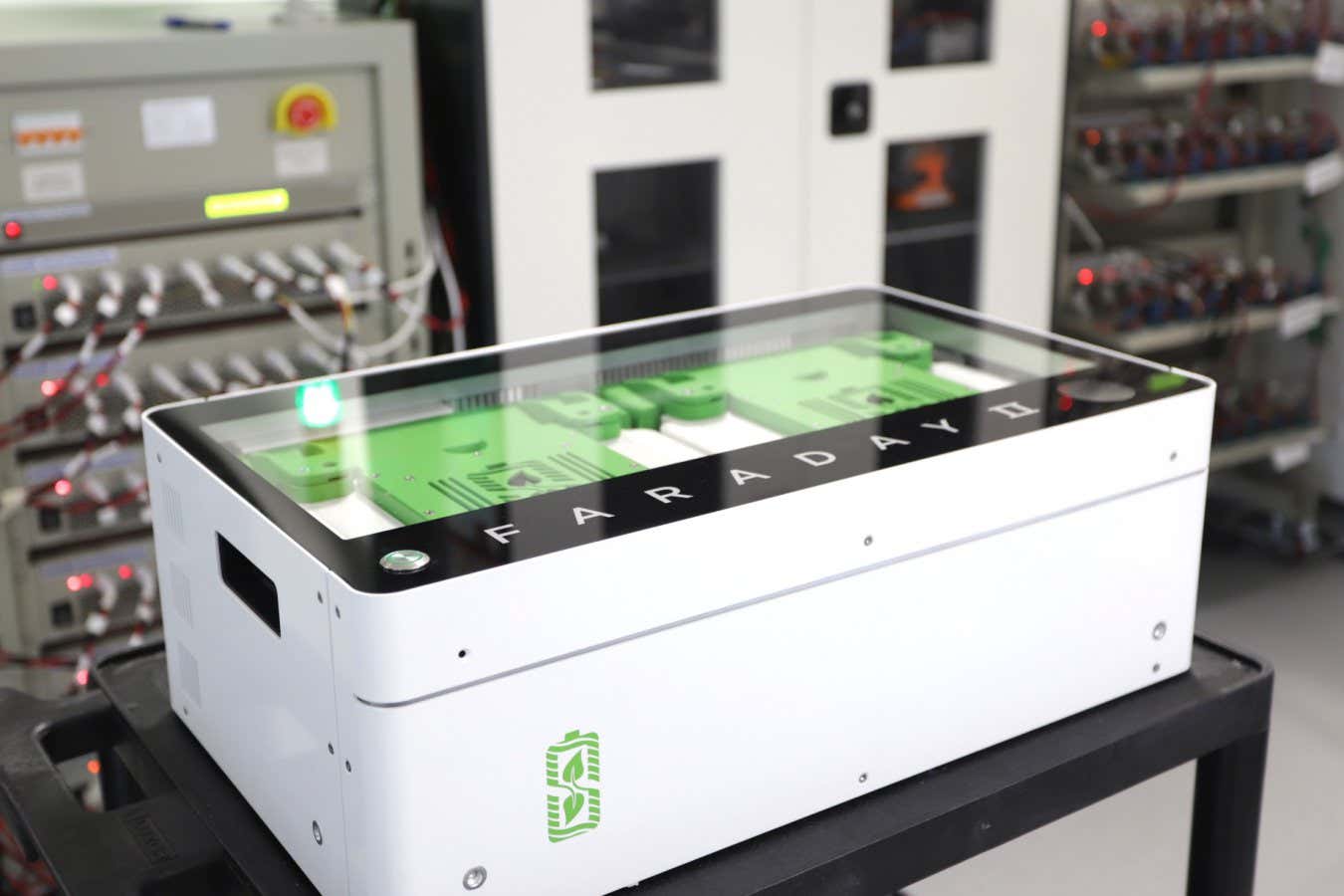
The Faraday 2 battery developed by Superdielectrics
Superdielectrics
A new battery storage system built using supercapacitor technology could “leapfrog” lithium-ion batteries and revolutionise how renewable power is stored and deployed, say its inventors.
UK firm Superdielectrics unveiled its new prototype storage system, the Faraday 2, at an event in central London on 8 July. It features polymers developed for manufacturing contact lenses, and while less energy dense than lithium-ion batteries, the firm says it has other advantages including a faster charging time, better safety standards, low cost and a recyclable design.
“We believe that the home energy storage market today is where the computer market was in about 1980,” Superdielectrics’ Marcus Scott told an audience of journalists and investors. “Clean, reliable and affordable electricity is no longer a future vision. It’s a reality, and we believe we’re building the technology that will power it.”
Energy storage is a vital technology for the global shift to green power, necessary to provide continuous power in spite of fluctuating wind and solar generation. Lithium-ion batteries are currently one of the leading storage technologies, but they are expensive, depend on scarce raw materials, are difficult to recycle and can explode if they overheat.
Superdielectrics says it solves these problems with its aqueous battery design based on supercapacitor technology. Supercapacitors store energy on the surface of a material, allowing very fast charge and discharge times, but with low energy density.
The company’s system features zinc halide electrolytes separated from carbon electrodes by a polymer membrane. Superdielectrics says this membrane technology is low-cost and uses abundant and widely available raw materials, and it can unlock a new generation of supercapacitors with high energy storage potential.
Speaking to New Scientist at the event, the firm’s CEO Jim Heathcote said the technology has the potential to “leapfrog” lithium-ion batteries in renewable energy storage.
The Faraday 2 battery is an advance on the Faraday 1 prototype, launched last year. Superdielectrics says it has managed to double the energy density at a cell level, from 20 watt-hours per kilogram in the Faraday 1 to 40 Wh/kg in the Faraday 2, and halved the charging time. The fast charging allows the system to take advantage of short-lived upticks in renewable energy production, says Heathcote, storing the surplus power for later use.
But Gareth Hinds at the UK’s National Physical Laboratory says the technology is still well short of lithium-ion devices, which can offer energy densities around 300 Wh/kg at a cell level. Andrew Abbott at the University of Leicester, UK, adds that the current energy density achieved by Superdielectrics is comparable with lead-acid batteries, which are widely used for starting cars and in back-up power systems. “It is certainly not going to leapfrog any of the market leaders in the foreseeable future,” he says.
Marcus Newborough, a scientific advisor to Superdielectrics, concedes the company is still “on a journey” to improving the system’s energy density. “We have a very high theoretical energy density,” he said at the event, adding that the company will work to deliver on this potential over the coming years. Its aim is to have a commercial system ready for launch as a home energy storage unit by the end of 2027.
But Hinds is sceptical the technology can ever compete on energy density with lithium-ion. “Obviously, it’s an early stage development, and they’ll keep pushing the energy density higher, but they’re never going to get the energy density to that of lithium-ion. There’s a hard limit there,” he says.
Nevertheless, he suggests there may be a market for storage systems that are larger to make up for being less energy-dense, but far cheaper and with a longer lifespan than lithium-ion.
Sam Cooper at Imperial College London agrees. “If they can build a system with the same amount of energy storage capacity as a Tesla Powerwall (no reason why they can’t, even if it has to be huge and heavy), but it really was 95 per cent cheaper to buy, then I guess it would be a breakthrough,” he says.
Topics:
