

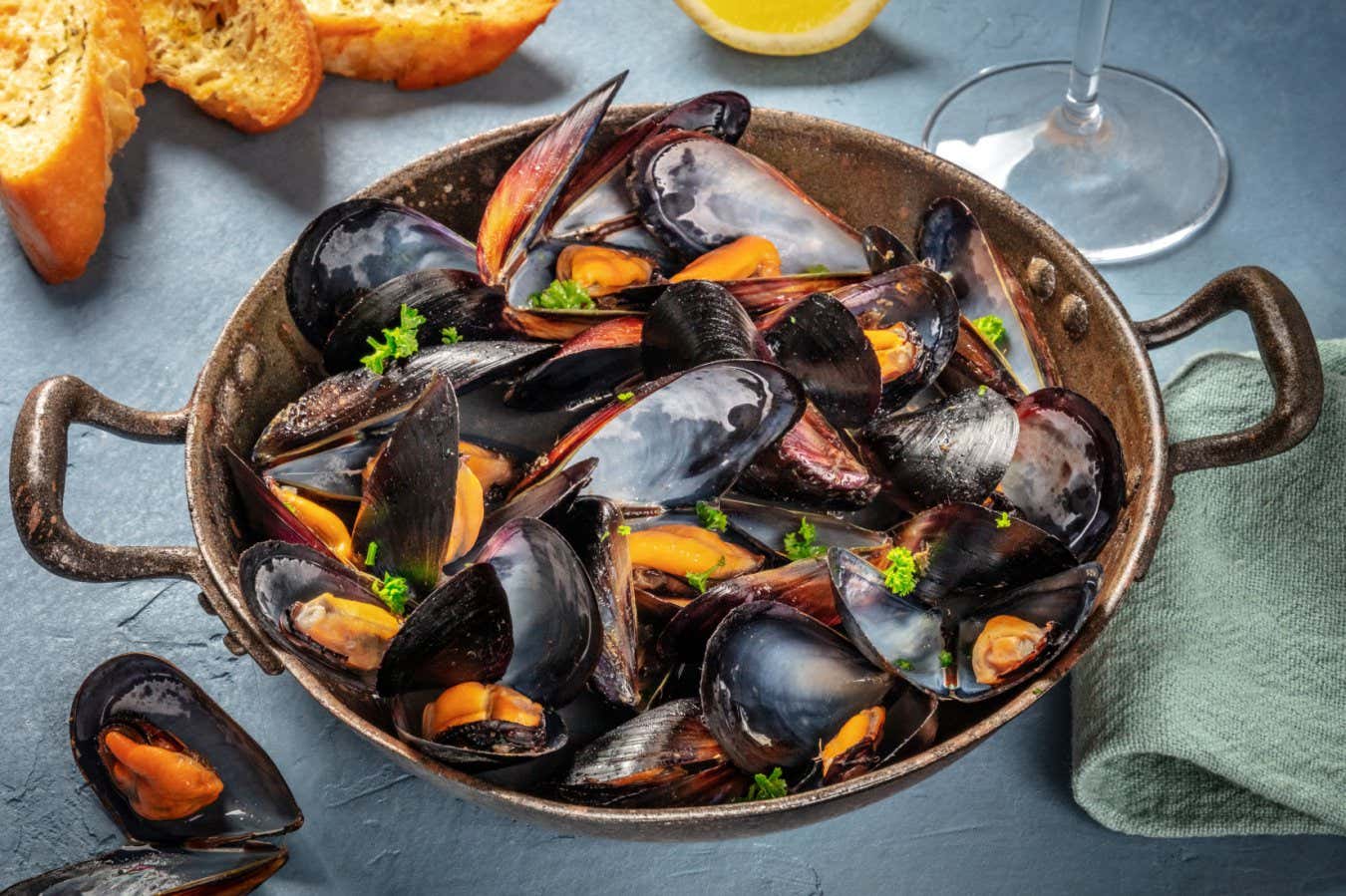
Tuck into a green dish of bivalves
Shutterstock/Plateresca
Picture an environmentally friendly food. Your mind might turn to the humble lentil, but is it possible to eat more luxuriously while still staying green? Bivalves such as oysters, mussels, clams and scallops already have green credentials, thanks to their ability to clean polluted water. Now, some researchers are arguing that they can even mop up carbon dioxide as well. Could farmed bivalves be the ultimate green food?
Food production is to blame for around a third of greenhouse gas emissions, on top of all the other damage it does, so identifying foods that minimise that harm is essential. When it comes to seafood, farming is usually regarded as more sustainable than catching wild fish. But farmed fish need at least some wild fish in their diet and, according to a study out last year, the amount of wild fish being caught to feed to farmed fish has been wildly underestimated. Fish farms also produce a lot of pollution from fish excretions and uneaten food.
The huge advantage of bivalves is that they don’t need active feeding. They are filter feeders that eat tiny particles of nutrients in seawater, including plankton. Most coastal waters are now overloaded with nutrients due to nitrogen and phosphorus pollution, so the harvesting of farmed bivalves helps to remove some of this excess, cleaning up the water as a byproduct of food production.
Harvesting wild bivalves can be harmful – for instance, dredging for wild scallops destroys seafloor life such as sea fans, corals and sponges. But farming bivalves has relatively few downsides, especially compared with, say, razing rainforests to feed beef cattle.
But wait, there’s more: in the past decade, a growing number of studies have claimed that farmed bivalves capture carbon – a claim that, if true, might allow farms to claim carbon credits as another source of revenue.
However, Fabrice Pernet at the University of Brest in France, whose team recently reviewed more than 50 studies of the issue, isn’t convinced. Most of these studies are based on theoretical models that assume that the formation of calcium carbonate shells removes CO2 from the oceans.
But this is true only on a geological timescale. Over mere decades or centuries – which is what matters when it comes to global warming – carbonate formation releases CO2.
What’s more, Pernet says, it is common for waste shells to be incinerated, releasing more CO2 into the atmosphere, instead of being put back in the sea to reverse the CO2-releasing process. As for the carbon in the flesh of the animals, that is released as CO2 after we consume it.
Some researchers are now making a different claim, that more carbon in the form of organic matter ends up in sediments below bivalve farms, making them a net carbon sink.
The latest claim of this kind is based on a study of oysters growing in five 150 cubic-metre enclosures. But Pernet says this and similar studies have flaws, such as CO2 measurements being made only in the daytime and summer when photosynthesis is happening.
The team behind the study says this didn’t affect the result. “The budget shows that carbon accumulation and sequestration outweigh the carbon harvested in shells,” says Shuang-Lin Dong at the Ocean University of China in Qingdao. But Pernet still isn’t convinced. “Today’s evidence suggests that bivalve farming emits CO2 overall,” he says.
Don’t cancel your reservation at the oyster bar just yet, though. While bivalve farming likely is a net emitter, it isn’t by much – just 1.4 kilograms of CO2 or the equivalent per kilogram of edible weight according to a 2021 study. That’s less than wheat or maize, and without the high land and freshwater requirements.
“So yes, farmed bivalves are one of the greenest foods,” says Pernet. Feast away.

Arctic marine biology expedition cruise: Svalbard, Norway
Embark on an unforgettable marine expedition to the Arctic, accompanied by marine biologist Russell Arnott.
Topics:
