

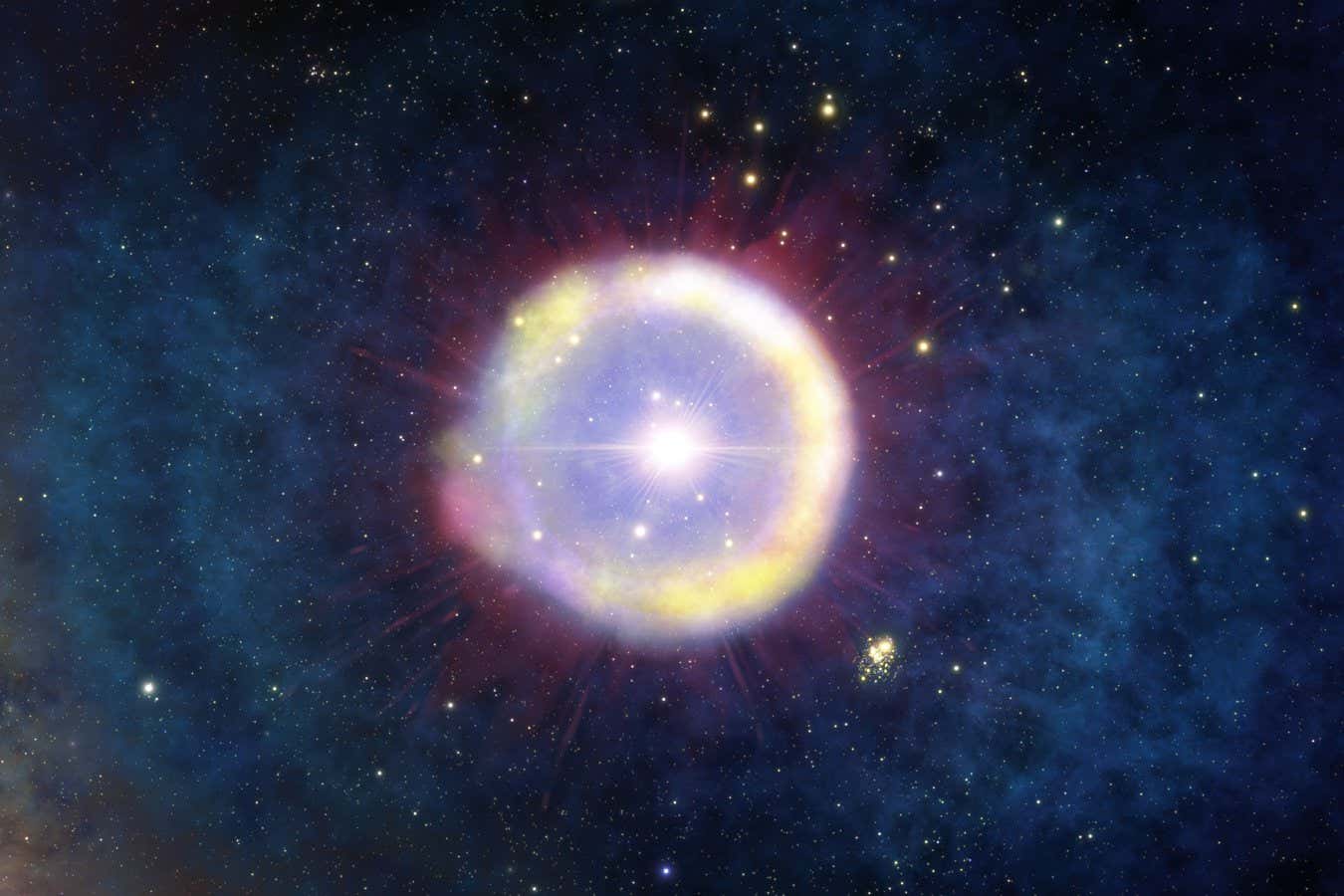
Artist’s impression of a field of Population III stars 100 million years after the big bang
NOIRLab/NSF/AURA/J. da Silva/Spaceengine/M. Zamani
The James Webb Space Telescope (JWST) is allowing astronomers to examine distant galaxies in the far reaches of the early universe for the first time. Some of these have chemical signatures that seem to point to exotic supermassive stars with masses up to 10,000 times that of the sun.
These behemoths are bizarre because for stars in the nearby universe, there seems to be an innate size limit. “All of our evolution models of the galaxies… rely on the fact that stars cannot be more massive than 120 solar masses or so,” says Devesh Nandal at the Harvard-Smithsonian Center for Astrophysics in Massachusetts. “There, of course, have been theoretical ideas that explore stars… more massive than that, but never has there ever been a real observation that one can point to.”
That is, until now. Nandal and his colleagues examined JWST observations of a distant galaxy called GS 3073 and found unusually high amounts of nitrogen in its chemical signatures. This isn’t entirely anomalous: high nitrogen levels have been seen in several other galaxies at similarly high distances.
However, for most of the other galaxies, the nitrogen levels aren’t quite high enough to cause any confusion – certain types of relatively normal stars and other cosmic events can explain them. That’s not the case for GS 3073, Nandal says. It simply has way too much nitrogen.
There is a particular type of hypothesised primordial star, called a Population III star, that models indicate could grow extremely large. When these stars do so, the simulations also show that they should form much more nitrogen than regular stars. Nandal and his colleagues calculated that just a few Population III stars with masses between 1000 and 10,000 times that of the sun could account for the excess nitrogen in GS 3073. “Our work shows the strongest evidence to date of Population III supermassive stars in the early universe,” he says.
However, some other researchers question whether supermassive Population III stars are the only fit for the data – or if they fit quite right at all. “Population III must be associated with a near-pristine environment” without many elements heavier than helium, says Roberto Maiolino at the University of Cambridge. “On the contrary, GS 3073 is chemically a fairly mature galaxy. So it does not seem to match the kind of environment where you expect to find Population III.”
This may simply be a strange galaxy, though, says John Regan at Maynooth University in Ireland. “When we have observations of the early universe, all we see are really weird, really exotic galaxies. So it’s hard to turn around and say yeah, but I don’t expect supermassive stars to form because that’d be too weird. Well, you just said that these are really weird,” he says.
If these colossal stars really do exist, it could help researchers understand the origins of supermassive black holes, which exist far earlier in the universe than they ought to. If they formed from supermassive stars rather than normal ones, that would give them a head start, which could explain how they grew to the enormous sizes that we see in a relatively short amount of time.
Confirming that GS 3073 and other nitrogen-rich galaxies in the early universe really do contain supermassive stars will be difficult, likely requiring the discovery of more chemical signatures of these strange giants. “Strengthening the argument for their existence is flat-out hard – it’s very hard for us to have a smoking gun signature,” says Regan. “But this signature is very strong.”
Topics:
