

Technology Reporter
 IXI
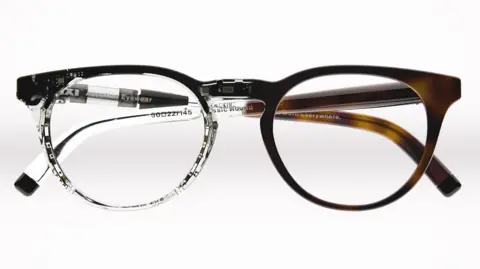
IXIThey look like an ordinary pair of glasses – but these are tech-packed specs.
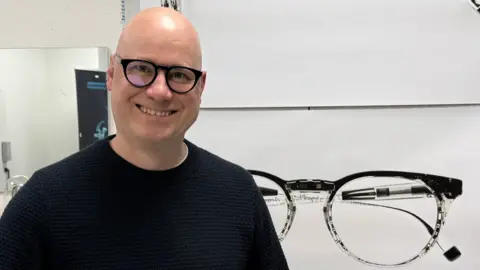
On a Zoom call, Niko Eiden, chief executive and co-founder of Finnish eyewear firm IXI, holds up the frames with lenses containing liquid crystals, meaning their vision-correcting properties can change on the fly.
This one pair could correct the vision of someone who normally uses totally different pairs of glasses for seeing near or far.
“These liquid crystals… we can rotate them with an electrical field,” explains Mr Eiden.
“It’s totally, freely tuneable.” The position of those crystals affects the passage of light through the lenses. A built-in eye-tracker allows the glasses to respond to whatever correction the wearer needs at a given moment.
However, tech-laden eyewear has a troubled history – take Google’s ill-fated “Glass” smart glasses.
Consumer acceptability is key, acknowledges Mr Eiden. Most people don’t want to look like cyborgs: “We need to make our products actually look like existing eyewear.”

 IXI
IXIThe market for eyewear tech is likely to grow.
Presbyopia, an age-related condition that makes it harder to focus on things close to you, is projected to become more common over time as the world’s population ages. And myopia, or short-sightedness, is also on the rise.
Spectacles have remained largely the same for decades. Bifocal lenses – in which a lens is split into two regions, usually for either near- or far-sightedness – require the wearer to direct their vision through the relevant region, depending on what they want to look at, in order to see clearly.
Varifocals do a similar job but the transitions are much smoother.
In contrast, auto-focus lenses promise to adjust part or all of the lens spontaneously, and even accommodate the wearer’s changing eyesight over time.
“The first lenses that we produced were horrible,” admits Mr Eiden, candidly.
Those early prototypes were “hazy”, he says, and with the lens quality noticeably poor at its edges.
But newer versions have proved promising in tests, says Mr Eiden. Participants in the company’s trials have been asked, for example, to read something on a page, then look at an object in the distance, to see whether the glasses respond smoothly to the transition.
Mr Eiden says that the eye tracking device within the spectacles cannot determine exactly what a wearer is looking at, though certain activities such as reading are in principle detectable because of the nature of eye movements associated with them.
Since such glasses respond so closely to the wearer’s eye behaviour, it’s important the frames fit well, says Emilia Helin, product director.
IXI’s frames are adjustable but not to a great degree, given the delicate electronics inside, she explains: “We have some flexibility but not full flexibility.” That’s why IXI hopes to ensure that the small range of frames it has designed would suit a wide variety of faces.
The small battery secreted inside IXI’s autofocus frames should last for two days, says Mr Eiden, adding that it’s possible to recharge the specs overnight while the wearer is asleep.
But he won’t be drawn on a launch date, which he intends to reveal later this year. As for cost, I ask whether £1,000 might be the sort of price tag he has in mind. He merely says, “I’m smiling when you say it but I won’t confirm.”
 Getty Images
Autofocus lenses could help people who struggle with varifocals or bifocals, says Paramdeep Bilkhu, clinical adviser at the College of Optometrists.
However, he adds, “There is insufficient evidence to state whether they perform as well as traditional options and whether they can be used for safety critical tasks such as driving.”
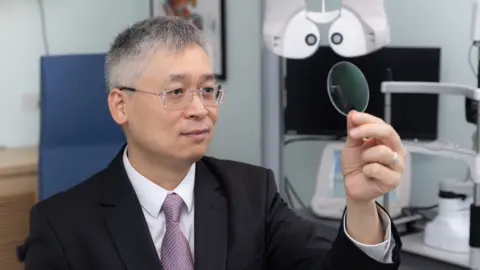
Chi-Ho To, an optometry researcher, at the Hong Kong Polytechnic University has a similar concern – what if the vision correction went wrong or was delayed slightly while he was, say, performing surgery on someone?
“But I think in terms of general use having something that allows autofocusing is a good idea,” he adds.
Mr Eiden notes that the first version of his company’s lenses will not alter the entire lens area. “One can always glance over the dynamic area,” he says. If wholly self-adjusting lenses emerge then safety will become “a much more serious business”, he adds.
In 2013, UK firm Adlens released glasses that allowed wearers to manually change the optical power of the lenses via a small dial on the frames. These lenses contained a fluid-filled membrane, which when compressed in response to dial adjustments would alter its curvature.
Adlens’ current chief executive Rob Stevens says the specs sold for $1,250 (£920) in the US and were “well received by consumers” but not so much by opticians, which he says “strangled sales”.
Since then, technology has moved on and the concept of lenses that refocus themselves automatically, without manual interventions, has emerged.
Like IXI and other companies, Adlens is working on glasses that do this. However, Mr Stevens declines to confirm a launch date.
Joshua Silver, an Oxford University physicist, founded Adlens but no longer works for the company.
He came up with the idea of fluid-filled adjustable lenses back in 1985 and developed glasses that could be tuned to the wearer’s needs and then permanently set to that prescription.
Such lenses have enabled roughly 100,000 people in 20 countries to access vision correcting technology. Prof Silver is currently seeking investment for a venture called Vision, which would further rollout these glasses.
As for more expensive, electronics-filled auto-focus specs, he questions whether they will have broad appeal: “Wouldn’t [people] just go and buy reading glasses, which would more or less do the same thing for them?”
 Hong Kong Polytechnic University
Other specs tech is even slowing down the progression of eye conditions such as myopia, beyond just correcting for them.
Prof To has developed glasses lenses that have a honeycomb-like ring in them. Light passing through the centre of the ring, focused as normal, reaches the wearer’s retina and allows them to see clearly.
However, light passing through the ring itself is defocused slightly meaning that the peripheral retina gets a slightly blurred image.
This appears to slow improper eyeball growth in children, which Prof To says cuts the rate of short-sightedness progression by 60%. Glasses with this technology are now in use in more than 30 countries, he adds.
British firm SightGlass has a slightly different approach – glasses that gently reduce the contrast of someone’s vision to similarly affect eye growth and myopia progression.
While autofocus glasses and other high-tech solutions may have promise, Prof To has an even bigger goal: glasses that don’t just slow down myopia but actually reverse it slightly – a tantalising prospect that could improve the vision of potentially billions of people.
“There is growing evidence that you can do it,” teases Prof To.
