

Scientists Identify a Brain Structure That Filters Consciousness
Our conscious awareness may be governed by a structure deep in the brain
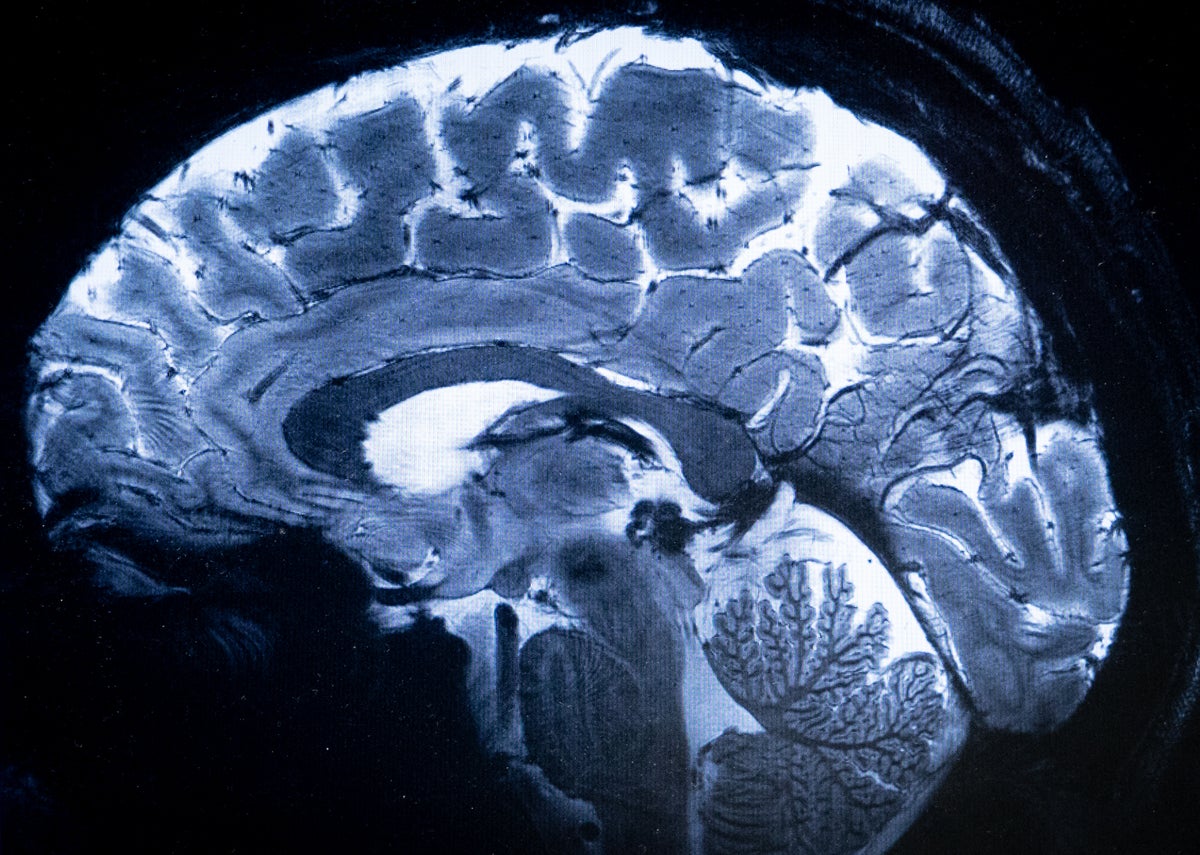
An MRI image of the human brain.
Alain Jocard/AFP via Getty Images
Neuroscientists have observed for the first time how structures deep in the brain are activated when the brain becomes aware of its own thoughts, known as conscious perception.
The brain is constantly bombarded with sights, sounds and other stimuli, but people are only ever aware of a sliver of the world around them—the taste of a piece of chocolate or the sound of someone’s voice, for example. Researchers have long known that the outer layer of the brain, called the cerebral cortex, plays a part in this experience of being aware of specific thoughts.
The involvement of deeper brain structures has been much harder to elucidate, because they can be accessed only with invasive surgery. Designing experiments to test the concept in animals is also tricky. But studying these regions would allow researchers to broaden their theories of consciousness beyond the brain’s outer wrapping, say researchers.
On supporting science journalism
If you’re enjoying this article, consider supporting our award-winning journalism by subscribing. By purchasing a subscription you are helping to ensure the future of impactful stories about the discoveries and ideas shaping our world today.
“The field of consciousness studies has evoked a lot of criticism and scepticism because this is a phenomenon that is so hard to study,” says Liad Mudrik, a neuroscientist at Tel Aviv University in Israel. But scientists have increasingly been using systematic and rigorous methods to investigate consciousness, she says.
Aware or not
In a study published in Science today, Mingsha Zhang, a neuroscientist at Beijing Normal University, focused on the thalamus. This region at the centre of the brain is involved in processing sensory information and working memory, and is thought to have a role in conscious perception.
Participants were already undergoing therapy for severe and persistent headaches, for which they had thin electrodes injected deep into their brains. This allowed Zhang and his colleagues to study their brain signals and measure conscious awareness.
The participants were asked to move their eyes in a particular way depending on whether they noticed an icon flash onto a screen in front of them. The icon was designed so that the participants would be aware of its appearance only about half of the time.
During the tasks, the researchers recorded neural activity in multiple regions of the brain, including the thalamus and the cortex. This is the first time that such simultaneous recordings have been made in people doing a task that is relevant to consciousness science, says Christopher Whyte, a systems neuroscientist at the University of Sydney in Australia. The work “is really pretty remarkable,” he says, because it allowed the team to look at how the timing of neural activity in different regions varied.
Gatekeeper
The activity in the participants’ thalamus and prefrontal cortex when they were aware of the icon’s appearance was markedly different from the activity when they were not. The activity when they were aware of the icon appeared earlier and was stronger in sections of the thalamus than in sections of the cortex, and seemed to be coordinated across the two areas. This suggests that the thalamus acts as a filter and controls which thoughts get through to awareness and which don’t, says Mac Shine, a systems neuroscientist at the University of Sydney.
Previous animal studies support these findings. In a 2020 paper, researchers used magnets to move individual mouse whiskers just enough for the mice to notice about half the time. The animals were trained to take a lick from a water-spout when they did feel the movement. The researchers found that cells in the cerebral cortex that were activated when the mice noticed the whisker-flick projected down to deeper brain regions, including the thalamus.
The latest study is “one of the most elaborate and extensive investigations of the role of the thalamus in consciousness,” says Mudrik. But there is still a question about whether the task genuinely captured neural activity associated with conscious experience, or just tracked attention to a stimulus that was not necessarily consciously perceived, she says.
Zhang plans to conduct more experiments in people and to investigate brain activity in detail in macaque monkeys.
This article is reproduced with permission and was first published on April 3, 2025.
