

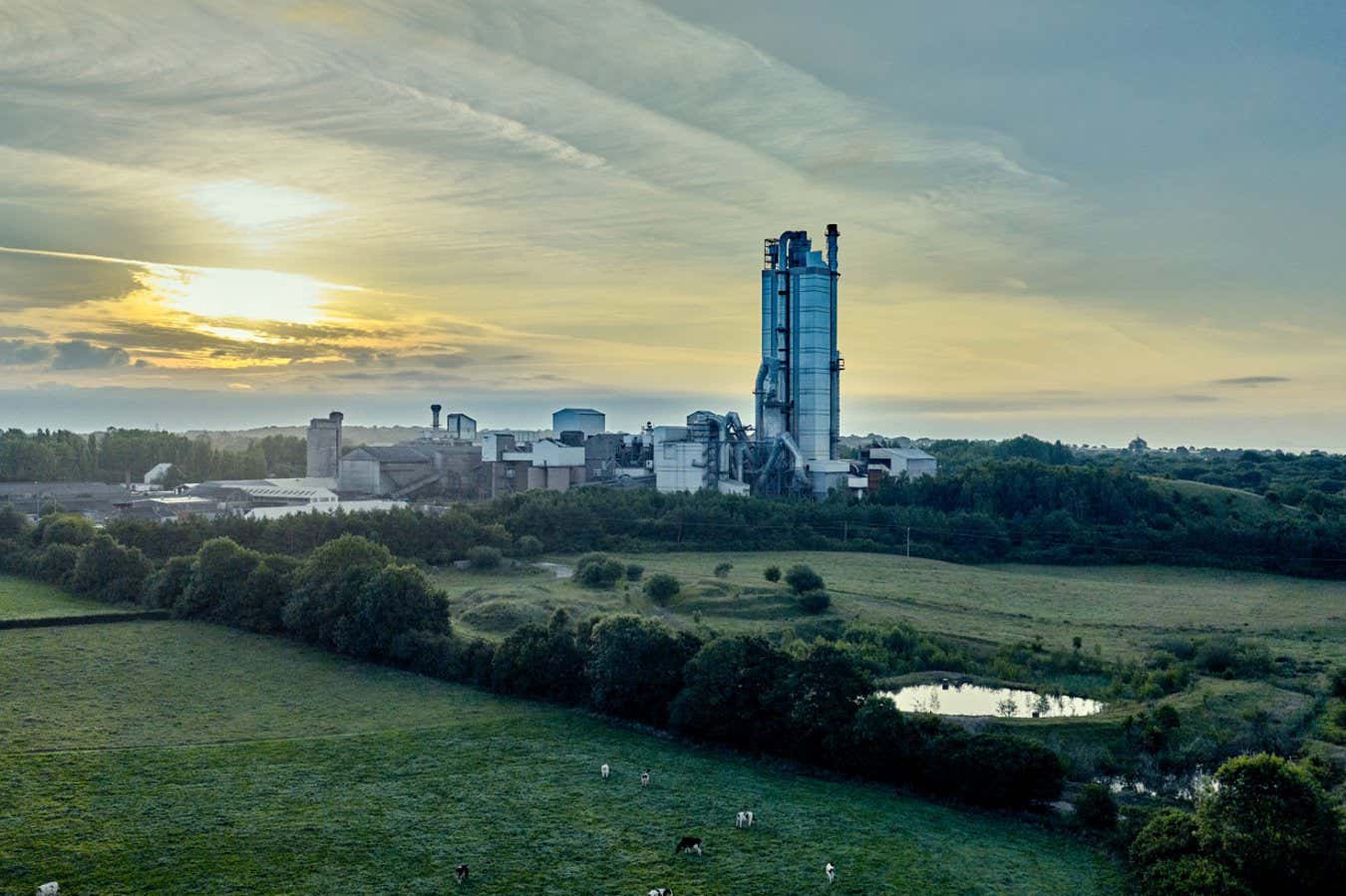
The carbon-capture-and-storage cement planet in Padeswood, Wales
Padeswood CCS
Commercial-scale carbon-capture systems for cement plants are now being deployed, raising hopes that one of the trickiest industrial sectors to decarbonise could finally be on the path towards net-zero emissions.
The world’s first carbon-capture plant on a cement works has been up and running in Norway since June, with the first “zero-carbon cement” products due to be delivered to the UK and elsewhere in Europe next month, according to the plant’s owner, Heidelberg Materials in Germany.
Meanwhile, the construction of a carbon-capture installation at the Padeswood cement plant in north Wales will begin within weeks, following a subsidy deal announced this week between the UK government and Heidelberg Materials. A handful of similar installations are planned in Sweden, Germany and Poland.
The developments could mark a big advance in the cement industry’s move to cut emissions, long seen as one of the most challenging aspects of decarbonisation. “It’s a good step forward,” says Paul Fennell at Imperial College London, speaking of the projects in Norway and the UK.
Cement is responsible for around 8 per cent of global carbon emissions, according to the think tank Chatham House. Much of this carbon dioxide is produced directly by the chemical process of making clinker, which is the main ingredient for Portland cement, the most commonly used type of the building material. “If you’re going to have ordinary Portland cement, you’ve got this issue that you’re producing large amounts of CO2 just from the intrinsic chemistry,” says Fennell.
Capturing the carbon dioxide produced from the process is widely seen as the only scalable way to decarbonise this aspect of cement production. But it is expensive, costing €50-200 to capture, transport and permanently store a tonne of carbon from cement production in Europe, according to analysis from Dutch bank ING.
The development of Heidelberg’s Brevik plant in Norway has been subsidised by its government. The carbon-capture infrastructure captures 50 per cent of the cement plant’s total emissions. It works by using an ammonia-derived solvent, called amine, to extract CO2 from the exhaust gases at the cement plant. The captured CO2 is then released from the solvent, liquified and pumped beneath the Norwegian seabed.
The Padeswood plant will use the same amine-based technology, but will remove roughly 95 per cent of the plant’s emissions once the carbon-capture-and-storage infrastructure is up and running in 2029, says Heidelberg Materials’ UK CEO Simon Willis. That is equivalent to around 800,000 tonnes of carbon dioxide per year. The Padeswood plant will capture more carbon than the Brevik one because the latter could not get the extra energy power supply required to run it at 95 per cent.
Construction work is set to begin within weeks, with the UK government having agreed to subsidise the operating costs of the technology, although details of the funding agreement haven’t been made public. “The fundamental principle is that the government is going to give us money to help us build and operate a carbon-capture plant,” says Willis.
Financial backing from governments is essential for building the first fleet of carbon-capture-and-storage cement plants, says Leon Black at the University of Leeds in the UK. “There is no way that carbon capture and storage could be commercially viable without state support,” he says.
But there are hopes that costs could fall in the future, as new technologies help to make it more energy efficient. For example, in Germany, Heidelberg is part of a group of firms trialling oxyfuel technology. This involves recirculating exhaust gases back into the burner, increasing the share of CO2 in the released exhaust gases to about 70 per cent, making carbon-capture processes more efficient.
Topics:
