

Life on Earth is thought to have emerged from the primordial ooze some four billion years ago. Now a provocative new study argues that this miraculous transition from chemistry to biology happened not once but twice.
Bacteria and archaea, the first two branches of the tree of life, each sprung separately, according to the study, which was published in the journal Science Advances. Their last common ancestor, known as LUCA (for “last universal common ancestor” of all life), was, in fact, not fully alive—it depended on metals deposited in hydrothermal vents to run its metabolism.
Over time and with countless chemical combinations, the bacteria and archaea that evolved from LUCA found ways to make their own internal enzymes to catalyze the chemical reactions needed for life, says the study’s senior author William Martin, an evolutionary biologist at Heinrich Heine University Düsseldorf in Germany.
On supporting science journalism
If you’re enjoying this article, consider supporting our award-winning journalism by subscribing. By purchasing a subscription you are helping to ensure the future of impactful stories about the discoveries and ideas shaping our world today.
“We’re getting a view into the phase of evolution where these very primitive proto-organisms were inventing enzymes that enabled them to cut lose from the crust and become a free-living cell,” Martin says.
Genetic data suggest that LUCA existed about 4.2 billion years ago, during the Hadean eon, when Earth’s surface was still hot. Only one set of Canadian rocks might date back to this time in Earth’s history—but their provenance is hotly debated, and otherwise, geological evidence is sparse. The oldest uncontested examples of fossilized life ever found are 3.5-billion-year-old microbial mats called stromatolites that must have evolved from simpler ancestors.
Some researchers have argued that LUCA was a complex cell with a primitive immune system to protect against viruses. But the genetic methods they have used can be misleading when one peers back through more than four billion years of evolution, Martin says. He and his colleagues employed a metabolic lens to focus on what genes would be needed to convert the components of early Earth, such as hydrogen, ammonia, carbon dioxide, water, hydrogen sulfide and phosphate, into the 20 amino acids, five natural nucleotide bases and 20 cofactors that keep cells humming. “It’s only 420 chemical reactions,” Martin says.
By comparing genomes representing all groups of bacteria and archaea, Martin and his colleagues found that these two branches of life shared common genes for about half of the enzymes needed for these basic reactions. The rest were unique to either bacteria or archaea, suggesting that these two forms of life “traversed the path to free-living cells, at least in part, independently,” says Natalia Mrnjavac, a graduate student in Martin’s lab and the paper’s first author.
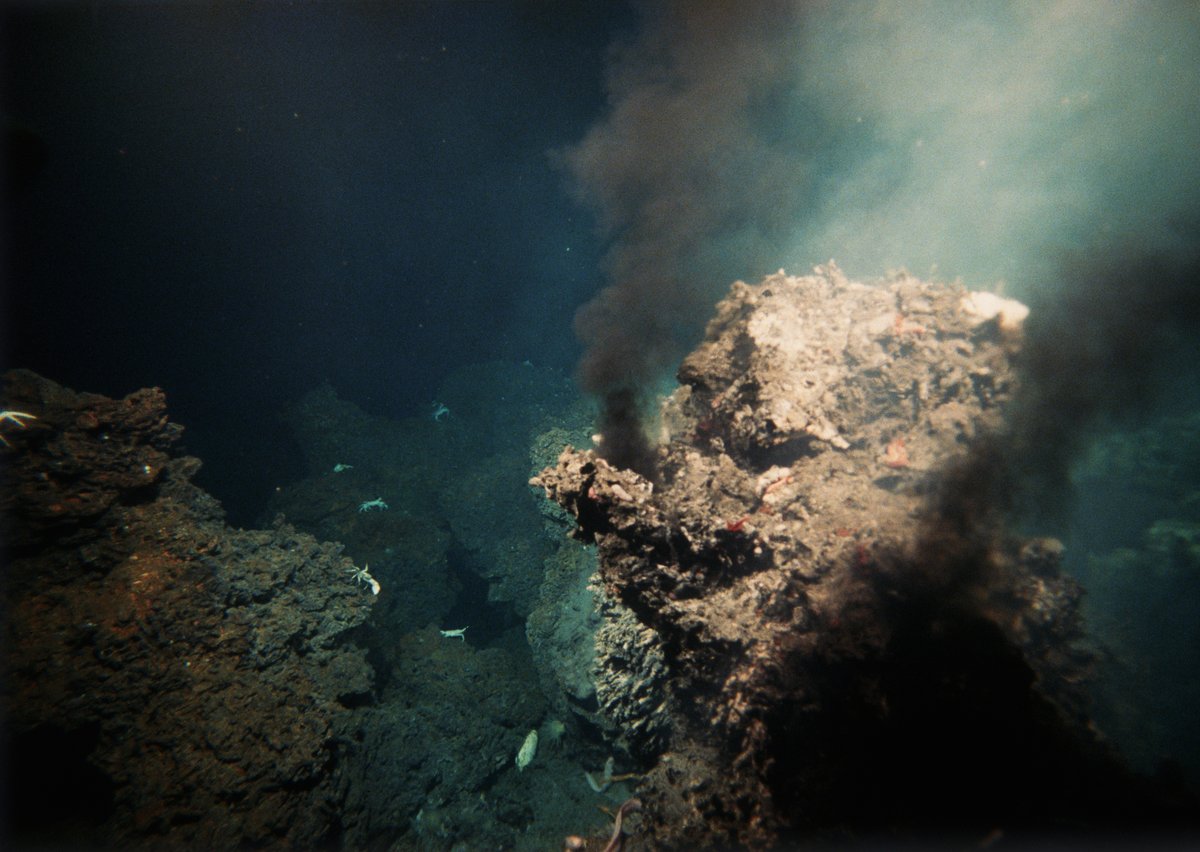
An image of the Beehive formation at Lost City hydrothermal field.
Courtesy of Deborah S. Kelley/University of Washington/Woods Hole Oceanographic Institution; See “An Off-Axis Hydrothermal Vent Field Near the Mid-Atlantic Ridge at 30° N,” by Deborah S. Kelley et al., in Nature, Vol. 412; July 12, 2001
In other words, bacteria and archaea didn’t split off on their own paths from LUCA. Instead LUCA would have been a cluster of RNA, DNA and enzymes that were stuck inside the rock in hydrothermal vents and dependent on the metals from these vents to make amino acids. Genes from various clusters could percolate through rocks, leading to a sort of evolutionary experiment that might eventually have led to life as the clusters replaced metal-catalyzed processes with their own enzymatic ones.
Martin’s lab has shown that metals can replace biological enzymes in many basic metabolic processes, bolstering the case. In the new study, the researchers found that palladium can catalyze a crucial reaction from phosphite (abundant at hydrothermal vents) to phosphate (crucial to cellular processes) that releases energy and could have powered LUCA.
“The idea that environment and geochemistry can provide what biology has not yet invented is very plausible,” says Betül Kaçar, director of a NASA astrobiology center and an assistant professor at the University of Wisconsin–Madison, who was not involved in the study. But modern life’s last common ancestor is not the same thing as the origin of life, she cautions. How chemistry and geology passed the baton to biology remains unknown. Further experiments will be needed to test the ideas raised by this study.
“Biologists have a tall order ahead of them,” she says. “There’s a lot we need to be doing in order to understand the nature of the last common ancestor and the role of bacteria and archaea.”
It’s Time to Stand Up for Science
If you enjoyed this article, I’d like to ask for your support. Scientific American has served as an advocate for science and industry for 180 years, and right now may be the most critical moment in that two-century history.
I’ve been a Scientific American subscriber since I was 12 years old, and it helped shape the way I look at the world. SciAm always educates and delights me, and inspires a sense of awe for our vast, beautiful universe. I hope it does that for you, too.
If you subscribe to Scientific American, you help ensure that our coverage is centered on meaningful research and discovery; that we have the resources to report on the decisions that threaten labs across the U.S.; and that we support both budding and working scientists at a time when the value of science itself too often goes unrecognized.
In return, you get essential news, captivating podcasts, brilliant infographics, can’t-miss newsletters, must-watch videos, challenging games, and the science world’s best writing and reporting. You can even gift someone a subscription.
There has never been a more important time for us to stand up and show why science matters. I hope you’ll support us in that mission.
