

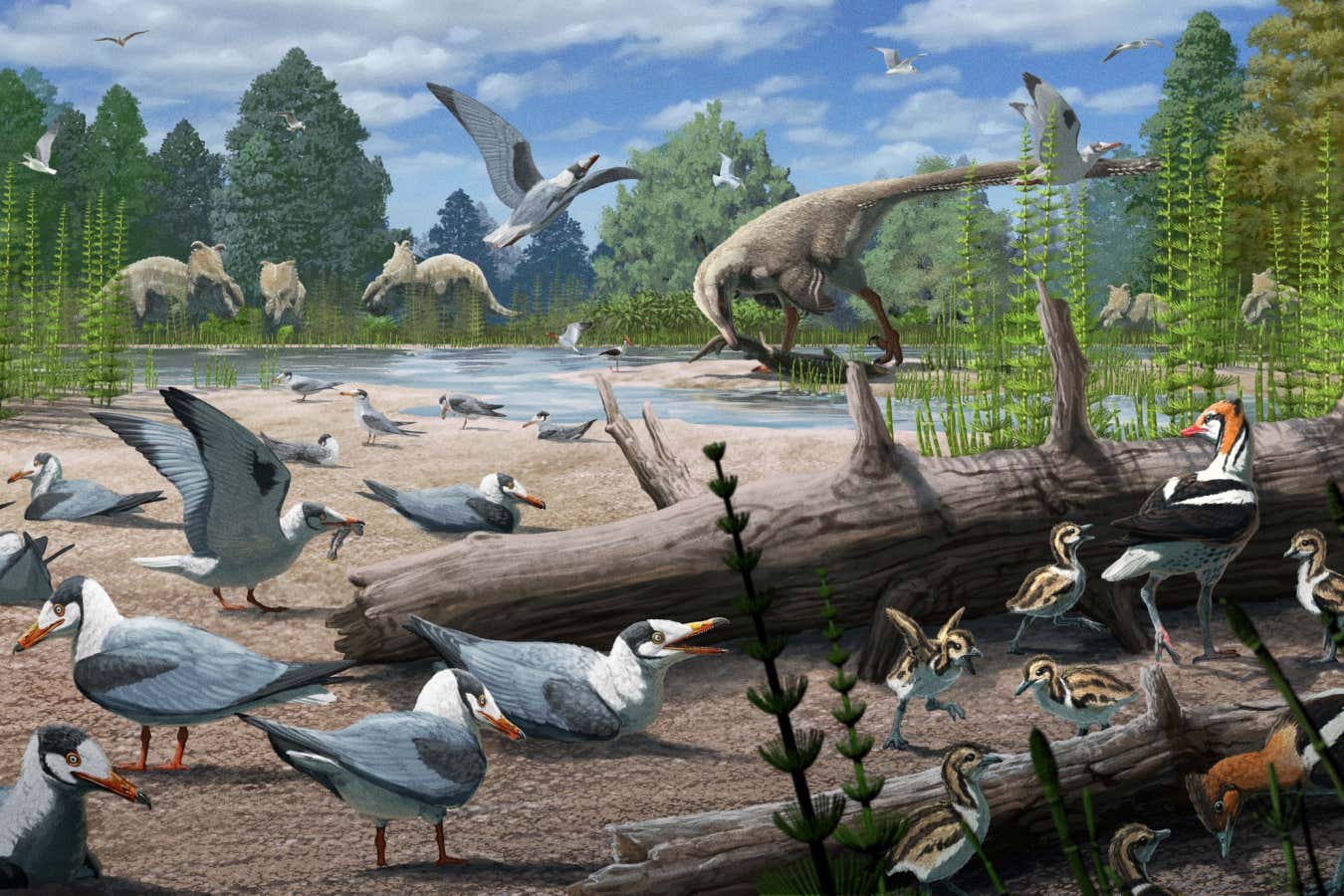
Illustration of ancient birds nesting above the Arctic circle
Gabriel Ugueto
Newly discovered bone fragments from Alaska suggest birds have been breeding and nesting in the Arctic for at least 73 million years.
“Which is kind of crazy, because it’s not easy to live in the Arctic and have newborn babies up there,” says study author Lauren Wilson at Princeton University.
Today, about 250 bird species have adapted to thrive at Earth’s poles. Some migrate great distances and only spend the summers there, with 24 hours of light each day. Others stay over winter too, enduring frigid temperatures and perpetual darkness for weeks on end. But very little was known about how and when these birds first got to the highest latitudes of Earth.
Wilson and her colleagues searched for traces of ancient birds in a sequence of rocks known as the Prince Creek Formation in northern Alaska, which were formed on a coastal floodplain about 73 million years ago. At that time, what is now northern Alaska was about 1000 to 1600 kilometres nearer the North Pole than it is today.
The team recovered chunks of ancient soil from some thin rock layers in the formation. This was during the winter, when temperatures were -30°C (-22°F) and home was a tent. “It’s definitely the most intense field work I’ve ever done,” says Wilson.
Back in the laboratory, they “spent hours staring” through a microscope “at grains of sediment that are smaller than two millimetres”, says Wilson, hunting through them carefully for tiny fragments of fossil bone.
They uncovered more than 50 ancient bird fossil fragments, many of which came from chicks or even embryonic birds. The fossilised bones of such young birds have a sponge-like texture because they represent a stage when bones are growing rapidly.
While birds probably began nesting in the Arctic even earlier than 73 million years ago, the fossils are the oldest traces of this behaviour found to date. They push back the record of this in birds by 30 million years.
Still, the fossils are very fragmented. They also don’t show whether the birds lived there year-round or just during the warmer summers.
“The Arctic as we know it, especially those food webs that eke out an existence in the cold and dark, could not exist without the many birds that call the high latitudes home,” says Steve Brusatte at the University of Edinburgh, UK, who wasn’t involved in the study. “These fossils show that birds were already integral parts of these high-latitude communities many tens of millions of years ago.”
Wilson’s team could identify three main groups of birds among the fossil fragments: extinct toothed birds similar to loons, extinct toothed birds similar to gulls, and some species that may belong to the same group as all modern birds.
The samples, though, didn’t have any bones from a group of more archaic birds known as the enantiornithines – or “opposite birds” – which dominate the fossil records from that time all over the rest of the world. Gerald Mayr at the Senckenberg Research Institute in Germany, who also wasn’t involved in the study, thinks this is a “significant” finding that could suggest that the ancestors of more advanced birds could cope with harsh Arctic conditions because of some unique evolutionary traits that the ancestral birds lacked.
The ecosystem that gave rise to the Prince Creek Formation existed at a time when the large non-bird dinosaurs still ruled the world, and fossils suggest the ancient birds shared these Arctic ecosystems with species of tyrannosaur and horned ceratopsians. There is even evidence that some of those dinosaurs nested in the Arctic as well.
Topics:
