

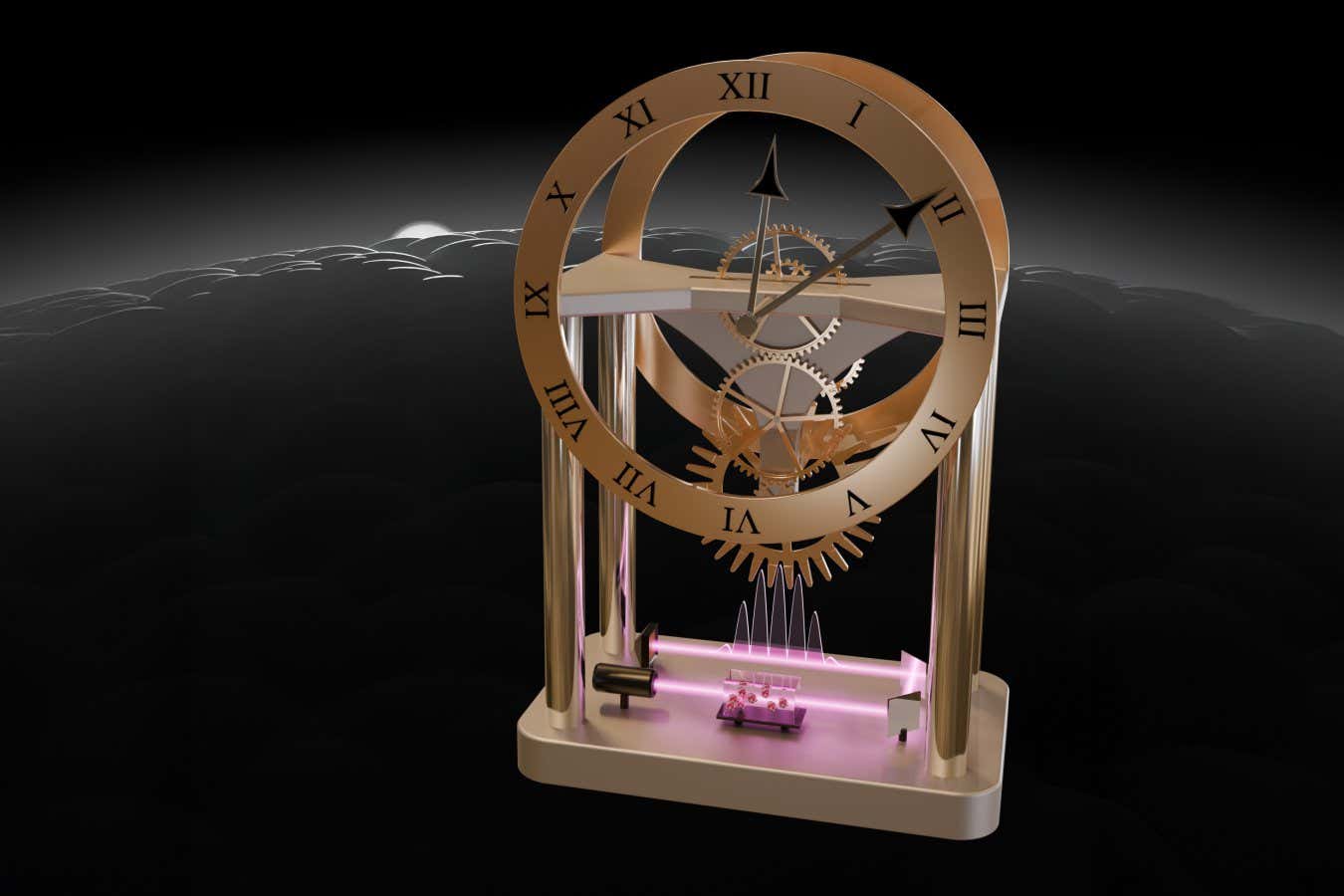
Conceptual illustration of a clock based on atomic nuclei
Oliver Diekmann, TU Wien
Scientists have built the first working nuclear clock, which uses the vibrations of atomic nuclei to keep time. Nuclear clocks have been sought after for more than two decades and could eventually allow for extraordinarily precise timekeeping and experiments that hunt for new physics.
The most accurate atomic clocks we currently have use electrons for timekeeping. Electrons occupy distinct energy levels, or orbits, around the atomic nucleus, and they only move between orbits when they are excited with light of a very specific frequency. The frequency of a light wave is defined by how many waves go past within a certain time, so counting these waves can be used for timekeeping, much like the ticking pendulum of a grandfather clock.
In an atomic clock, a laser tuned to the electron-exciting nuclear frequency is used to stimulate a collection of atoms. If it deviates from the correct frequency, fewer electrons will jump between energy levels and the frequency is corrected. This maintains the accuracy of the timekeeping, ensuring that clocks built in this way lose only a few seconds every billion years.
Atomic nuclei can also be made to bounce between energy levels. In theory, they promise greater accuracy than electrons because they have much higher energies and require more precise excitation. This means they have the potential to work to stabilities of seconds over hundreds of billions of years, far older than the age of the universe, which would help physicists look for exotic new physics.
A practical barrier to building these nuclear clocks, however, is that most nuclei require more energy to be excited than even the most energetic lasers can provide. But radioactive thorium can be excited with relatively little energy, so it has been the focus of a possible nuclear clock ever since the specific laser frequency required to excite its nucleus was first discovered in 2023.
Now, Thorsten Schumm at the Vienna University of Technology in Austria and his colleagues have built such a device. Made from thorium, it is already showing promise in the hunt for elusive dark matter particles. “It’s the culmination of 15 to 20 years of research,” says Schumm. “It’s amazing. Very few researchers actually see their dream become true.”
Previous systems have shown thorium’s nuclear frequency can be excited by the right laser, but they lacked the distinct frequency adjustment mechanism of a working clock. “If there’s ever going to be a ‘this is it’ moment, it’s probably this,” says Harry Morgan at the University of Manchester, UK.
Schumm and his colleagues built the clock by embedding the thorium in a crystal made from calcium fluoride and shining an ultraviolet laser through it. The laser, which acts as the clock’s ticking, periodically switches between two frequencies just above and below thorium’s known nuclear frequency. If the slightly higher and lower frequencies are absorbed by thorium equally, then the laser is tuned correctly. If it is different, then the clock uses this as feedback to tune the laser to the right frequency.
The nuclear clock doesn’t yet have the stability of the best atomic clocks, instead running at tens of seconds lost every billion years. But Schumm and his team say the clock is more of a proof of principle and they have yet to fine-tune the system with the best available lasers and electronics.
For such a simple prototype, it is demonstrating impressive stability, says team member Ekkehard Peik at PTB, the German national metrology institute. “What impressed me the most was that the system ran overnight and for 24 hours without user intervention,” he says. “This is something that has not been achieved so rapidly with other optical clocks.”
But even without this stability, the nuclear clock can do things that atomic clocks can’t. Because the nucleus is shielded from the chaotic electromagnetic environment of the atom’s electrons, it has a very precise transition that isn’t affected by moving electrons, which makes it more sensitive to external effects of physics. In practice, this means sensitive properties of the nucleons can be measured without the noise of electrons, which helps both for more accurate “ticking” and for measuring fundamental physical properties with greater precision.
. It also doesn’t need to be cooled to extremely low temperatures or have its atoms placed in a vacuum like atomic clocks, and instead works at room temperature. “It’s really the most simple thing you can imagine,” says Schumm.
This means the system should be more easily miniaturised, he says, which could allow it to be deployed in many different kinds of experiments, such as satellite tests of relativity. “While the current performance is considerably below the current state of the art, we can expect orders-of-magnitude improvement in the near future,” says Eric Hudson at the University of California, Los Angeles.
Schumm and his colleagues used the very high energies of the thorium nucleus to rule out possible dark matter particles. If dark matter is an electromagnetic-like force that permeates our universe, then it should subtly change the nuclear energy transitions of all matter, including thorium. This would make the specific frequency that the clock works at measurably different, which would be obvious because of thorium’s high nuclear frequency. “It’s a little bit like if you want to measure the change of length [in a metal] because of heat temperature change,” says Schumm. “The longer your stick, the larger the effect.”
Topics:
