

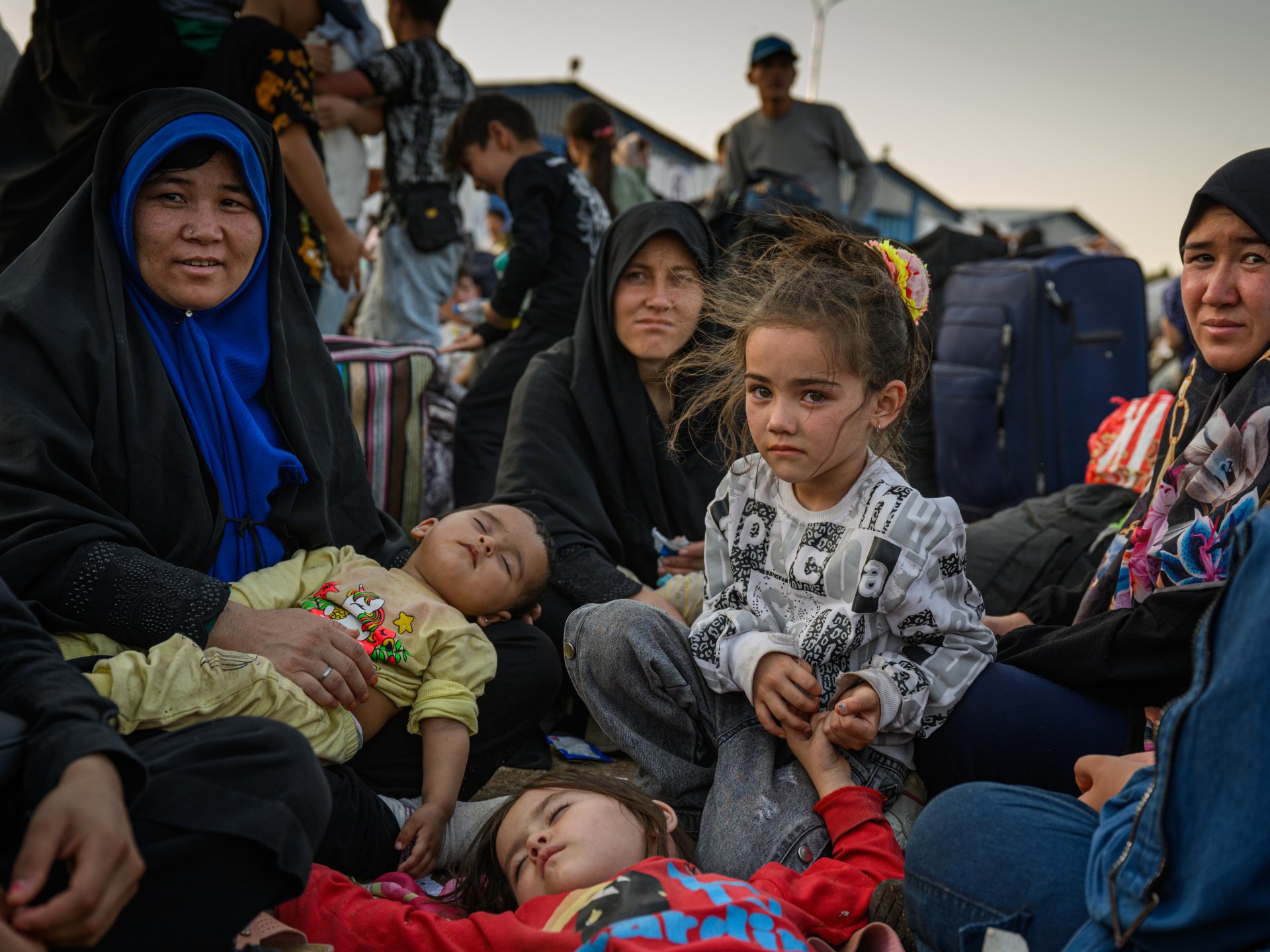
At the transit camp in Islam Qala in western Afghanistan, Fatima steps out of the bus into the blazing heat and an uncertain future. She is one of 10,000 people who has arrived from Iran that day and one of 800,000 who has arrived over the last six months. She hurries her three children to an empty spot, slumps onto the dusty ground, and shelters her family with bed sheets. When asked where she goes from here, she says a brother might take them in in her home town.
The IFRC supports the Afghan Red Crescent Society to provide hot food and healthcare at the camp. UN agencies provide some cash. But within a day, it’s time to leave. Bus drivers call out the names of Afghan cities and towns. Fatima lugs her cases towards a bus to Owbeh, in Herat province. Her three children trail behind her. She explains that she learned carpet weaving in Iran, but wasn’t allowed to bring any materials or instruments with her. How can she start from scratch without money, she asks. And who would buy her carpets in her village anyway? They have nothing. Not even to eat.
The departure from Iran has been traumatic, but her real challenges start now. When she arrives in her hometown, there will be no jobs in the public sector for her. Men will be reluctant to hire her because of the rules and regulations associated with employing women. Her one chance to cope will be to get her own enterprise going. For that, she’ll need start-up capital. She may also need assistance from her brother to access markets. It will be a struggle, but increasing numbers of Afghan women are rising to this challenge. Fatima could, too. If only she could get access to credit.
But will anyone in her community be able to buy her products? Like most Afghans, her neighbours will largely depend on agriculture, which will depend on irrigation and rain. In much of Herat province, and across the country, irrigation is becoming impossible because of drought. Rivers are dust. Underground water sources are drying up. With no possibility to farm, men are pouring into the cities in search of daily labour, only to find the battle for water is raging there, too. Mercy Corps has claimed that half of the boreholes in Kabul have dried out and the city could run out of accessible groundwater in five years. This trajectory could be slowed down or reversed, but only with major investment in water conservation, rain vats, storage dams, and check dams. Just the sort of investment that Afghanistan is struggling to raise.
If Fatima can earn a little money and live close to water, then she can focus on her children’s schooling. Her daughter will have to attend a madrassa. This will be a significant downgrade from her education in Iran. But if she’s lucky, it will be one of the many madrassas that are already introducing more varied subjects and offering classes until 12th grade. If she’s resourceful and can invest some funds, there may be other options too, including vocational training and online courses. The restrictions she will have to navigate are extreme, but not new. They reflect a long-running struggle between cities and the countryside, between desires for self-realisation and deeply rooted patriarchy. Foreign aid may help by quietly creating multiple and flexible opportunities to exchange and learn, while recognising that the ideological battles are for the Afghans themselves and will take time. Some organisations are trying to do this, but not to scale.
It will take a lot of luck for Fatima to get investment in her social enterprise, to access clean drinking water and to get an education for her children. The alternative is grim, and sadly, much more likely. Like most new arrivals, she will probably be destitute within weeks. She won’t access the rare opportunities for business support. Lack of water will empty the villages around her. If she stays put, her health will fail. Medical care will be too far to reach or too expensive. She may be forced to marry her daughter off early and nudge her boys away from school into some cheap, daily labour. This is what is happening across the country. If she can, to avoid such a terrible fate, she will try to get back to Iran.
Can foreign aid play a role in supporting Fatima and the millions like her? Despite all the reservations, humanitarian funding has been generous in the last four years. More than $7bn has been spent on assistance. Enough to have helped tens of thousands of women to start small businesses. Enough to have irrigated farms, deepened bore holes and stored water across the country. Enough to have created thousands of alternative learning options for children. Humanitarian agencies have tried to assist in all these areas, but the demand for emergency relief has taken the bulk of the funds, and many donors have been reticent to invest in anything longer term for fear of appearing to legitimise those in power.
The need for a new approach is compelling. There is less money available now due to aid cuts, but what little is left can still be invested into locally led strategies for livelihoods, water infrastructure, health and learning. This may give people like Fatima a spark of hope in their futures. This is what IFRC will focus on, as much as its resources allow.
If the moral case for that is not compelling enough, it is worth reflecting that on the current trajectory, the historic repatriation to Afghanistan taking place this year is likely to be a prelude to a much bigger exodus in the years to come. It would be far wiser to invest now and give people a chance to thrive in their home country than to invest much more in refugee camps and anti-trafficking work in the near future.
The views expressed in this article are the author’s own and do not necessarily reflect Al Jazeera’s editorial stance.
