

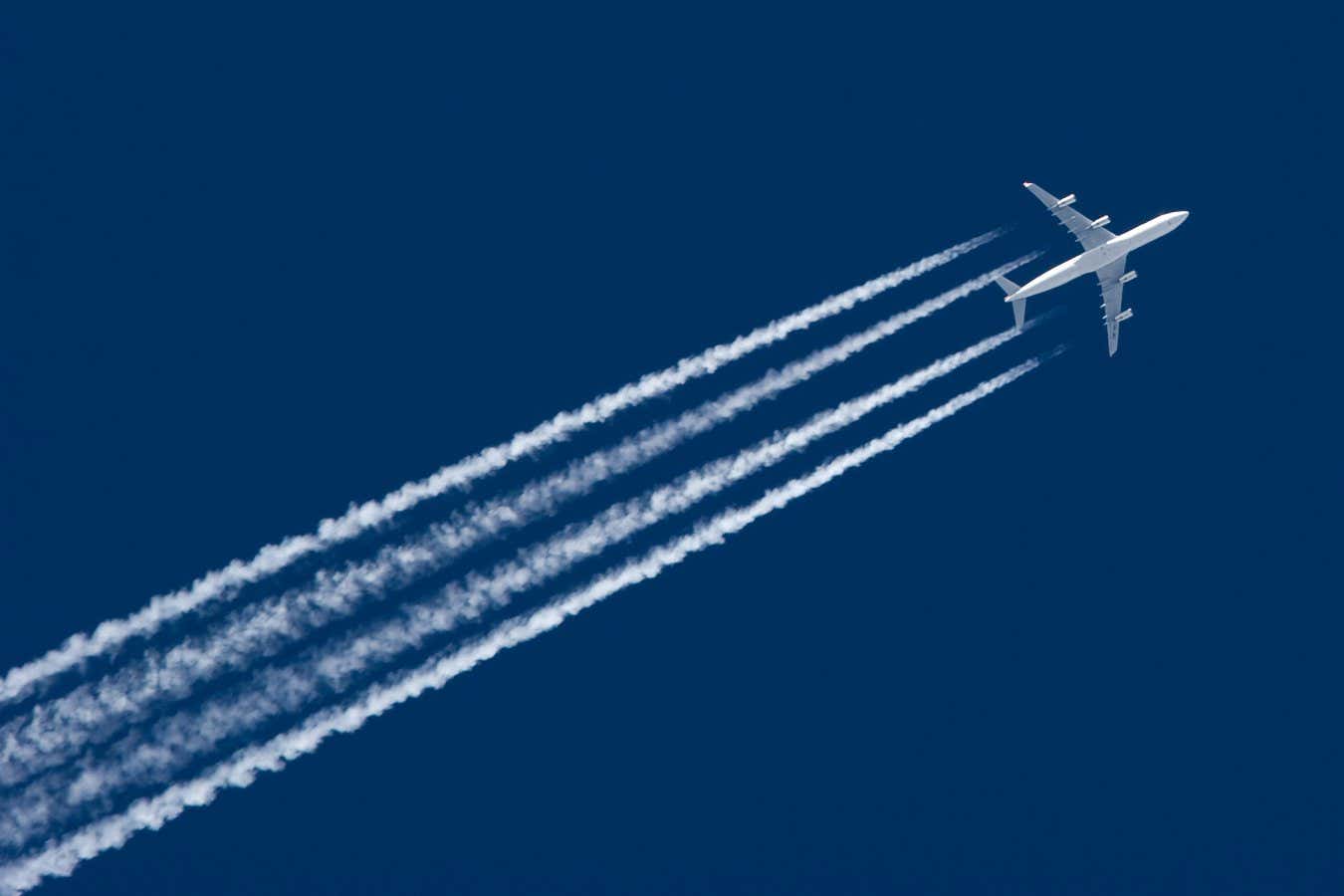
Commercial airliners could pass through clouds of sulphuric acid if solar geoengineering schemes go ahead
Alexandru Magurean/Getty Images
Spraying sun-reflecting particles near the poles to counteract global warming could expose passengers on certain commercial flights to hazardous levels of sulphuric acid.
With Earth on course for up to 3.7°C of warming by 2100, the idea of blocking the sun to bring temperatures back down is gaining popularity. The most widely discussed approach involves injecting sulphur into the stratosphere, in an attempt to emulate the large volcanic eruptions that have cooled the planet in decades and centuries past.
But spreading those chemicals into the upper atmosphere near the equator, where they would have the greatest and most enduring impact, would require a new generation of aircraft that can reach an altitude of 20 kilometres, nearly twice the maximum altitude of today’s planes.
As a more practical alternative, researchers have begun to investigate how Boeing 777s or similar planes could be upgraded to deposit sun-reflecting compounds in the sky near the poles, where the stratosphere dips as low as 7 kilometres. This, however, poses a potential hazard to flights, like those connecting Asia to North America, which often follow polar routes.
Most proposals involve releasing sulphur dioxide gas, which would then form sulphate aerosols in the atmosphere. In most commercial planes, air is routed from a compressor in the engine to the cabin via an environmental control system; during this process, the sulphates would react to form sulphuric acid.
“If airplanes can get up there to spray the sulphur, that’s also where airplanes go for passenger flights,” says Alan Robock at Rutgers University in New Jersey. “So I was wondering how much [sulphuric acid] passengers and flight crew would be breathing if they were flying through these clouds.”
Previous studies have simulated an injection of 6 million tonnes of sulphur dioxide into the stratosphere, 13 to 15 kilometres above the ground, near the North Pole between March and June, and a separate injection of the same size near the South Pole between September and December.
Atmospheric models suggest that these 12 million tonnes of total sulphur dioxide sprayed into the stratosphere would be sufficient to cool the globe between 0.6 and 1.0°C. Robock and his colleagues used the resultant concentrations of sulphuric acid from these simulations to estimate how much of this hazardous substance would pollute a plane’s cabin.
Geoengineering flights will spray the sulphur in long, thin plumes that will take days or weeks to spread and scatter. In some instances, passenger aircraft could travel through areas where cabin concentrations are just 7 micrograms per cubic meter, which is lower than the ground-level sulphur dioxide levels in many of the world’s largest cities. But the planes could also pass through regions that drive the amount of sulphuric acid well over 50 micrograms per cubic metre, a level the European Union defines as being hazardous.
Breathing sulphur dioxide can irritate the throat and inflame the lungs. At higher concentrations, it can trigger more severe respiratory issues, like a tightening of the airways, that impair people’s ability to breathe. Exposure to elevated levels of sulphur has also been linked to an increased risk of stroke. But even when concentrations aren’t high, the pollution can trigger asthma attacks. These risks would be highest for pilots and flight attendants who routinely travel on these flight paths.
“The sort of deployment discussed in the paper is many decades away, if it ever happens,” says Wake Smith of Harvard University. That would, he thinks, give airlines and engineers plenty of time to upgrade air filters to handle the loads of sulphur dioxide and sulphuric acid that are predicted in the study and thus keep passengers safe.
“It was a useful exercise to run because nobody had looked at this before,” says Daniele Visioni at Cornell University in New York state. “And they’re interesting preliminary results, but definitely not anything that would be a dealbreaker. The risks clearly lie elsewhere.”
Topics:
