

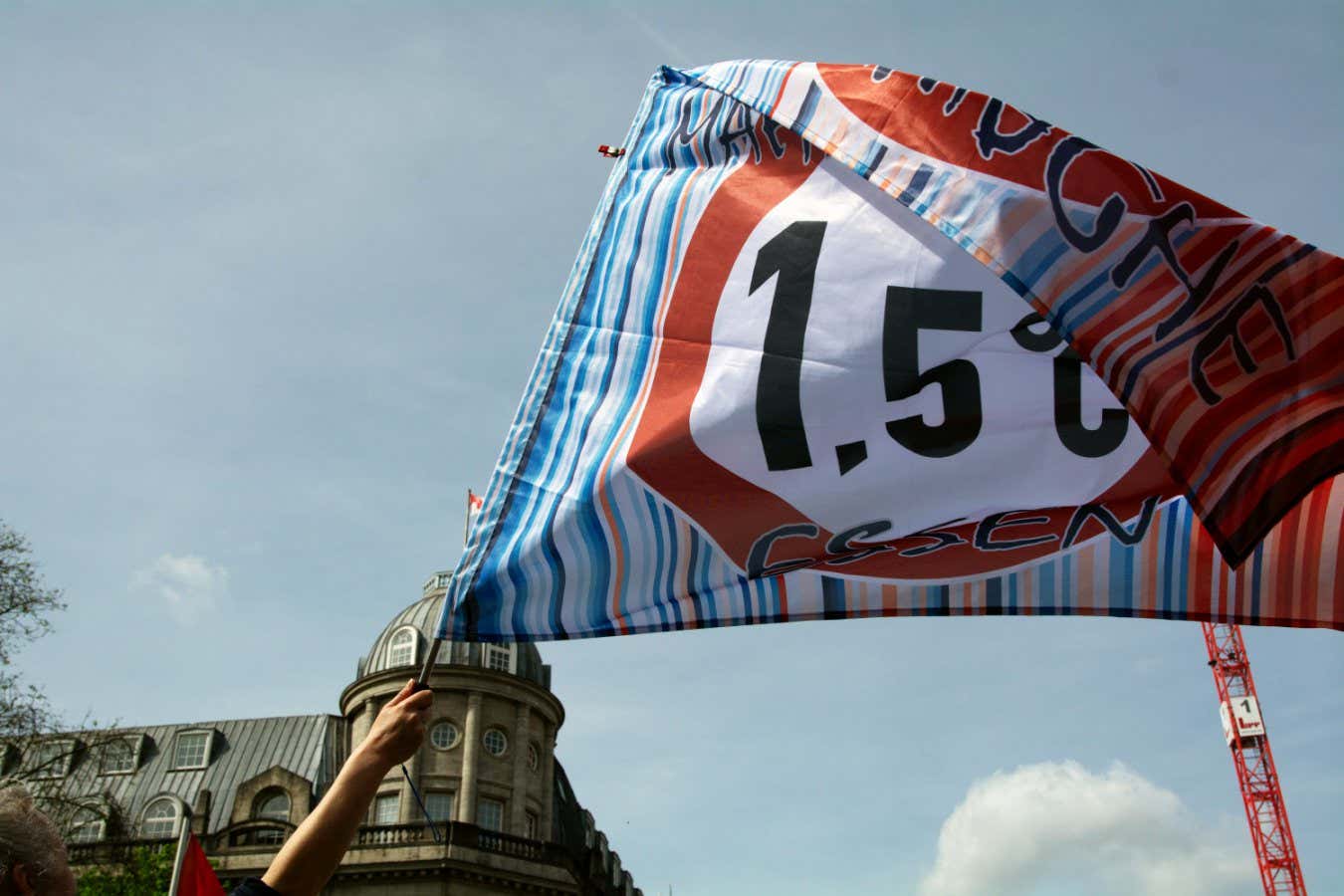
A climate protester’s flag in Düsseldorf, Germany
Ying Tang/NurPhoto/Shutterstock
Last month, researchers confirmed that 2024 was the first year to see global average temperatures rise more than 1.5°C above pre-industrial levels. It was a symbolic moment, given the world’s collective goal, set in 2015 under the Paris Agreement, to keep long-term warming to a 1.5°C threshold. But scientists were quick to stress that this goal is based on a 20-year average temperature, so global efforts to deliver on it are still – technically at least – in play.
Yet experts are increasingly asking whether shorter periods of high temperatures could be a sign that the world has already breached 1.5°C. Can we conclude that this target has bitten the dust?
Emanuele Bevacqua at the Helmholtz Centre for Environmental Research–UFZ in Germany and his colleagues set out to investigate whether a single warm year above 1.5°C could be a signal that long-term warming will soon reach that level.
Using a combination of real-world observations and climate models, Bevacqua and his team studied warming thresholds already breached between 1981 and 2014. They found that the first single year exceeding 0.6°C, 0.7°C, 0.8°C, 0.9°C and 1°C above the pre-industrial benchmark has consistently fallen within the first 20-year period in which the average temperature reached the same thresholds.
By that measure, the first single year above 1.5°C puts the world within the 20-year period scientists use to define 1.5°C of long-term warming, the team concludes. “It is highly probable that we are already within the 20-year period,” says Bevacqua. “We are most likely within the first 10 years [of the period]”.
The findings chime with most predictions that long-term warming will reach 1.5°C by the late 2020s or early 2030s. It is a “confirmatory result” of what researchers are already predicting, says Paulo Ceppi at Imperial College London.
But monthly temperature data may tell a different, more concerning, story. June 2024 was the 12th month in a row with average global temperatures at least 1.5°C above pre-industrial levels. In a separate study, Alex Cannon at Environment and Climate Change Canada used a climate model to compare the first time global temperatures reach 1.5°C for 12 consecutive months with the time when the 20-year temperature average crosses 1.5°C.
He found that, in climate model simulations, a run of 12 consecutive months above 1.5°C indicates an 80 per cent likelihood that long-term warming of 1.5°C has already been reached, even when natural variability such as El Niño phases are accounted for. “If you shift back into the real world, that would imply that there’s a good probability we have already passed the long-term threshold [for 1.5°C],” he says.
However, the conclusions are based on a climate model that assumes Earth’s atmosphere is very responsive to changes in CO2 concentrations. The model is also running a high emissions scenario, notes Duo Chan at the University of Southampton, UK. “I will interpret the result with caution,” he says. Cannon notes this limitation in the study and suggests that if the model’s climate sensitivity is tempered and run on a medium emissions scenario, the long-term crossing of the 1.5°C threshold would probably occur before 2029, in line with estimates from the wider community.
The conclusions also rely on models being able to accurately represent all drivers of warming and predict year-to-year variability in the global temperature. “If the models underestimate this variability, then they would overestimate the probability of having exceeded 1.5°C for a given number of months above the threshold,” says Ceppi. More research is needed to verify how well climate models are simulating short-term variability, he says, particularly given uncertainties about effects such as the reduction in atmospheric aerosols from shipping. Aerosols reflect sunlight out of Earth’s atmosphere, and so using cleaner shipping fuels can paradoxically lead to increased warming.
Such uncertainties mean we should be cautious about over-interpreting results from single studies. After all, the Paris Agreement is a major political treaty, and declaring one of its key goals dead and buried would have seismic consequences. “[To answer] the question of whether or not we have exceeded the temperature levels referred to in the Paris Agreement, we would need to have very high scientific certainty, and we do not have that,” says Carl-Friedrich Schleussner at the research institute Climate Analytics in Berlin, who contributed to Bevacqua’s study.
Cannon says even with the results of his research, “I don’t have sufficient information to say that [the 1.5°C goal has been breached] with any certainty”. The problem, he says, is that climate models predicting this scenario didn’t expect the recent run of record-breaking temperatures. “There’s an inconsistency between the timing in the models and what we’ve actually observed.”
This implies the models are missing something that explains the recent surge of real-world warming. Most climate models don’t take into account the reduction in aerosols from shipping, which is one possible explanation. Cannon says his work is unearthing “warning flags that we need to understand things better”.
Yet even if it is too early to say whether the Paris goal has already been reached, to some extent this is splitting hairs. “We are entering a 1.5°C world,” says Schleussner, with warming levels now very close to this critical threshold. “The impacts that scientists told us will happen around 1.5°C [of warming] are going to materialise.”
“The truth of the matter is that the goals of the Paris Agreement hang in the balance,” he stresses. “If we continue on the current track, we will fail.”
Topics:
