

College campuses are known for acerbic disagreement. What does a just society look like? What is the best way to distribute society’s resources? How should the latest geostrategic crisis be handled? These days, the contention turns on the very mission of higher education. What is education supposed to be like in the age of AI? The debate could not be more polarized: According to some, responsible educators should prepare students for artificial intelligence with AI, lest those students find themselves undesirable in the workplace of the future; others believe that the incursion of AI into education is destroying critical thinking skills, and consequently, learning itself. Boosters see in AI the combination of unprecedented opportunity and peril; critics say they have seen hyped-up educational technologies too many times before. The best is yet to come; the worst is yet to come; or maybe, we’ll spend enormous time and money just to stay where we are.
There is speculation about AI in education, and then, there are facts. Many students are already using AI-powered tools, like chatbots. Some students turn in AI-generated output for assignments. Copying another human’s work without attribution is a clear academic integrity violation, but few had thought to set rules on chatbot output until recently. Now, universities are tightening those rules, but gray areas are impossible to avoid. What constitutes AI help in writing? What if students are using AI tools to check for typos only? What if they are bouncing ideas off of an AI tool before making up their mind? These questions are not merely about policing the boundaries of academic integrity; instructors are under pressure to rethink course design, adjust course content and come up with alternative assignments so that AI can enhance, rather than replace, students’ learning experience.
Student use of AI is one facet of its adoption in higher education. Since the public release of ChatGPT in November 2022, there has been an explosion of EdTech tools tailored to plagiarism detection, grading assistance, peer review, lesson-plan creation and more. At a bare minimum, AI tools are expected to boost productivity for tasks ranging from drafting emails to preparing course outlines. A more ambitious expectation is improved learning outcomes thanks to personalized AI tutors — provided, of course, that the wildly inaccurate and inconsistent outputs known as AI “hallucinations” are eliminated over time.
University administrators have had to respond to the AI moment. Just about every campus has an AI initiative or equivalent. Recognition as the most AI-forward campus is the elusive great reward for administrators playing the numbers game. Some universities have designated chief AI officers. The University of Washington has recently announced a Vice Provost for AI. There is no uniform approach to AI incorporation, though. Making effective use of commercial AI chatbots can be one goal; producing an exclusive campus chatbot can be another. Many institutions offer AI literacy programs as a cost- and time-effective method for bringing students up to speed.
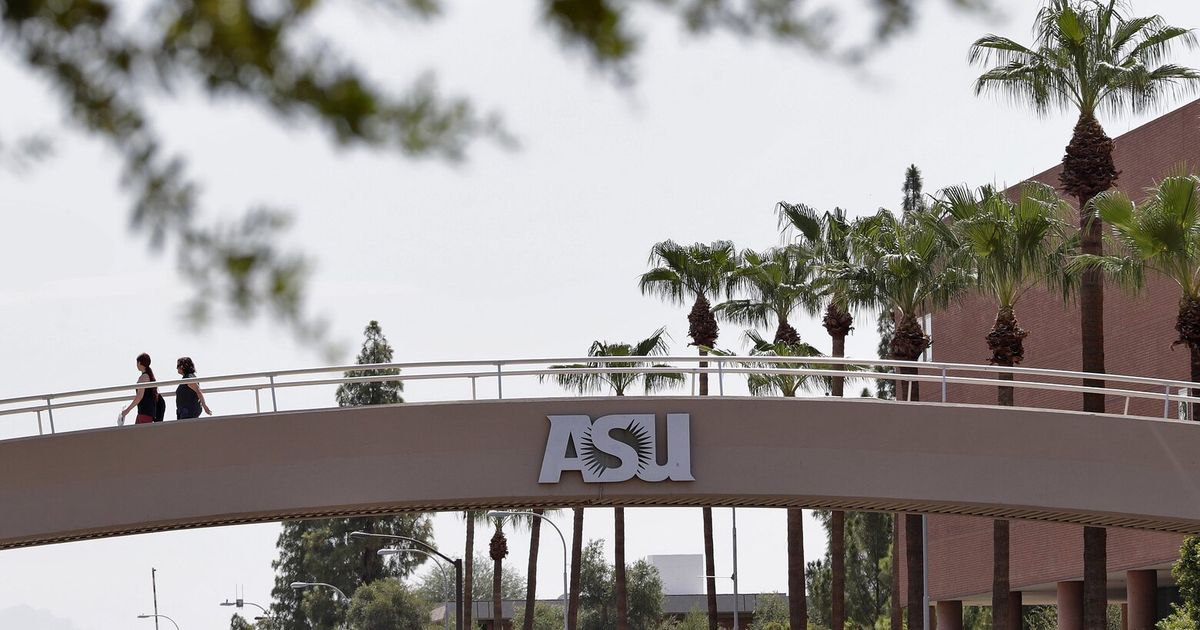
AI adoption on campus is happening against the backdrop of significant student and faculty discontent over the potential risks and actual harms of AI, including trust and safety issues, environmental impact and intellectual property violations. Tensions rose at Arizona State University where a pilot program called ASU Atomic claims to offer personalized educational modules — a collage of content that one professor called “Frankensteinian.” The main legal and ethical questions hinge on whether a university administration can use instructional resources to train AI. ASU’s Board of Regents owns intellectual property for content instructors create using “significant” university resources, but it is worth mentioning that use for training AI models is not mentioned in the Intellectual Property Policy. Far from a one-off controversy, the AI controversy at ASU may extend to other campuses where stakeholders are not aligned over the ends and means of AI development and use.
It is undeniable that the pressure to adopt AI for personal productivity, student success and workforce preparation is immense. Yet, another undeniable fact remains: By and large, educators remain AI skeptics. AI inaccuracies scare professionals whose entire vocation is premised on logical and mathematical facts, scientific findings, and broadly speaking, the pursuit of truth. Furthermore, many of them are unconvinced that AI in education is inevitable, transformative or even all that useful. A more fundamental objection — one that advances in the underlying technology cannot address — is that learning cannot be reduced to quick information acquisition and retrieval, as it requires repetitive drills, struggling with one’s own errors and misconceptions, a quest for appropriate logical, scientific and philosophical tools, and ultimately, moments of discovery and growth.
My wild speculation is that AI will revolutionize those components of education for which efficiency is necessary — say, information retrieval — but will not replace the processes of learning that are slow, repetitive and reflective by design. Scaffolding course and curriculum design to build guardrails around the misuse of AI will be the real AI revolution in education.
