
Close Menu
    National News Brief
    Monday, November 16
    • Home
    • Business
    • Lifestyle
    • Science
    • Technology
    • International
    • Arts & Entertainment
    • Sports
    National News Brief
    Home » Huge cloud of plasma belched out by star 130 light years away

    Huge cloud of plasma belched out by star 130 light years away

    Team_NationalNewsBriefBy Team_NationalNewsBriefNovember 17, 2025 Science No Comments3 Mins Read
    Share
    Facebook Twitter LinkedIn Pinterest Email


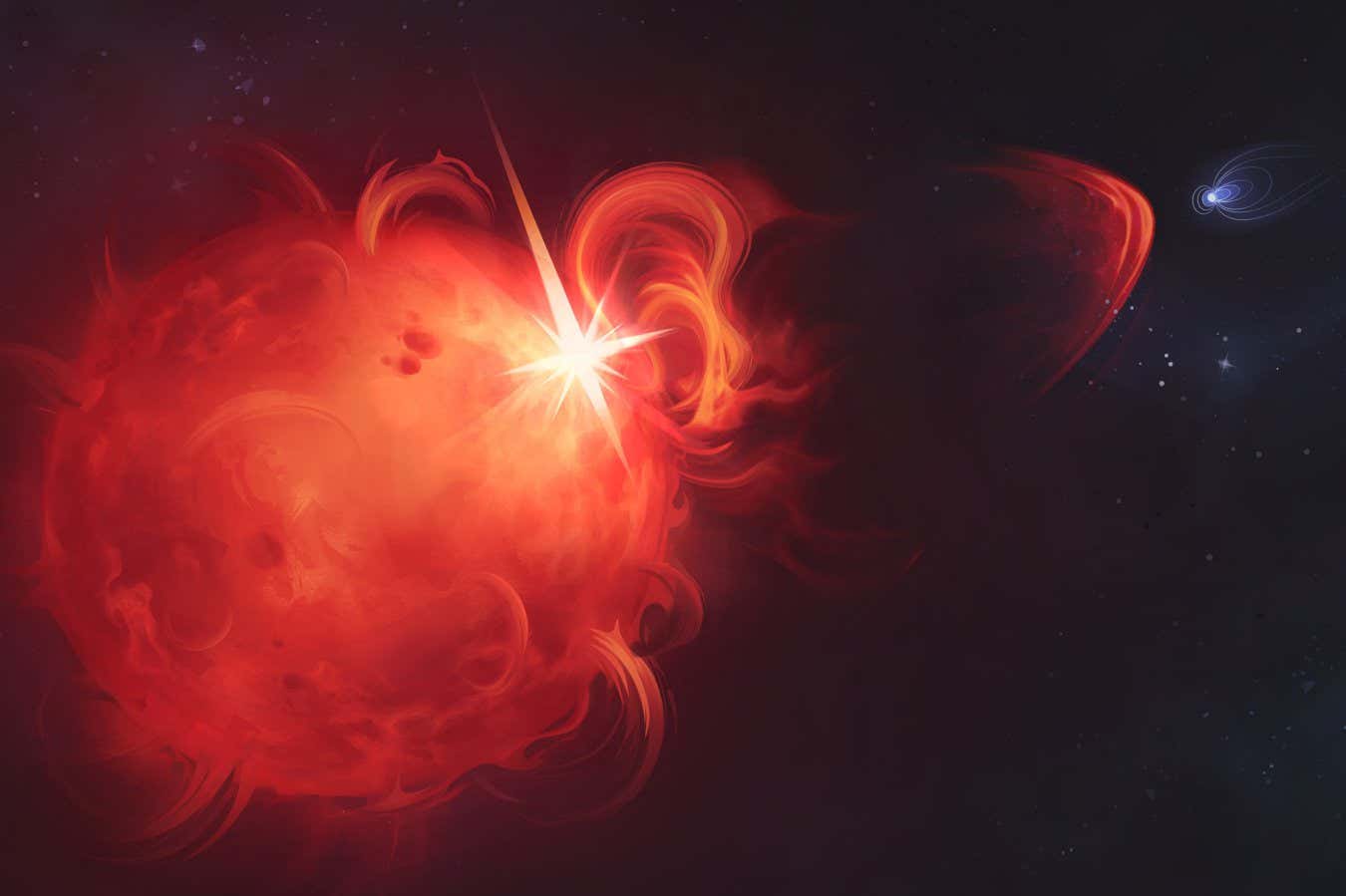
    Artist’s impression of a coronal mass ejection on a star

    Olena Shmahalo/Callingham et al.

    A cloud of plasma ejected by a star 130 light years away has been detected by a radio telescope on Earth, giving astronomers their first definitive observation of a coronal mass ejection (CME) from a star beyond our sun.

    CMEs occur when storms on the surface of a star fling out bubbles of magnetised plasma into space. Such eruptions from our sun produce the auroras we see on Earth, but they can also be powerful enough to rip the atmosphere away from Venus, which is closer to the sun and isn’t protected by a magnetic field.

    Scientists have seen hints of CMEs on distant stars for decades, but have been unable to prove that material actually escaped the stars’ gravitational and magnetic pull, rather than just leaping up from the surface before being drawn back in.

    Now, Joseph Callingham at the Netherlands Institute for Radio Astronomy and his colleagues have used the Low Frequency Array (LOFAR) radio telescope in the Netherlands to pick up a burst, or radio waves, emitted by a CME as it travelled through space. These signals would be possible to detect only if the ejection had completely left the star StKM 1-1262, from which it originated. 

    The team also used the space-based X-ray telescope XMM-Newton to determine the originating star’s temperature, rotation and brightness.

    Callingham says prior observations suggested that CMEs happened on distant stars, but that this new data is the smoking gun that confirms it. “You could argue that we’ve had hints for 30 years, and that’s true, but we never explicitly proved it,” he says. “We’re saying that mass has been ejected, has been lost from the star, and that’s always been a debate in the literature.”

    The radiation from the ejection would have been powerful enough to jeopardise any nearby life forms. Anthony Yeates at Durham University, UK, says greater knowledge of the frequency and magnitude of CMEs from distant stars should be incorporated into models about the potential habitability of exoplanets. “If there was an exoplanet, it would have been quite catastrophic for any life on it,” he says.

    New Scientist. Science news and long reads from expert journalists, covering developments in science, technology, health and the environment on the website and the magazine.

    The world capital of astronomy: Chile

    Experience the astronomical highlights of Chile. Visit some of the world’s most technologically advanced observatories and stargaze beneath some of the clearest skies on earth.

    Article amended on 12 November 2025

    We corrected the star’s distance from Earth.

    Topics:


    Source link

    Team_NationalNewsBrief
    • Website

    Keep Reading

    The neuroscience behind stuttering | Scientific American

    Record-breaking simulation sheds light on cosmic ‘dark ages’

    Why your brain sometimes craves sour tastes

    The Euclid space telescope captures nearly a billion celestial objects in stunning detail

    Scientists might have discovered what makes AI so effective at chess

    We beat screwworm once. Here’s how we’re trying to do it again

    Add A Comment

    Comments are closed.

    Editors Picks

    Moody’s pushes US out of top triple-A rating club citing rising debt

    May 16, 2025

    Seven mouths, one meal: Feeding a family through Gaza’s food crisis | Gaza News

    September 6, 2026

    Trump’s tariff ‘medicine’ injects turmoil into global markets

    April 8, 2025

    Kansas City Royals Official Team Website

    August 23, 2026

    Forecasting The Future | Armstrong Economics

    May 28, 2026
    Categories
    • Arts & Entertainment
    • Business
    • International
    • Latest News
    • Lifestyle
    • Opinions
    • Politics
    • Science
    • Sports
    • Technology
    • Top Stories
    • Trending News
    • World Economy
    About us

    Welcome to National News Brief, your one-stop destination for staying informed on the latest developments from around the globe. Our mission is to provide readers with up-to-the-minute coverage across a wide range of topics, ensuring you never miss out on the stories that matter most.

    At National News Brief, we cover World News, delivering accurate and insightful reports on global events and issues shaping the future. Our Tech News section keeps you informed about cutting-edge technologies, trends in AI, and innovations transforming industries. Stay ahead of the curve with updates on the World Economy, including financial markets, economic policies, and international trade.

    Editors Picks

    How Sam Bankman-Fried Lost Out on a $35 Billion Jackpot From Anthropic

    November 16, 2026

    Ireland Refuses To Hunt Down Men For Zelensky

    November 16, 2026

    Connecticut’s Top 5 High School Football Plays, Weeks 9-10

    November 16, 2026

    Taylor Swift’s Lawyers Fire Back In Bitter Showgirl War

    November 16, 2026
    Categories
    • Arts & Entertainment
    • Business
    • International
    • Latest News
    • Lifestyle
    • Opinions
    • Politics
    • Science
    • Sports
    • Technology
    • Top Stories
    • Trending News
    • World Economy
    • Privacy Policy
    • Disclaimer
    • Terms and Conditions
    • About us
    • Contact us
    Copyright © 2024 Nationalnewsbrief.com All Rights Reserved.

    Type above and press Enter to search. Press Esc to cancel.