

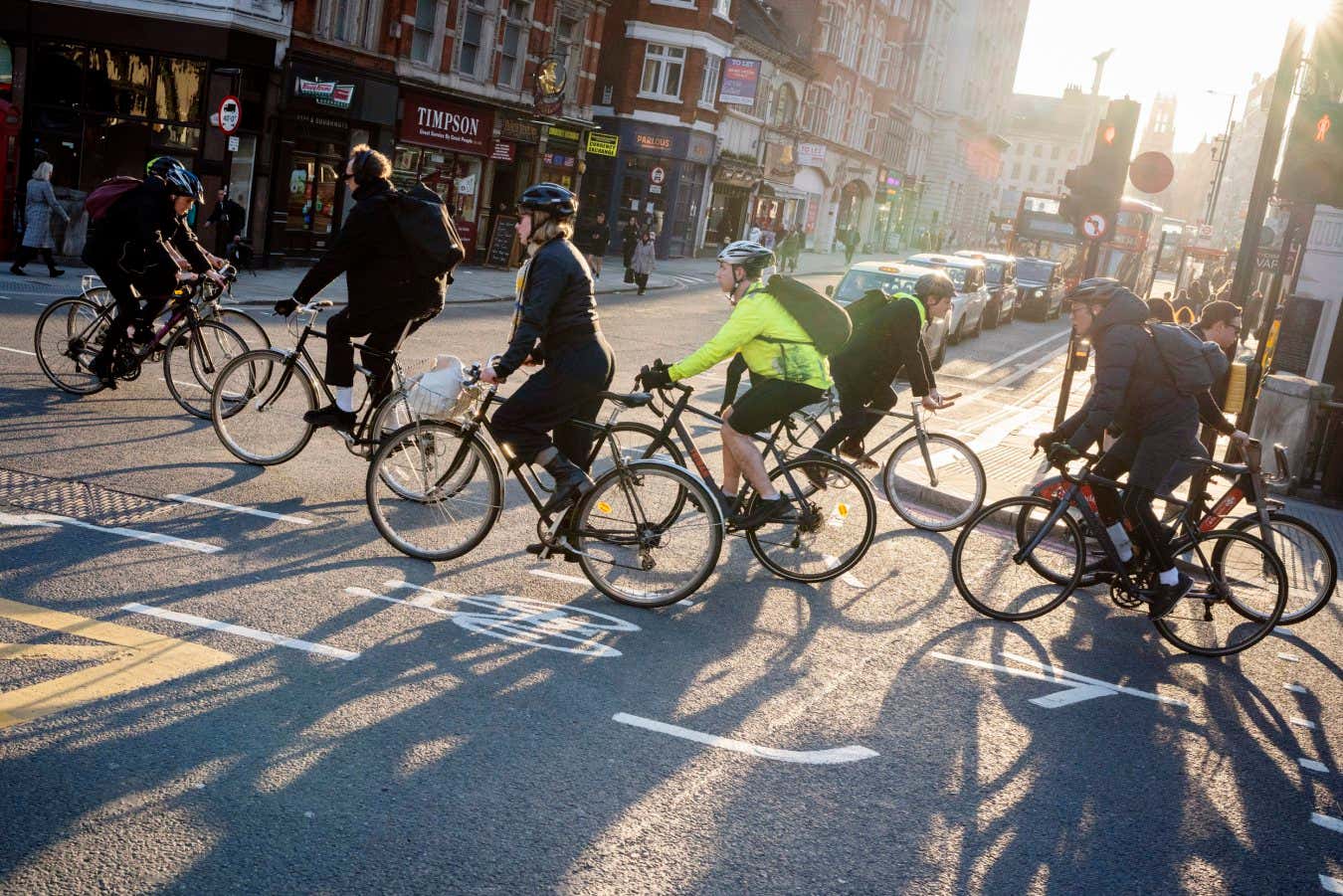
“I cycle everywhere in London…”
Richard Baker/In Pictures via Getty Images
Having plied their trade in several US and Chinese cities for years, driverless taxis are on their way to London.
As a cyclist, a Londoner and a journalist who has spent years covering AI’s pratfalls, I am a tad nervous. Yet, given how often I have been struck by inattentive human drivers in London, part of me is cautiously optimistic.
At the end of the day it boils down to this: will I be better off surrounded by tired, distracted and angry humans, or unpredictable and imperfect AI?
The UK government has decided to allow firms like Uber to run pilots of self-driving “taxi- and bus-like” services in 2026. Then, in the second half of 2027, things will ramp up fast as the Automated Vehicles Act becomes law, giving the industry a proper legal framework. Crucially, this law holds car-makers responsible for accidents rather than occupants.
The government claims driverless cars could actually improve safety, given that human error contributes to 88 per cent of all road accidents. And there are plenty of those: there were 130 deaths on London’s highways last year alone, which includes 66 pedestrians and 10 cyclists. Globally, around 1.2 million people die each year on the roads.
I cycle everywhere in London and it gives you insight into the problem. I have seen drivers reading, eating bowls of cereal and watching movies. I have been crashed into from behind at red lights at least four times. They say that one thing AI lacks is creativity, and in the field of poor driving, humans really do have flair.
Meanwhile, AI doesn’t get tempted by a text, take drugs or drink, or nod off. It doesn’t make turns without checking blind spots, because there is no such thing as a blind spot for a machine that has dozens of sensors.
Yes, there are very worrying examples of driverless cars simply failing to stop for pedestrians and killing them. These, rightly, are big news. But we have become so inured to road deaths that reports of the far more numerous ones involving human drivers barely register – more than four people a day die on UK roads, on average.
The robocar safety issue is a delicate one. In my opinion, not a single road death should be tolerated, but from a pragmatic point of view, if AI can drive the same number of miles and kill fewer people, then there is a strong argument that we shouldn’t make perfect the enemy of progress.
“
You can’t be sure that an autonomous car won’t decide a pedestrian is a shadow and run them over
“
Indeed, studies have shown that driverless cars tend to be safer than those piloted by humans, although this record dips in dim lighting and when making turns – hardly a rarity in city driving – and there are concerns about under-reporting of accidents.
We also rely on tech firms to make robotaxis safe, and there could be a conflict of interest here between profit and the greater good. Already we have seen morally repugnant efforts to pass the problem on to pedestrians by suggesting they wear electronic sensors to broadcast their presence to such machines.
When it comes to cyclists, do tech firms ensure they are given 1.5 metres of space when their robocars overtake them, or do they decide that as long as a cyclist isn’t knocked off, that is OK? The latter would both improve car journey times in a busy city and terrify and imperil cyclists. How forcefully will robocars barge out of side roads to join busy routes? Do they wait for pedestrians to fully cross roads, or keep rolling at a pace that encourages the sad little trot we do to appease drivers? These are all parameters that can be changed, and there will be a commercial tussle between safety and speed of journeys.
Even if firms act altruistically, AI is non-deterministic. We can’t perfectly predict how it will behave in any given situation. Just as you can’t guarantee a chatbot won’t list glue as an ingredient in a pizza recipe, you can’t be totally sure an autonomous car won’t decide a pedestrian is a shadow and run them over. That isn’t convenient, or reassuring to hear, but it is a fact.
In truth, I don’t trust AI to operate a car near to me. Nor do I trust people to do it. But while humans are about as good as they are going to get, AI has the potential to improve rapidly. Trials of autonomous taxis in London will provide valuable training data, with the potential to improve safety in a virtuous circle. In the long term, if I had to pick, I am opting for AI drivers.
That said, the harsh reality is that a couple of tonnes of steel, five armchairs and 100 computers on four wheels is never going to be a sensible, totally safe or efficient means of urban transport. Such taxis are as poor a solution to transport in tomorrow’s London as human-driven ones are today.
Electric bikes and safe cycle lanes are greener and can get people from A to B faster, while buses can carry 80 people in the space taken up by two SUVs. But there is no profit margin in that for big tech, is there?
Matt’s week
What I’m reading
How Music Works by Talking Heads frontman David Byrne.
What I’m watching
Horror film Bring Her Back (through hands clamped over eyes at points, admittedly).
What I’m working on
Preparing lots of cuttings in the garden to fill some bare spots next spring.
Matt Sparkes is a technology reporter at New Scientist
Topics:
