

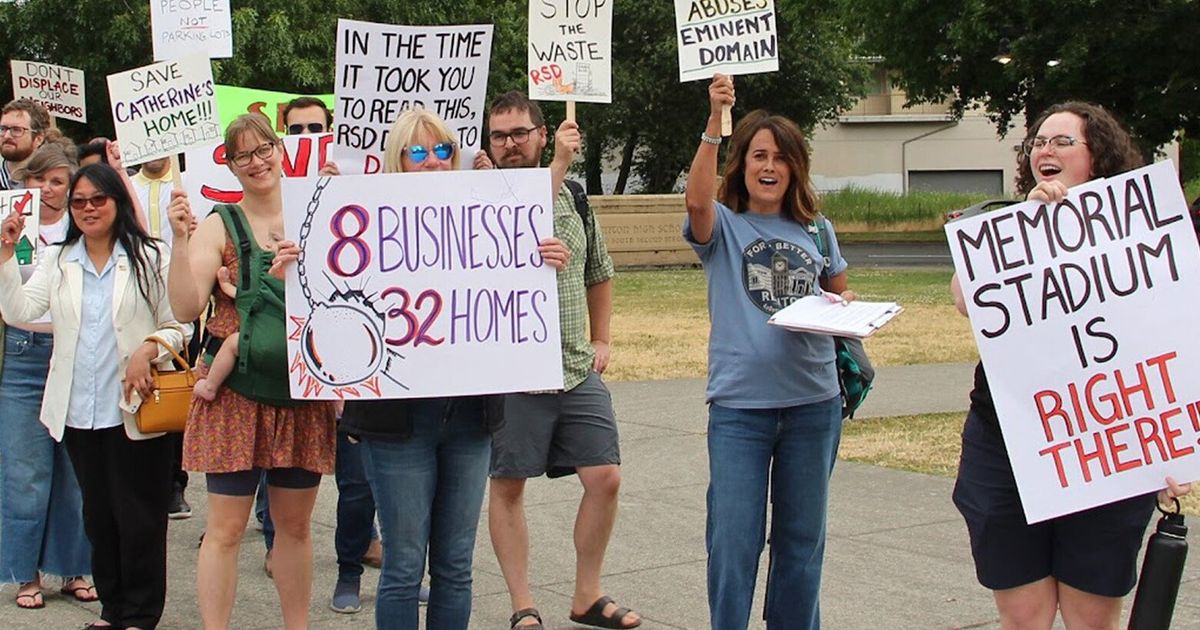
On a Wednesday evening outside the Renton High School Performing Arts Center, chants filled the air: “Houses, not ballfields!” “You displace one of us, you displace all of us!” It’s not a typical scene in Renton, a suburb south of Seattle where civic engagement is usually muted, local School Board elections are often uncontested and City Council election turnouts are low. But that night, residents from across Renton showed up to the School Board meeting with a protest, petition and public comments to make a simple demand: accountability.
In a time when faith in American democracy is waning, what’s happening in Renton offers a rare glimpse of democratic hope: ordinary people organizing, mobilizing and engaging in the civic process to stand in solidarity with their neighbors.
This story begins in 1968, when the Renton School District seized the land of the Houston family — one of the few Black families in the area to own property — through eminent domain. The district never built a middle school, as it had promised. Instead, it sold the land and turned a profit, while the Houston family was left struggling.
Fifty-five years later, history is repeating itself. The district is again invoking eminent domain, this time to force out longtime residents and small-business owners to primarily build ball fields and a parking lot when there is already a stadium nearby for student athletes.
The families being displaced include a woman who volunteered in the district for two decades, retirees who cannot afford to relocate and immigrants for whom English is not a first language. The justification for this expansion? A 2022 bond measure that voters approved to “provide safe, modern facilities to enhance learning.” But ball fields and a parking lot do not fulfill that promise.
In 1968 no one mobilized, so why are people doing so now?
Because this time, the families aren’t alone. A member of South Renton Connection, a neighborhood group on the other side of town, told us residents were being displaced. She then connected me to the North Renton Neighborhood Association, where I met others similarly informed and outraged. We pooled our knowledge about eminent domain and the board plans, displaced people’s stories, alternatives that could improve the school and save homes, and what leadership should look like in our community.
Word continued to spread. A local business owner got others to sign a letter to the School Board in solidarity with the residents and businesses. New groups formed, such as For a Better Renton, which brought together people with the mission of holding Renton public officials accountable. This group introduced me to John Houston, who told me his story. Across Renton, neighbors began organizing — sharing resources, petitioning, canvassing, holding teach-ins about civic literacy and collectively pursuing politics that persuade elected officials to be responsive to their constituents.
What emerged was a vision of democracy often romanticized but rarely practiced: one where people put the most vulnerable first and work together, despite differences in opinion, to build alternative solutions that take care of everyone. We aren’t just trying to stop an expansion plan. We are trying to transform how power operates in our community.
This is not politics as performance. This is politics as collective care.
We know that we may not succeed in reversing the district’s use of eminent domain. But that does not mean we are not making progress. Houston successfully advocated for a bill signed into law last month, the Houston Eminent Domain Fairness Act (SB 5142), that prohibits school boards from making a profit from eminent domain. The next step is ensuring our public officials use these tools with care and then holding them accountable when they misuse it to harm the community. We know that no matter what happens, we are building — new political structures, civic networks and expectations that will make our democracy more responsive, more representative and more just. That’s worth fighting for.
In an era when Americans are told that democracy’s survival hinges on one election or one leader, Renton’s story reminds us that democracy begins at home. It begins in how we treat each other, how we show up for one another and how we hold public officials accountable. If we fail to do that, we will continue to see democracy falter — one displacement, one silence, one forgotten neighborhood at a time.
The question isn’t whether democracy can be saved. The question is: Will you fight for it?
