

Intuitive Machines landed a robot on the moon last year. Can the Houston company do it again, but keep the spacecraft upright this time?
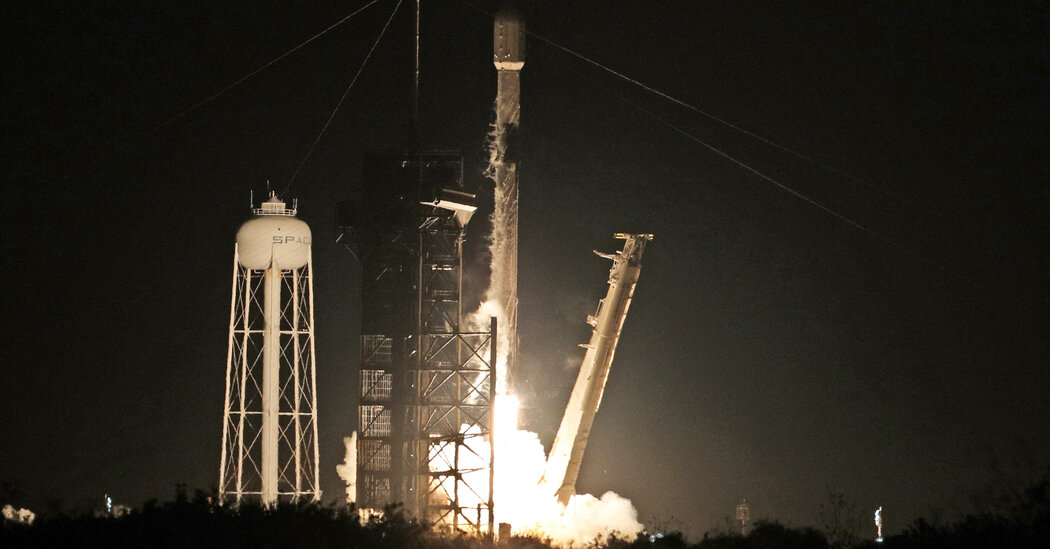
The company’s second lander, named Athena, launched on Wednesday evening on a SpaceX Falcon 9 rocket from NASA’s Kennedy Space Center in Florida. It is now on an arcing path to the moon.
The spacecraft turned itself on, but then several minutes of suspense followed when it was late to check in. Eventually, data from the probe arrived, accompanied by relief at Intuitive Machines’ mission control.
On March 6, the spacecraft will attempt to land in Mons Mouton, a region about 100 miles from the moon’s south pole. That will be closer to the south pole than any previous spacecraft has landed.
When Intuitive Machines’ first lander, Odysseus, set down on the moon in February last year, it managed to communicate with Earth even though it had toppled on its side. It was the first commercially operated lander to reach the moon’s surface, and the first American vehicle to land softly on the moon since Apollo 17 in 1972.
The main payload on Athena is a drill for NASA as part of its Commercial Lunar Payload Services program. Paying a commercial company like Intuitive Machines to take something to the moon is cheaper for NASA than designing and building its own spacecraft.
The drill is designed to dig about three feet below the surface, pulling up lunar soil about four inches at a time and dropping it onto a pile on the surface. An instrument known as a mass spectrometer will then sniff around the drilled material for compounds like frozen water that easily transform into gases.
The Athena lander is also carrying three robotic rovers and a small flying “hopper” that will be deployed after landing.
The largest rover, known as the Mobile Autonomous Prospecting Platform, or MAPP, is part of a NASA-financed test of the first cellphone network on the moon. Nokia won financing from the space agency to test the technology but then needed a way to move at least one antenna some distance from the lander. So Nokia hired a company called Lunar Outpost to build the rover, which is about the size of a small dog.
Lunar Outpost sold space on MAPP to other customers. One, the Massachusetts Institute of Technology, built a tiny rover called AstroAnt, which will crawl around on the top flat surface of MAPP.
Athena will also deploy a rover called Yaoki, built by a Japanese company, Dymon, that is a bit bigger than a Mac mini computer.
Intuitive Machines built the hopper as part of another NASA contract. The small rocket-powered craft could offer new opportunities to explore long distances, similar to the way NASA’s Ingenuity helicopter on Mars provided a different way to explore areas not easily reached on the ground.
On the airless moon, helicopters cannot fly, but thrusters will allow the hopper to fly long distances. It will also be carrying one of the Nokia cellphone antennas. The plan is to fly into one of the moon’s permanently shadowed craters.
Why did Intuitive Machines’ last lander topple over?
The Odysseus lander was supposed to use a laser altimeter to help guide it to the moon’s surface. But because of an oversight during the launch preparations, a safety switch for the device was never disabled, rendering that tool useless. Engineers at Intuitive Machines hurriedly rewrote their landing software to use similar measurements from an experimental NASA instrument on the spacecraft. But they missed updating one key parameter in the computer code, and the landing software ignored the data.
The spacecraft thus landed oblivious to its exact altitude, only guessing its distance above the surface based on horizontal speed calculated from camera images and measurements of accelerations in the spacecraft’s velocity. The guesses were close enough that it did not crash, although it was still moving horizontally. The landing gear broke, and the spacecraft tipped.
The Athena lander is almost identical to Odysseus — each is what the company calls its Nova-C design — and Intuitive Machines officials said they had tested the laser multiple times.
What other spacecraft are traveling with Athena?
Three more separate spacecraft are riding on the Falcon 9 rocket. They are essentially taking advantage of extra payload space in the rocket for a cheaper ride to space.
One, Lunar Trailblazer, is a lost-cost NASA mission — about $100 million — designed to measure the distribution of water on the moon from orbit.
While Athena will make a quick one-week trip to the moon, Lunar Trailblazer will take a more leisurely, fuel-efficient path. If launch occurs on Wednesday, it will take just over four months to reach the moon. (If the launch occurs on a different day, the trajectory changes, and the journey could be as long as seven months.)
A second spacecraft, Odin, is a microwave-size spacecraft built by the company AstroForge of California. It will head to a near-Earth asteroid to examine whether it might be full of valuable metals that could be mined in the future.
A third vehicle, CHIMERA GEO 1, is a spacecraft from Epic Aerospace of San Francisco designed to put small satellites in distant orbits.
An eclipse?!
The mission on the surface is scheduled to last for less than one lunar day, or about 10 Earth days, until the sun sets. With no solar energy, the spacecraft’s batteries will run out of power.
But in the middle of the lunar day, on March 14 at about 2 a.m. Eastern time, darkness will fall for a few minutes — an eclipse when the Earth passes between the sun and the moon.
The solar-powered lander will have to draw power from its batteries during the eclipse but should survive.
What else is landing on the moon soon?
Athena is the third commercial lander launched toward the moon this year, although it might be the second to arrive.
On Jan. 15, a Falcon 9 rocket launched carrying the other two landers — Blue Ghost from Firefly Aerospace of Austin, Texas, and Resilience by Ispace of Japan.
Blue Ghost, like Athena, is part of NASA’s CLPS program, and it is scheduled to land on March 2, ahead of Athena. It is headed toward Mare Crisium, a basin in the northeast quadrant of the near side of the moon.
Resilience, also known as the Hakuto-R Mission 2 lander, is taking an indirect route and is expected to arrive at the moon in May. Its landing site is near the center of Mare Frigoris, or the Sea of Cold, in the moon’s northern hemisphere. This will be Ispace’s second lunar landing attempt. Its first mission, in 2023, crashed.
