

In the past month, three earthquakes of magnitude 7 or above have struck Indonesia, Colombia and Mexico, killing hundreds of people. In June, two powerful quakes seconds apart levelled swaths of northern Venezuela.
The run of disasters has prompted a question asked after every cluster of big earthquakes: Is the Earth shaking more than it used to?
In this visual explainer, Al Jazeera examines a decade of earthquake data to see how 2026 compares and explains how and where earthquakes strike.
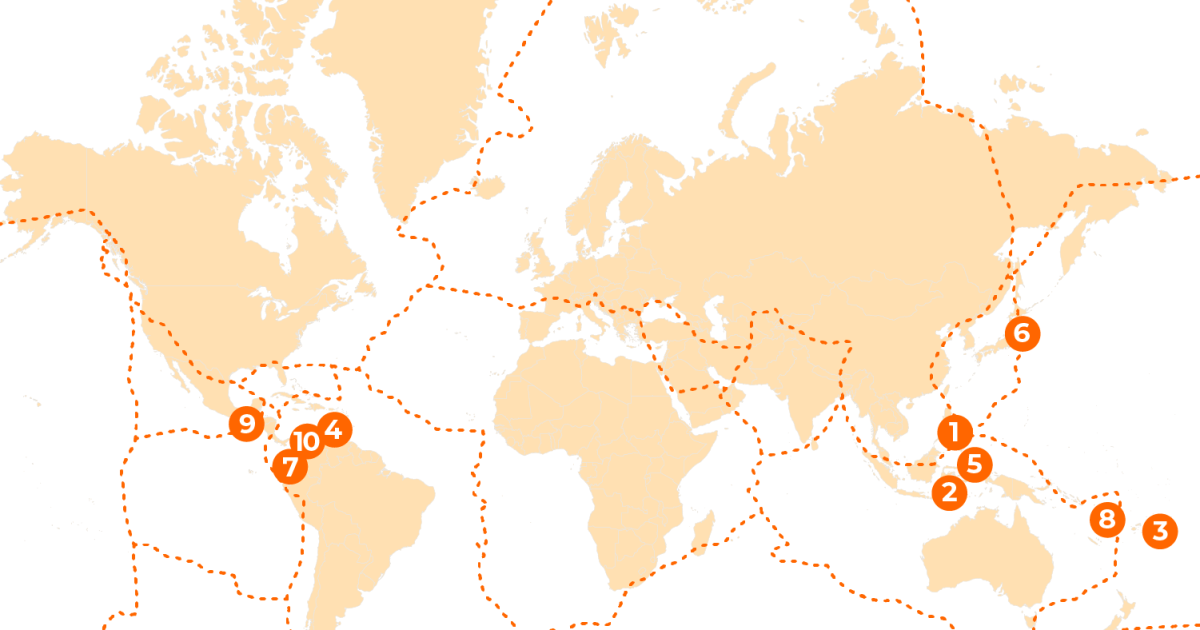
The 10 largest earthquakes of 2026
According to the United States Geological Survey (USGS), there are about 20,000 earthquakes recorded globally each year, roughly 55 a day. However, most of these are too weak to be noticed by people.
It is when earthquakes reach magnitude 6 and above that large-scale damage tends to occur.
The map below shows 2026’s 10 largest earthquakes. The Philippines recorded the strongest, a magnitude 7.8 off Mindanao in June that killed more than 100 people. Venezuela’s 7.2 and 7.5 quakes, also in June, killed more than 6,300 people. The most recent quakes, in Mexico in July and Colombia and Indonesia in August, were all magnitude 7.4 or higher.
Ten years of earthquakes and where 2026 stands
From 2016 to 2025, the world recorded an average of 133 earthquakes of magnitude 6 or greater each year. They ranged from the lowest number of quakes at 99 in 2024 to the highest of 157 in 2021.
By mid-August this year, 91 earthquakes of magnitude 6 or above had been recorded worldwide, including 11 above magnitude 7. Both those numbers are slightly ahead of the past decade’s pace but still within the normal range. None reached magnitude 8 or 9, the most destructive categories.
What makes an earthquake deadly has less to do with its magnitude than where it hits. Depth, proximity to cities and the strength of local buildings matter more than the number on the Richter scale. The deadliest earthquakes of the past decade were not the largest ones. They were the ones that struck beneath population centres.

Is there such a thing as ‘earthquake season’?
No. Long-term records show that earthquakes occur throughout the year with no consistent seasonal pattern. The US Geological Survey says scientists have never been able to predict when a major earthquake will strike because the tectonic stress that builds along fault lines over decades or centuries cannot be tied to a 12-month cycle.
Aftershocks can continue for months or even years after a major quake.
Instead of predicting individual earthquakes, seismologists calculate the probability that a large quake will hit a given area over a span of years, work that underpins life-saving building codes. They also run early warning systems that alert people once a quake has begun.

How do earthquakes happen?
An earthquake, in the simplest terms, happens when the Earth’s crust shakes.
The Earth’s outer shell is broken into a puzzle of moving pieces called tectonic plates, roughly 100km (62 miles) thick. They sit on hot mantle rock that is solid but slowly flowing, dragging and pushing the plates over millions of years.
The plates are always moving, but their edges often lock together, building stress until the rock gives way along fractures called faults, which can run for hundreds of kilometres. Many faults are well mapped, but others are discovered only when they rupture.

Where do earthquakes happen?
The most seismically active zone in the world, accounting for roughly 90 percent of the world’s earthquakes, is the Pacific Ring of Fire. It forms a belt stretching along the western Americas to the Russian Far East and down to Southeast Asia and New Zealand.
The Ring of Fire includes Japan, the Philippines and Indonesia.
Earthquakes can also strike outside the Ring of Fire. The Alpide belt, stretching from Java through the Himalayas to Turkiye and the Mediterranean, produces 17 percent of the world’s largest quakes, and rarer tremors occur along ancient faults far from any plate boundary.

How are earthquakes measured?
Earthquake size is measured on the moment magnitude scale, which reflects the energy released at an earthquake’s source.
Magnitudes are based on a logarithmic scale, meaning each whole-number increase represents about 10 times more ground shaking and roughly 32 times more energy released.
To put that into context, earthquakes registering a magnitude of 4 to 4.9 are considered light but may still cause some damage.
A magnitude 5 quake produces 10 times more ground shaking than a magnitude 4, releases about 32 times more energy and can cause moderate damage to buildings.
Magnitude 6 quakes are typically considered strong, producing 100 times more ground shaking than a magnitude 4 and releasing about 1,000 times more energy.

Magnitude 7 earthquakes are considered major with the potential to cause significant loss of life and damage to buildings and infrastructure.
Earthquakes registering magnitude 8 or higher are classified as great and can result in near-total destruction across a wide area.
Magnitude, depth, proximity to inhabited areas, soil conditions and the chance of triggering secondary disasters, such as tsunamis and landslides, are just some of the many factors that determine how deadly and destructive an earthquake is.
What are the largest quakes on record?
The most powerful earthquake ever recorded was a magnitude 9.5 quake that struck Valdivia, Chile, on May 22, 1960, generating a Pacific-wide tsunami.
Four years later, a magnitude 9.2 quake struck the Prince William Sound region of Alaska, the second most powerful on record.
On December 26, 2004, a magnitude 9.1 to 9.3 quake off the coast of Sumatra triggered a tsunami that killed about 228,000 people across the Indian Ocean.

