

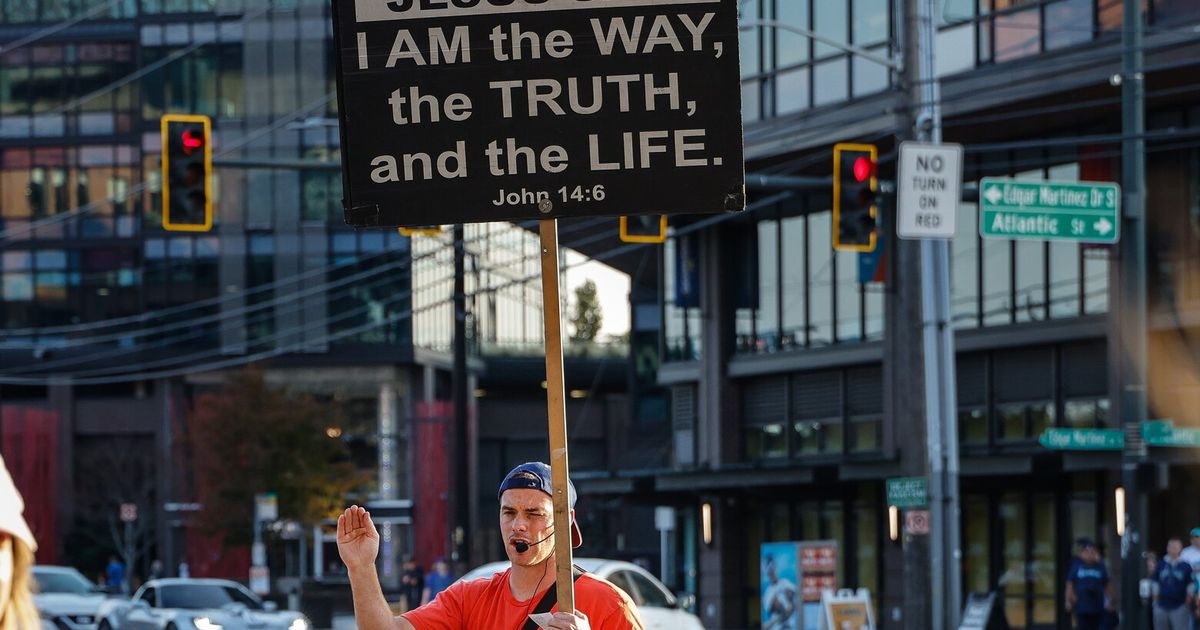
If you’ve been to a game at Lumen Field or T-Mobile Park, you’ve probably seen them. Or heard them.
Street preachers barking into microphones, stationed where lines of ticket-holding fans form to get into the game. The problem isn’t the message or the messenger. It’s the amplification.
It’s painful. It’s obnoxious. And it ought to be regulated.
In this time of relentless attacks on free speech, it is important to differentiate the government’s duty to protect expression with its obligation to protect public health.
The Mariners fan site Lookout Landing reported that team officials outlined a plan to deal with the problem at a recent meeting of the Washington State Ballpark Public Facilities District, the public agency that owns T-Mobile Park.
“We’re seeing more of the coordinated actors showing up, we’re seeing louder and louder messages,” said Christian Halliburton, a Mariners lawyer, according to Lookout Landing. “And unfortunately they’re becoming more and more aggressive and really singling individuals out with truly hateful messages.”
The preachers have become “dangerously loud and frankly unreasonable.”
The Seattle City Attorney’s Office has drafted legislation that focuses specifically on amplified noise at stadiums and other public areas while making sure protesters can use bullhorns at rallies and demonstrations.
Seattle’s noise ordinances need to be updated, said Seattle Deputy City Attorney Scott Lindsay in an interview. The stadiums fall into a gap because they are publicly owned and border public sidewalks. Mariners games are most impacted because baseball season is much longer than other sports.
Seattle city law makes it illegal for a “person to cause sound … to intrude into the real property of another person” at volumes above a certain level. In commercial zones, that level is 60 decibels.
In May, Lindsay said a police officer took a reading of a preacher hitting 113 decibels — about the same level as a chain saw at three feet.
Children — whose hearing is more delicate than adults — and those with neurological sensitivities are most at risk.
Under the law, municipalities may enact what’s called “time, place, and manner restrictions” on speech to prevent harm, as long as the content of the speech isn’t considered.
Lindsay said the draft legislation focuses on places where people are concentrated in small areas, such as entering or exiting stadiums. There are proposed civil infractions punishable by fines — and forfeiture of the sound equipment.
Seattle City Council ought to take up and pass a revised noise ordinance.
It’s too late for this baseball season (may it stretch until October!) but next year let the ballpark be a peaceful place where sports fans may be subject to fire and brimstone sermons delivered at the level of a very loud human voice.
