

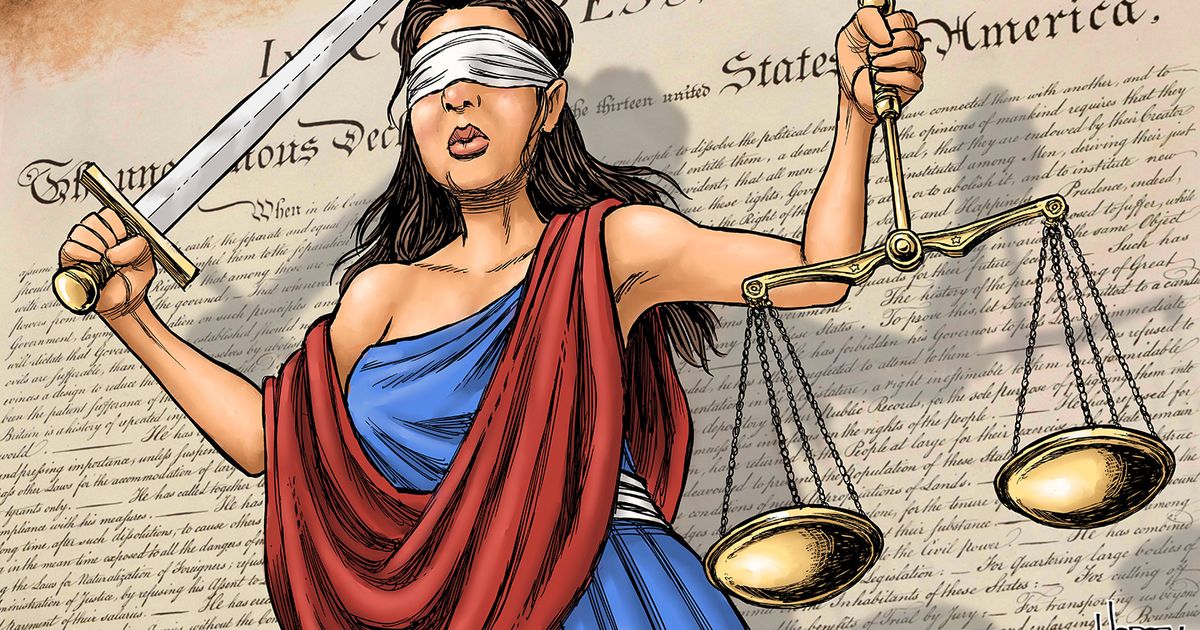
We are the 17 federal district court judges of the Western District of Washington. We were appointed by five different presidents, and we write together to commemorate the 250th anniversary of the Declaration of Independence. As our nation celebrates its founding document, we reflect on the reason for its creation. The Declaration not only announced this country’s separation from Great Britain but also set forth 27 specific grievances — warnings from the founders that tyranny follows when the law is trampled in the quest for power.
One of the Declaration’s grievances was that the King of England had taken control of the levers of justice: He not only wielded the power to appoint all judges but, as stated in another grievance, he also “made Judges dependent on his Will alone[.]” At the time, judges relied entirely on the King’s grace for their jobs and their compensation. Any judge who ruled against royal interests risked losing his livelihood (the first female judge would not be appointed until over a century later). The result? Capitulation and obedience.
To protect our new country from tyranny, the founders knew it was important to establish an independent judiciary that would act as a check on governmental power, preventing overreach and abuse by the executive or legislative — or “political” — branches. Success demanded that the judicial branch be insulated from political pressure. Only then could judges freely uphold the law, especially when doing so might be unpopular. Ultimately, this idea, which is really nothing more (or less) than the rule of law, was embodied in Article III of the Constitution, which provides that judges “shall hold their Offices during good Behaviour” and shall not have their pay “diminished during their Continuance in Office.”
In other words, a core intent of the founders was that American judges would not be fired or have their pay docked on account of their decisions, even when they ruled against the government. The founders recognized that judges’ impartiality is an essential component of a fair legal system where all individuals, regardless of status or power, receive equal treatment under the law. As former Supreme Court Justice Anthony Kennedy put it more than 230 years after the founding, “Judicial independence is not conferred so judges can do as they please. Judicial independence is conferred so judges can do as they must.” Without judicial independence, courts can become tools for political or personal agendas, fostering a rot that undermines justice and, eventually, public confidence.
As judges, we know firsthand that maintaining the rule of law requires active, daily work. We decide cases based on the facts and law before us. Each of us has sworn an oath to administer justice without favoritism, to do equal right to the poor and to the rich, and to faithfully discharge all of our legal and constitutional duties. Each of us takes that promise very seriously. It represents our commitment to the fundamental idea of equal justice under the law.
Regrettably, directed disinformation has misled some into believing that our judiciary is not committed to the dispassionate dispensation of justice, but to self-interested, prejudiced advocacy instead. Judges have been called “biased,” “corrupt” or even “enemies of America” when their decisions did not align with a political preference. Courts have been described as meddlesome obstacles, not coequal institutions. It is now expected that news articles reporting on a decision by a federal judge will name the president who appointed the judge, as if the politician, sometimes long out of office, remains present, dictating results from afar. But as Chief Justice John Roberts has explained: “We do not have Obama judges or Trump judges, Bush judges or Clinton judges. What we have is an extraordinary group of dedicated judges doing their level best to do equal right to those appearing before them.” His words were a defense of the judiciary as an institution that is essential to the preservation of our rule of law.
When toxic rhetoric unfairly labels judges as political actors, it erodes the public confidence in our courts that the Constitution seeks to ensure. Of course, criticism of the government, including judges and their decisions, is essential to our democracy. Indeed, petitioning the government — speaking one’s mind — is the first freedom protected in our Bill of Rights, and it is first for a reason: Robust debate, including debate about judicial decisions, has always been part of our democracy, as it should be.
But what used to be rational disagreement about the reasoning behind a legal decision has in recent years transformed into threats of violence against dedicated public servants. Hateful rhetoric has put judges, their families and judges’ independence at risk. Judges in this district have experienced this firsthand, as have far too many other judges around the country. We will not be deterred from our obligations to the Constitution and the people who appear before us every day seeking justice. But as we mark the moment that 250 years ago birthed this country, we feel the need to take the unusual step of speaking out together in defense of our founders’ historic call for judicial independence.
When judges and their families receive death threats for doing their jobs, when courthouse security must be increased because of threats of violence and when judicial staff fear for their safety, it is not democracy in action. It is not robust debate about judicial decisions. It is democracy under siege. The difference between good faith criticism and bad faith intimidation is not difficult to grasp. One strengthens our system by holding it accountable, while the other undermines the Founders’ vision. Judges should not be put in the position of choosing between their safety and their duty to uphold the law.
Two hundred and fifty years after its signing, the promise of the Declaration endures: The rule of law is not a power to wield in pursuit of tyranny, but an ideal that we must all uphold in order to protect what the Founders called our “unalienable rights.” If the Declaration of Independence marked the birth of a nation committed to the rule of law, then the preservation of judicial independence is the ongoing work required to sustain it. The threats we face today — incivility, delegitimizing rhetoric and attacks on institutional integrity — may be different in form from the king’s tyranny in 1776, but they challenge the same foundational principle: that no one is above the law.
We must all work to ensure that we are governed not by relationship, or power, or intimidation, but by the ideal that We the People are equal under the law.
