

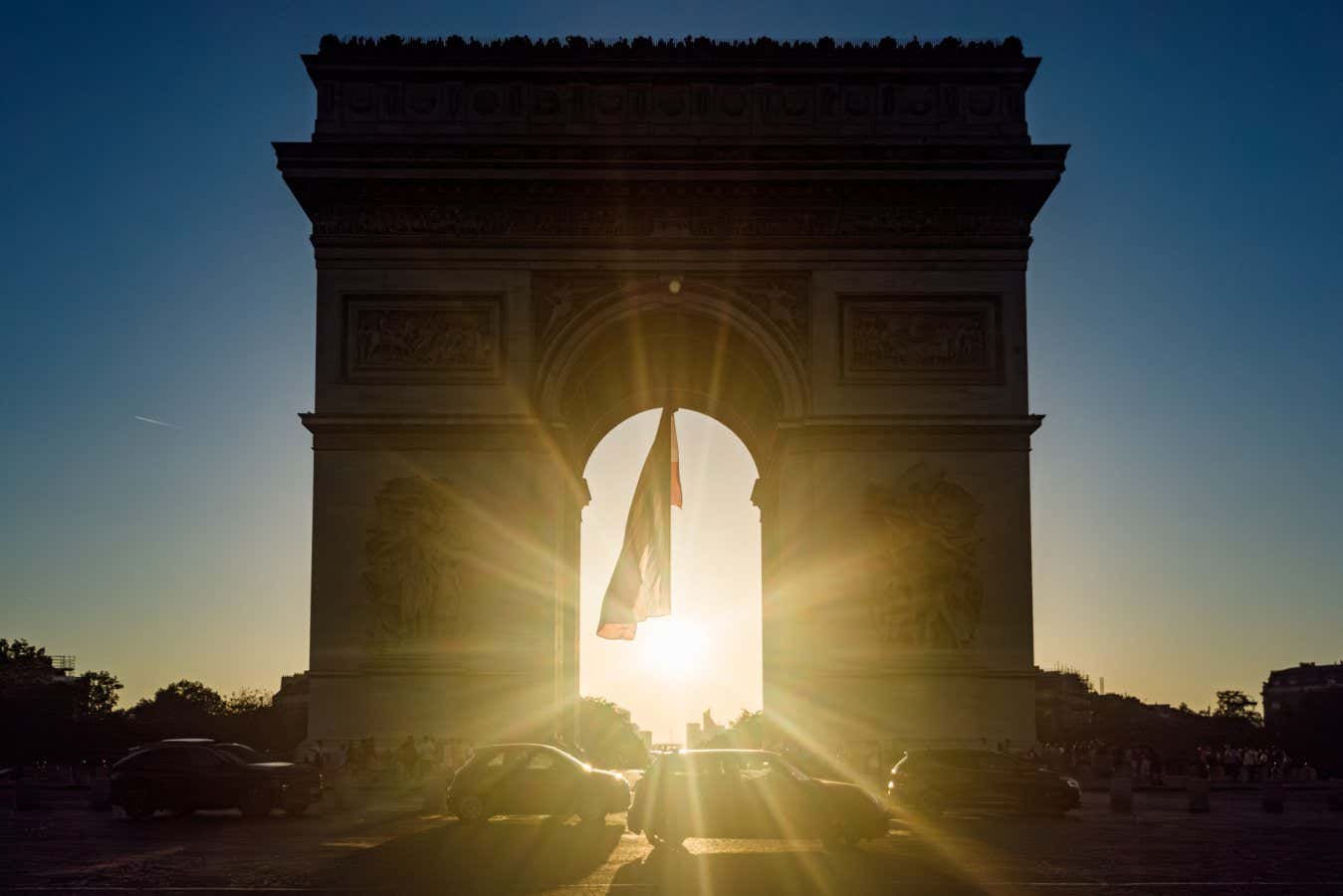
The June heatwave is estimated to have killed more than 5000 people in France
Laurent EMMANUEL / AFP via Getty Images
Europe’s most extreme heatwave so far may have killed between 17,000 and 25,000 people, according to an early estimate based on past deaths from heat in the region.
“These numbers are preliminary,” says Christopher Callahan at Indiana University. “But they highlight the need for rapid adaptation investments to avoid these impacts in the future.”
Callahan’s estimate is based on a study his team published last year. “We’re taking data on temperature and mortality across Europe, and we are correlating how high temperatures relate to excess mortality rates,” says Callahan. “We then use that relationship to infer how a given heatwave affects mortality over a region like Europe.”
Callahan’s conclusion is that the heatwave in Europe from 22 to 28 June 2026 killed approximately 20,390 people, including 5210 in France, 4543 in Germany, 3163 in Spain, 2709 in Germany and 862 in the UK. These numbers are much higher than the direct counts announced so far, but this isn’t surprising because it takes time for data on deaths to be collected and analysed.
“This figure is a modelled estimate rather than a final count, and it will be some months before the true toll is confirmed, in part because heat rarely appears on a death certificate,” says Raquel Nunes at the University of Warwick in the UK.
For instance, on 28 June, the head of the World Health Organization, Tedros Adhanom Ghebreyesus, said more than 1300 excess deaths had been reported so far. This number is largely based on a statement from Public Health France reporting around 1000 more deaths in the country than expected from 24 to 26 June.
However, that statement made it clear that this number is based on a computerised death certificate system that is far from complete. It records 80 per cent of hospital deaths, 45 per cent of deaths in long-term care facilities and 25 per cent of deaths at home. “Mortality will consequently be higher than these initial figures suggest,” the statement said.
Even so, other experts think Callahan may have overestimated the numbers. “Twenty-thousand for a single week seems very large,” says Dann Mitchell at the University of Bristol in the UK. “We’d have to look into details of the modelling to be more sure.”
While Callahan’s method is sound, the main issue is that he used data from 2015 to 2019 to calculate the relationship between heat and deaths, says Marcin Walkowiak at Poznań University of Medical Sciences in Poland. People may now be less vulnerable due to ongoing adaptations, such as increased access to air conditioning, his team’s work suggests. Walkowiak’s back-of-the-envelope calculation is that if this is taken into account, the actual number of deaths would be around 15,000.
Callahan is sticking to his guns. “We don’t have very strong evidence that the relationship between temperature and mortality dramatically changed over time,” he says. “So it’s not obvious it’s different now than it was 10 years ago.”
“In general, we find that our sort of broader statistical estimates give higher numbers than direct reporting on the ground, because that direct reporting can often miss people who die from heat where it’s not obvious that heat was the cause,” he says.
On the flip side, Walkowiak says that Callahan hasn’t taken into account the fact that heatwaves of the same temperature are more deadly in early summer than in late summer. “In late summer, part of the especially vulnerable population is already long gone,” he says.
Mitchell also says the kind of approach used by Callahan also counts only the immediate deaths. There can be longer-term impacts, such as more deaths from domestic violence, suicides and kidney failure. “The impacts of heat on health vary a lot across timescales,” he says.
What matters most is avoiding further deaths as the planet warms further and heat becomes more extreme, says Nunes. “The signal is clear: heat is now the deadliest weather hazard we face, and the majority of these deaths are preventable,” she says. “We can now forecast these events with considerable accuracy; what we have not done is build the systems, across health, housing, social care and transport, for example, that translate an accurate forecast into actual protection. Adaptation is not keeping pace with the risk.”
Topics:
